
Happy New Year, everyone! I want to start out by thanking all of you who read my blog. I know that I only have a small(ish) group of subscribers, and I also have regular commenters and I want to convey to you how important you all are to me. I have tried to do some private writing (in my offline space) but it is only when I start thinking of my now 17 year old blog and its readers that I can find flow for my thoughts. 2025 seems to have flown but it isn’t until I take stock of my reading that I realise that it has been a long and eventful year both personally, as well as in world events. I started with the Nikos Papastergiadis’s memorable John Berger and Me and finished with Maisey Yates’s Cowboy It’s Cold Outside with its delightful cover but forgetable story.
53 books
Fiction: 29 – Romance fiction: 25
Audiobooks: 0
Picture Books and Junior fiction: 0
Non-Fiction: 24 (note: 22 but I reread two books)
Graphic Novel memoir: 4
Australian authors – 9
YA – 0
DNFd but counted: 3
Of the 53, I only bought 6 books (and 3 of those were given as gifts after I loved them). All the rest were library eloans. No library fines were accrued this year.
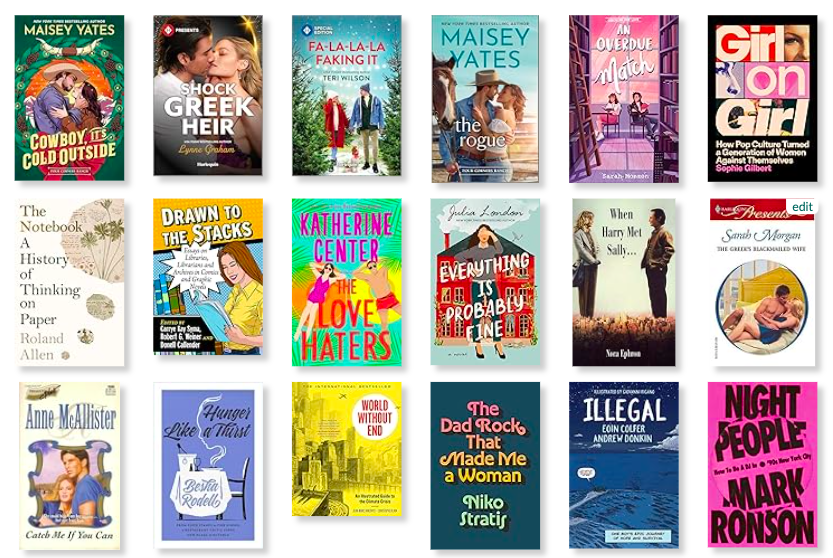
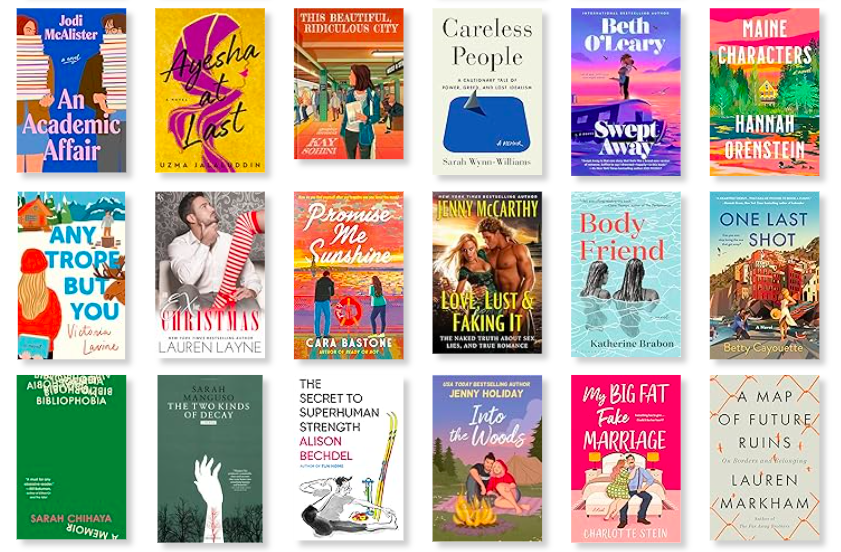
My 5 star books for 2025
I had 14 five-star books (12 non-fiction and only 2 fiction/romances) yet upon reflection, 6 of my four-star books left a lasting impression upon me. My full list of books is available on my Goodreads 2025 Challenge account. Here are some of the books which stood out for me:
Best of the Fiction Books
Jodi McAlister’s An Academic Affair and Cara Bastone’s Promise me Sunshine. Both of these books centre on overcoming loss and grief. The romance is steadfast in the space of all the other chaos in the protagonists lives. I adored both. I will be rereading both. A heads up that MJodi McAlister is a friend so I am super-biased, and in fairness, I have decided to not review the book online.
Best of the Non-fiction Books
Where do I even start! I read 14 books which I rated as 5-stars (two of which I have already reread). But there are also a number of notable 4-star books which, to be honest, perhaps I should reassess them up to 5-stars considering the depth with which they have resonated and stayed in my consciousness. I will only mention here the ones that had the deepest impact: memoirs, histories, socio-technical and investigative journalism. So many books that lead to the examination of the self:
John Berger and Me by Nikos Papastergiadis – Papastergiadis reflects upon his scholarly life being mentored by John Berger (of Ways of Looking fame). The part that resonated deeply with me is that Papastergiadis discusses his families’ Greek peasant heritate, his own break from an agricultural life to grow up in the Melbourne, Australia Greek diaspora, highly literate (unlike his parents), yet so drawn to visiting Berger who chose to live life in a village on the foot of a mountain in France. A return to peasant life which mirrored his own heritage, which mirrors my own heritage too. I keep returning to so many concepts that Papastergiadis raises in his book. It hovers in the corners of my every day exchanges.
A Map of Future Ruins: On Borders and Belonging by Lauren Markham. I read this book twice mostly because my Kobo lost my notes from the first reading, but then lost my notes in my second reading. Technology frustration! Markham is an investigative journalist on the environment and refugees, usually focusing upon the US/Mexican border. In this book, she travels to Greece to write about the 6 young Afghan refugees who have been arrested for a devastating fire in a refugee camp on the island of Lesbos. Markham follows their arrest and court appearances, as well as reporting on the Greek media. At the same time, Markham is trying to work out what being Greek means to her, as she is of Greek-American heritage, several generations separating herself from family. She travels to islands that are part of her family’s lore, and also questions the centuries/millenia of Greek myths and folklore and how they inform us about what being Greek means in contemporary society. Though there are many parallels as a diasporic Greek, there were ruminations that I just couldn’t agree upon, such as when Markham dreamily imagines what life could have been like if her family had not migrated. She states “We could have been radicals, aristocrats, berry hawkers, bondsmen to the wind”. I got annoyed. No they could not have been any of those things. Those opportunities, even the meagre ones, did not exist, and in so many ways, continue to not exist for Greeks, which is why her great-grandmother left, why my parents left, and why so many young Greeks are spearheading a 21st century exodus.
The Dad Rock That Made Me a Woman by Niko Stratis, a trans woman who through a series of essays on the music they listened to while working in their dad’s glass-making shop. The “dad rock” emotionally raw music shaped Stratis as they examine their life trying to work out who they were. This book is filled with revelations and observations on music from my childhood but looked at in a way that was unexpected to me, a cis woman. Each essay is emotional, each essay had me pausing to understand the depth of their situation, especially while they were working in construction in the hypermasculine Yukon where it was common to hear threats to anyone or any situation resembling queerness. The most astounding moment for me is when Stratis describes Bruce Springsteen as “the perfect idea of a man who is both comically masculine and as queer as a three-dollar bill. A voice like a wild animal backed into a corner that drips still with honey and lavender.” As an decades-old Springsteen fan, I realised that this was a perfect description yet one that I had never seen. It was perfect. I find that I keep talking about this book to friends. I loved it deeply as it changed the way I saw the idols of my youth, and their ability to impact others in ways I had not considered.
Atlas of AI: Power, Politics, and the Planetary Costs of Artificial Intelligence by Kate Crawford – the first chapter of this book, named “Earth” is a set reading for one of the subjects I teach. I started reading the chapter and ended up reading the book in full over the 2025-26 summer holidays. It was a deeply sobering examination as to the extractive damage that AI brings to our lives, from the broken earth, labour practices, demand for data and the lack of standardisations, ethics and governance, and so much more related to power and the state and the military. This book has settled deep in all my digital engagements, where at the inception of social media, I was frivolous, flippant, the digital was fun but so many decades later, like so many other people, I distrust the tech bros making surveillance and data-mining decisions. Crawford writes “Refusal requires rejecting the idea that the same tools that serve capital, militaries, and police are also fit to transform schools, hospitals, cities, and ecologies, as though they were value neutral calculators that can be applied everywhere” (p. 227). She goes on to describe this all as “Dark Utopianism” and I cannot shake these ideas. Fuck – what a scary ending to this book. Surveillance at its most ominous level.
Careless People: A Cautionary Tale of Power, Greed and Lost Idealism by Sarah Wynn-Williams. Wynn-Williams was initially working in the New Zealand embassy in Washington DC before she got excited by the possibilities of social media, specifically Facebook. She lobbied the FB executive until they gave her a job and she then spent several years working at Facebook (and then Meta) in international relations, teaching/guiding Zuckerberg all about diplomacy and how to engage and relate with world leaders. By the time Wynn-Williams is walked out of the Meta doors, she has lost any of the idealism that led her to the job. Wynn-Williams writes an unsettling and frank discussion of the discomfort of working for Meta, and raises the alarm on our engagement with a company who would literally walk over the dying bodies of its staff in pursuit of its unethical and punishing productivity demands. Though I admire Wynn-Williams for her (and her publisher’s) courage to write this memoir despite Zuckerberg’s attempts to silence her, I was agitated by Wynn-Williams’s role in the expansion of the business. This book is devastating to read, and I read it twice in 2025.
The Notebook: A History of Thinking on Paper by Roland Allen. “Notebooks interest me as a technology that has had tangible effects on the world around us”. This is a great book on the history of paper and the way it has impacted the way we think and behave in society. It covers sketching, sailors log books, accounting ledgers, and diaries – the ego log. There are so many iterations of the notebook and its impact upon trade, discoveries, science etc. I like that at the end of the book, Roland Allen discusses that paper was an innovation and that we should look at new inventions the same way – how will they change our uses, our lives, our societies. A balm to the more alarming Wynn-Williams and Crawford books.
Best of non-reading/media engagement
I continue to be delighted and deeply engaged with my TikTok account. TikTok is only as good as the FYP algorithm or the accounts you follow. Like last year, I continue to follow The Australia Institute with all its lobbying on issues on Australian policies and politics. And most importantly, is my following of EthicAI, two Australian female consultants in ethical (yes – they question this deeply) AI, and the critical thinking needed to be able to understand the changes AI is bringing to our lives.
Of course, I continue with favourites such as Letterboxd (my digital audiences students getting excited and asking about my Fave Four and the whole cohort being energised is an ice-breaker success), as well as Apartment Therapy in whatever iteration – I follow their Tiktok, their Youtube and regularly go to their website.
I also went on a few deep dives on When Harry Met Sally… after reading Betty Kaklamanidou’s Instigation published in May in the Journal of Popular Romance Fiction called “When Harry Met Sally…Friendship, Fear and Orgasms”. I rewatched the movie several times, I attempted to write my own Instigation, I wrote a private response to the Instigation, and I read the screenplay and ordered a copy in November. It has yet to arrive.

2026 planning like a fool….
2025 was the year of shutting down some of my social media engagements and I will continue to do this in 2026. This is not out of fear but mostly out of digital exhaustion. I could not maintain all the different apps and platforms in a way that make me happy. So I now mostly engage on TikTok, BlueSky (mostly lurking), this blog accompanied by my Goodreads accounts, and my reading apps. Yes, I am still on Facebook and Instagram but in a much diminished way, rarely posting except for birthdays, condolences etc. For over a month I have removed these apps from my phone so I only check in once late in the day, after work. I still have an account on X but it has been unused for many years. Occasionally, I venture to see what a fire-dump it has become and then I turn it off indefinitely. I am grappling with what it means for my memories to all be documented in these media spaces. At the time, it was in the moment and fun. But now I want to slowly divest my life from these spaces. Check in this time next year to see if I have progressed.
My only conviction is to keep Shallowreader going. Earlier today, I read Willaful’s post on “Going Small” rather than not blogging at all, and I am going to try to emulate her. And of course, I have put my hand up for SuperWendy’s 2026 TBR challenge. I was so pleased to have completed the 2025 challenge albeit with some cheating and short cuts.
So here is to a good and readerly 2026.
 Shallowreader
Love to know we’ll keep ‘seeing’ you here; here’s to many good books and good reading experiences, over 2026.
Also, “delightful cover but forgettable story” is the most relatable thing ever.
I’m glad to have inspired some of my oldest blogger friends. 🥰
The Dad Rock… was already on my TBR and I’m moving it up!
Cheating and short-cuts for the #TBRChallenge are welcome and encouraged 😂
Thanks for the validation. I will give it the best shot I have!
If it’s not too much trouble, when you put up a post here, could you put a link to it on Bluesky, even though you’re “mostly lurking” there? I keep forgetting I have a feed reader, so I only knew to come across here to read your post because SuperWendy posted a link to it on Bluesky.
Or did you do that already and I missed it? If so, I will do a bad blog-reader grovel followed by a bad Bluesky-reader grovel!
And now I should probably delete all of that, because I’ve just spotted an option below to get new posts emailed to me. But I won’t, because the more reminders I get, the less likely I am to miss anything here.
Hi Laura! You are so right. It is not too much trouble to post on Bluesky. I was more embarrassed that I am not really adding much to the conversation anywhere these days so it felt a bit self-serving to only post about my own blog. From here on, I will post more flowers (my bromeliads are astounding at the moment!) and intersperse the pics with my occasional blogs 🙂
Think of it not as “self-serving” but serving the people who follow you and want to read about what you’ve been doing!
You are right. I really have lost my social media mojo! Shifting my perspective of my own blogging/posting will be my 2026 goal! Bring back the joy-scrolling, as I tell my students!
I think I lost my comment due to having to log in after I’d written it 😦
Well, all I was saying is that I seem to have forgotten about using my feed reader, so I’ll try subscribing to posts here by email, but if you did happen to post a link to new ones on Bluesky, that would be appreciated (and apologies if you do already do that and I missed it – I got here via a link SuperWendy shared on Bluesky).
And you didn’t lose the comment! I got both of them. And I can’t tell you how happy I am that you have commented here. Sorry to be so vague with my Bluesky!