
I am still here but in my own rushed interpretation of the SuperWendy’s TBR challenge, I am posting super-late (so late that it is February). I have also decided to change up my book review template this year, including a discussion of each book’s metadata, so it may get a bit technical in my tiny corner of the internet. And just a tad ranty and sweary.
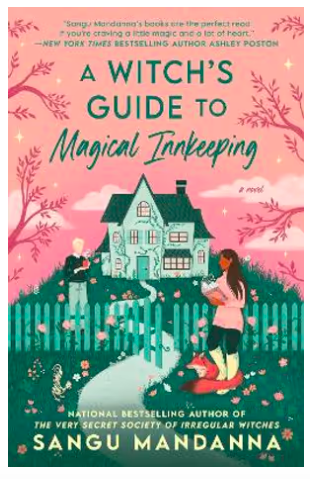
Sangu Mandanna’s A Witch’s Guide to Magical Innkeeping
Blurb: “Sera Swan used to be one of the most powerful witches in Britain. Then she resurrected her great-aunt Jasmine from the (very recently) dead, lost most of her magic, befriended a semi-villainous talking fox, and was exiled from her Guild. Now she (slightly reluctantly and just a bit grumpily) helps her great-aunt run an enchanted inn in Lancashire, where she deals with her quirky guests’ shenanigans, tries to keep said talking fox in check, and longs for the future that seems lost to her. But then she finds out about an old spell that could hold the key to restoring her power…. Enter Luke Larsen, a handsome and icy magical historian, who arrives on a dark winter evening and might just know how to unlock the spell’s secrets. Luke has absolutely no interest in getting involved in the madcap goings-on of the inn and is definitely not about to let a certain bewitching innkeeper past his walls, so no one is more surprised than he is when he agrees to help Sera with her spell. Worse, he might actually be thawing. Running an inn, reclaiming lost magic, and staying one step ahead of the watchful Guild is a lot for anyone, but Sera Swan is about to discover that she doesn’t have to do it alone…and that the weird, wonderful family she’s made might be the best magic of all”.
I felt like I waited forever for my library hold to come through to me. I placed it in July 2025 just to receive it in January 2026. I really enjoy magic (and witch) books set in the real world. I have no patience for trying to read through other worlds being built while also trying to understand a plot. Set in very pretty Lancashire in the UK, the titular inn is quaint with splendid gardens in abundance.
The blurb really covers the whole plot of this book. This magic/witching part is a both a wild ride and a nostalgic throwback to the children’s book I read as a child. A smidgeon of No Flying in the House, The Ghosts who went to School, as well as experiencing the English countryside from The Abbey Girl series. There is a wealth of weird and wonderful characters who live in Sera Swann’s inn as she is a collector of kind souls, caring for them as part of the love spell Sera cast upon the inn before she lost her powers when she resurrected her beloved great-Aunt (and a previously long dead rooster). Sera was a witch with deep and strong powers which she lost due to this resurrection. She had been kicked out of the Witch’s Guild but as the book progresses, you discover that not everyone in the guild had wanted her to be gone, and that there was a deep corruption within the guild’s own power structures.
These revelations spoke more strongly to me than the romance itself. The guild’s historian Luke Larsen is important in providing Sera access to spells that helped her understand the way her world was ordered and how to challenge those who were in power that wanted (rendered) her powerless. Luke gives Sera a way of understanding herself and her own impulsive magic, saying “
“In a moment of rage, that was the spell you cast. It wasn’t planned. You weren’t careful. It just happened. And yet in spite of that, it didn’t hurt the people who’d made you so angry. Your magic knew exactly who you were. That’s why your spell was a shield, not a sword.”
The romance itself was underwhelming bordering upon boring. I was much more interested in the absurdism of this book such as the zombie-chicken and the spellbound fox’s machinations “stop decapitating the resurrected rooster….it’s impolite”. This absurdism was juxtaposed to the growing gentle love of Sera and Luke.
Sera’s loss of her magic devastates her. She misses the feelings it gave her and her greater yearning is not for her very mortal, (very boring) love for Luke, but for the sensation of her former strength.
“My name is Sera Swan,” she said “My magic is a galaxy. I belong in the sky, but I stopped being able to fly. And maybe that would have been okay if I could have become a creature of the earth instead, but this world, down here, it doesn’t want me.
Overall, I would highly recommend this book for its magic qualities and its sense of how Sera reconciles herself to a life of losing her magic, losing her power due to strong and nasty men. An age old story of women needing to negotiate the world that we are constrained in. The romance….hmmmm not such a big recommendation if you were expecting sparks and witty repartee but certainly if you like the promise of steadfast support (perhaps a much more realistic love goal we should all be aiming for). This steadfastness is where this month’s TBR theme sets in – Luke is on standby. He is still here as all the calamity of Sera’s magic disrupts her life. But Sera too is steadfast. Always present and always here for all those who come to her inn. She is the mainstay. Still here with the promise of always being here.
I deeply enjoyed Mandanna’s weaving of nature description throughout the book. It moves the plot forward as much as it is the comfort of the setting. Lancashire’s being everpresent through its nature which thankfully, is still here too.
Metadata:
Now I would like to take a moment to also explore the library metadata (and my own Goodreads generated metadata) for this title.
I would like to start from the position that library metadata is generated as a taxonomy. It has a set list of industry approved subject headings that the library cataloguers can draw from. Unlike my own metadata which is firmly in the space of a folksonomy – grass-roots generated, participatory, and rules that are fully dependent upon the whim of the creator not by the library overlords scarily protecting their authority file (Jesus! the power wielded over library subject headings!). There are a number of other metadata protocols also produced in the area of SEO (search-engine optimisation) that is used by marketing teams. This overlaps with library metadata (publishers increasingly choose their library metadata), but doesn’t interest me as much for the purposes of my blog post which I would like to explore for this year’s TBR posts. This also adds more complexity to my writing, so I can appreciate if you want to skip reading this section.
My local library: Hotelkeepers — Fiction; Magic — Fiction; Witches — Fiction; Man-woman relationships — Fiction; Romance fiction.
National Library of Australia: England — Fiction; Fantasy fiction; Foxes — Fiction; Great-aunts — Fiction; Guilds — Fiction; Historians — Fiction; Hotelkeepers — Fiction; Lancashire (England) — Fiction; Magic — Fiction; Man-woman relationships — Fiction; Secret societies — Fiction; UK & IRL fantasy fiction; UK & IRL romantic fiction; Witch fiction; Witches — Fiction
My Goodreads Tags: anthropomorphic, antiquities, boarding school, chickens, conformity, death, depression, england, environment, family-dynamics, fantasy, friendship, funny, gardens, ghosts, glass-ceiling, grief, growing-up, hope, house, inequity, kindness, knew-each-other-years-ago, knights, lgbtq-characters, libraries-in-fiction, loneliness, love, magic, martyrdom-for-family, monsters, pretty, read, reparations, romance, sadness, scarred, school, secret-crush, shiny-sparkly-glitter, trust, veddy-english, witch, zombie chicken.
I want to point that my own folksonomic tags add to my short review of Mandanna’s book. I especially like providing my own emotional response to the books that I am reading. I cannot expect libraries to add some of the more esoteric emotional responses as we all respond to books differently. For me this book was all shiny and sparkly just like glitter, and I cannot in any way expect library subject headings to include such a description. However, horror (emotional), romance (emotional), grief (emotional) are all straightforward enough terms that could be expected in a library catalogue.
Now to the library metadata. I also acknowledge that no system is perfect and cataloguing has its own complex skills and regulations. No hate to any individual. But lots of side-eye anger to ridiculous structured subject headings. I obviously have a gripe: Why the fuck do libraries continue to use the fuckedest subject heading to ever fucking exist. The anger I feel whenever I see “Man-woman relationships” is like peak rage. The whole purpose of subject headings and genre tags is to lead the person who is searching a library cataogue to the material which (hopefully) has rich descriptors. And motherfuckers, “man-woman relationships” is such a fucked up, conveys fucking nothing, subject heading that I am totally convinced that the LCSH committee who sat around a table some time in the late(ish) 20th century trying to decide upon an appropriate term for romance fiction, decided to fucking choose the least possible search term that could be used (Veros, 2020, p. 46 – and yes I am going to cite my fucking phd because this idea is buried so far deep in those 247 pages that I want to highlight this idea here) (PS Plus I could not fucking swear about this in my fucking phd). I really think it is time to let this old and useless subject heading wither into the nothingness of useless subject headings.
So anyway, what the fuck is Man-woman relationship. Also, what the fuck is “UK & IRL” fantasy/romantic fiction. UK I understand. But I see IRL and think “In Real Lfe” so it took me more than a moment, and to be honest, a few revisits to cotton on to this not being a descriptor for “set in the real world” but a descriptor for Ireland. Ireland is IRL in library terms? Well fuck me, why don’t we disappear a whole fucking country too. Who the fuck would search for Irish fiction by throwing in an IRL as their search term? This whole “Libraries are neutral” my fucking arse! Also, there isn’t even a twinkle-in-the-eye mention of IRL in this book. Why the fuck choose a library tag that isn’t even representative of the text. Lancashire, England will suffice. Why fucking broaden the term to something the book isn’t???
Also, what fucking is this “romantic fiction” tag? Show me someone who is searching the library catalogue who uses romantic rather than romance. And why the fuck isn’t there a zombie chicken tag? Don’t we all need a zombie chicken reading list? The zombie chicken was a delight in this book!
I have words. I have ideas. I have anger.


I am glad you are still here!!
Oh thank you! Apologies for the late response. I just saw this!
And why the fuck isn’t there a zombie chicken tag?
OK, I practically snort-laughed my tea out of my nose. Will recommend to my head cataloger at work this next week.
Thank you! I think we need to revolutionise LCSH. I love it as much as I hate it. And I am pretty sure there are other Zombie Chicken books that would benefit from this addition.
Greetings to your cataloguer 🙂
Long live the zombie chicken – in whatever form that may take!
Hahahaha! Long live indeed!