
My last blog post was asking for suggestions of your favourite romance authors to include in library collections. It was in order to present a talk at the Readers Advisory seminar held at the Mitchell Library at the State Library of NSW. Here is the slideshare of my presentation. Thank you to all who posted their suggestions.
Libraries
Historical Romance for libraries: your top 5 picks
Next week, I am doing a 5 minute lightning talk on selecting Historical Romances for your library at the History in the Dixon readers advisory seminar. I thought, rather than tell librarians the authors that I deemed necessary to be added to a standing order list (because that would be subjective and we can’t have that), I thought I would crowdsource some reader preferences.
So, send me your Top 5 Historical Romance authors for libraries. Either post your preferences in the comments below or send them to shallowreader@gmail.com and I will post them to this blog. I will also collate them for the presentation and create a Top 10 out of everyone’s Top 5.

Thank you.
Alphabet vs Genre
As a child, I remember progressing from the picture books to the chapter books at my local children’s library, The Warren in Marrickville. Upon my progression to the Junior Fiction section, disorganised child that I was, I made the decision to delve into the collection at the beginning. At A. And I would progress until I read every book in this, albeit tiny, branch library. I read Alcott’s Little Women, Brink’s Baby Island, Brown’s Flat Stanley, Cleary’s Henry Huggins and Ramona the Pest and as you could imagine the list goes on and on all the way to Zindel’s The Pigman. (As an aside, I spent about a year at E and F having hit the mother lode with Elizabeth Enright, Eleanor Estes, Edward Eager and Eleanor Farjeon). I went on to use the same method when I matured from the children’s library and I moved up two flights of stairs to the then Adult Library at Marrickville Town Hall under the beautiful stained glass ceiling.
Once again, I started at A and progressed slowly through the collection. Serendipity ruled for me. And browsing shelves alphabetically, whether in a bookshop or a library was great because, unlike Dewey, it was simple and unbiased. I just read whatever caught my fancy. Steven King, Leon Uris, Wilbur Smith, Isabelle Allende, Penny Jordan, Carole Mortimer all interfiled in the one big area. Horror, literature, romance, fantasy all there. Despite this, I still discovered my favourite genre, I still found my favourite romance authors. This was objective shelving, for while the library may not pass judgements on different genres, people sometimes do, and link a writer’s, and even reader’s quality, to their preferred genre.
Over the last 10 years, libraries have seen a shift in the layout of their spaces and the way people access their shelves. There is a lot more display space, bookshop layout is aspired towards, and this is all very positive as it makes libraries much more attractive and appealing places to their members. But I am ambivalent about the reorginisation of books according to the genre that they fall in. Unlike retailers, libraries are not about profit margins but about unbiased access to information and cultural materials. Selection may be unbiased but we are seeing a move towards subjective organisation.
Now don’t get me wrong. I am a big fan of genre fiction. Over the last 30 years my reading has seen me devour comics, horror, literature, children’s fiction and, of course my mainstay fiction favourite, romance. To add to these, I will occasionally dabble in fantasy, science fiction and my least favourite (and only because I’m squeamish), crime. But I found my favourites by browsing unbiased shelves. And much as I love walking into my favourite bookshops and libraries and heading straight to the romance shelves I often wonder about the people who will miss out on reading a fabulous romance because they don’t want to be seen in the romance section or the science fiction fan who just doesn’t want to read literary work. Somehow, I feel that it is like apartheid for books (harsh words, I know!).
For, heaven forbid Dean R Koontz is shelved near Milan Kundera, or Roald Dahl to be seen alongside Victoria Dahl, or Howard Jacobson grace the same shelf as Eloisa James. And then, what of the books that sit across genres such as Charlaine Harris’ Sookie Stackhouse and J. R. Ward’s Black Dagger Brotherhood books that sit comfortably in both fantasy or romance genres. Or benchmark setting authors such as Margaret Atwood – does she sit in literature or speculative fiction. Genre-based shelving endorses a classification of fiction that may not be needed.
I know that as a child, I loved discovering books and that none of them had genre labels. As an adult, I am struggling to decide upon whether I like the genrification of libraries or if I would like fiction, to once again, be a roll call of authors on shelves.
* strikethrough added a few years after I first posted this
No Touching Rule in a Touchy-Feely-Needy Library World
I love being a librarian. And as a librarian I will take up most causes, promotions, events. I will willing give you whatever information you want and don’t want (but hey! maybe one day you’ll realise I was right and you did need it and you’re welcome). I (humbly big noting myself here) am a dedicated librarian.
When the powers that be asked me to celebrate National Simultaneous Storytime. Great, I did it! When I was asked to take part in National Science Week – I was there with safety glasses on! Four years in a row now (but who is counting). When I was asked to take part in Public Lending Rights counting (in pre Online Catalogue days) I volunteered. And so the story goes from ALIA week, to Library Lovers’ Day to Heritage Week even threatening to make “Avast! ye’ll walk the plank, ye landlubbing, fine dodging curmudgeon” on Talk Like a Pirate Day. I am hands on!
Even when twibrarians get in the swing and start library #hashtags trending – I get involved. Yup. I’m there, in the midst of the #savelibraries, #followalibrary, #followalibrarian, #readit2011, #AliaIoc, #reading, #nswra, #hcod, #followreader, #spbkchat….you get my drift. I’m there with bells on. And I’m there with bells on because I want to be there.
But today, my lovely leaders in the ether whoever you are. Today, you declared the day to be the International Hug a Librarian Day. I’m sorry but I cannot support this program. I cannot open up myself to strangers throwing their arms around me, I cannot endorse this touchy feely program. With Hug a Librarian I feel that you have entered my personal bubble, that cone of silence that I hold sacred – my body.
I am quite happily a “No touching” type of person.
When I am with my family, I am affectionate. I hug my children, I kiss them and adore them. I hold my husband’s hand in public (really – I do!), I kiss him and adore him. But that is my “Out of work” personal life and even there I am not overly touchy, feely.
But in the workplace, I am a professional and a “No Touching” rule prevails. Affection does not come into it. As it stands, I really don’t appreciate having to approach the occassional amorous, horizontal teenage couple in the corner of the library to tell them to keep it vertical and frankly, I don’t want any of the 1000’s of borrowers that cross the library threshold to feel that I am in need of affection of any kind. I am happy in my answering questions objectively, contributing to someone-else’s information needs. And damn it, no one is walking around proclaiming it’s “Hug an Actuary” day or “Hug a Surveyor” day. Is this another stupid way of perpetuating the grim, spinster librarian stereotype?
So, please, leave me alone to do my job. Do not encourage strangers to give me unsolicited affection. I don’t want dead-pigeons-down-her-top lady hugging me, or the guy-who-exposes-himself hugging me nor do I want that over-perfumed-botox woman giving me “Mwah!”. I just want to do my job. And needy affection is not in my job description. Hell, I don’t know where members of the public have been and frankly they don’t know where I have been either. And we’re all covered with germy germs.
P.S I think that I would have accepted “High 5 a Librarian” Day. Though that too would have entailed touching.
Sex, love and passion: the appeal of romance novels: the moderator responds
On Friday the 11th of February, I moderated a Romance Panel for the City of Sydney at Ultimo Library.
Kick off your Friday night talking about Sex, Passion and Love with our romance panel discussion. Join Mills and Boon author Annie West, romance scholar Sandra Barletta and book blogger, Kat Mayo along with Ultimo’s romance reading librarians in discussing romance fiction in the 21st century…
It was a fabulous night with an engaged audience, a wonderful panel and fantastic discussion that ensued. So fantastic that Ultimo Community Centre staff had to push us out of the building as we went beyond their closing time.
As the moderator for the panel I had my questions prepped and I knew that I wouldn’t have to prepare meaningful answers (ever the shallowreader).
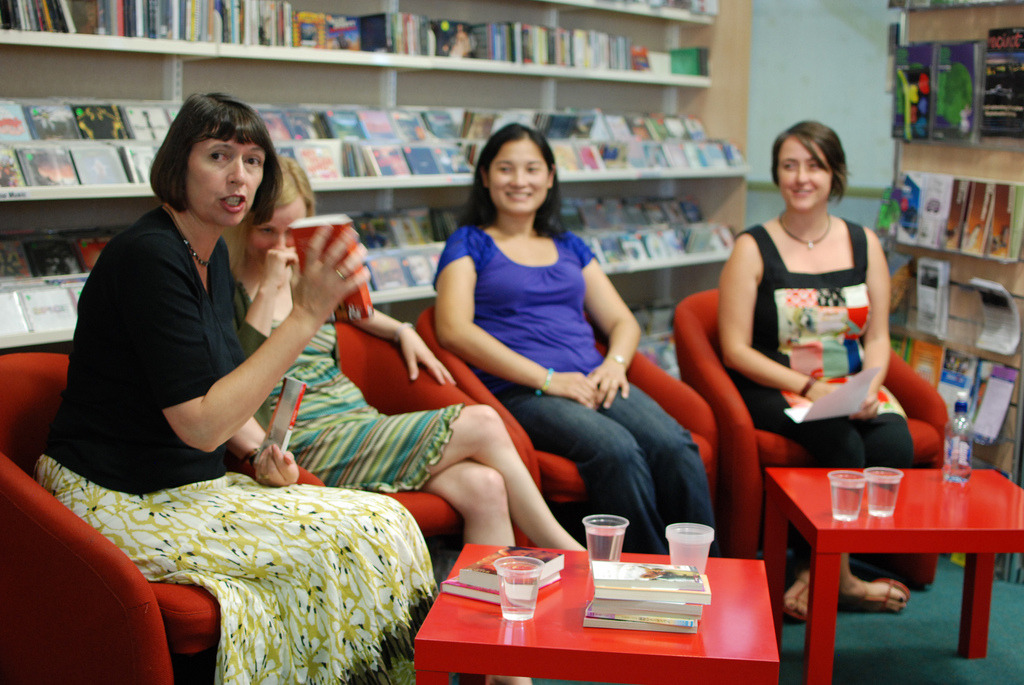
From the left: Annie West, Sandra Barletta, Kat Mayo and Vassiliki Veros Photograph courtesy from BookThingo http://www.flickr.com/photos/bookthingo/
However, as the panel discussion progressed I found that I really wanted to give my point of view, too. I behaved and, with the exception of the last question and some library promotion, I left the answers to the panel. A transcript of the panel’s answers is available on BookThingo’s blog. I now would like to share my answers to the questions on the night:
Why do you do what you do in romance, of all genres (I’ll answer this in the vein of why do I promote romance reading as a librarian)
Public libraries are charged with providing equity and access of information to all. My feeling had been that libraries and librarians were not treating genre fiction and it’s readers with equity. Throughout all my years as a librarian, romances not only were not purchased for library collections but there was also a certain attitude amongst staff and some borrowers that romance reading was secondary and that library budget money would not be devoted towards the genre. This annoyed me so I decided to support the underdog, climb onto my soap box and declare romance King until the shelves were populated and the staff accepting of readers choices.
What have you observed as differences between romance in the past decade as opposed to romance in the 80s?
For me there are 2 standout differences:
1. Like Annie, the 80’s and prior were predominately written from the female point of view. During the 90’s and now in the 21st century there was a gradual shift to both the female and male point’s of view being written into a novel. In my opinion, this shift has been so strong that the way I personally categorise the books I read is that if it has both the protagonists’ points of view then it is a romance. If it is only a female or male point of view it is categorised as Chicklit or Ladlit.
2. The sex is much more explicit and, thankfully, turgid shafts and manhoods have made way for erections and dicks. A much more realistic reflection of contemporary language.
Some people think that reading the last page first is sacrilege. Do you?
I always read the last page. I feel that “fairies must die” and have previously blogged about this.
Now about male leads. Why do we love rakes, rogues, cowboys, tycoons, sheikhs?
My favourite leads are Montana cowboys and the best friend/sibling’s best friend hook up. Journeys into someone else’s life, journey’s into a world quite foreign and the complete escape from the reality of our own lives. I tend to avoid romances set in Sydney and in Australia as I keep finding myself distracted by the setting of the book.
Kat, you said people get bored with just a kiss, but the obvious exception is Twilight. Can you discuss why it was successful?
As I haven’t read Twilight nor have I watched the movies I cannot answer this question. Though on a purely aesthetic basis – Team Edward.
Do you think romance has lost its stigma?
I think that some of the stigma associated with reading romance has dissipated for the following reasons.
1. Romance readers and romance publishers are leading the ebook revolution. This is acknowledged further by traditional book review magazines taking on romance reviewers.
2. The establishment of the International Association for the Study of Popular Romance and the Journal for Popular Romance have made inroads in bringing academic merit to the study of popular romance literature. Having been established for under 3 years it will be interesting the changes that will come forth over the next decade.
That said, there is still a large amount of bias towards romance literature and a lot more work is needed from not only the reading and reviewing public but the publishers of romance, also.
What books would you suggest to a new romance reader?
My 1st question to the person venturing into reading romance would be: What do you normally enjoy and then I would select titles from there. I’m a strong believer in merging someone into a genre by using cross-over fiction titles though there are some definite titles that I never hesitate to recommend:
Agnes and the Hitman by Jennifer Crusie
A Matter of Class by Mary Balogh
How come book stores don’t have a romance section? Where can we buy romance?
Unfortunately, romance isn’t stocked in most bookstores because it relates back to the stigma question and bookstores don’t value their readers. I get my romance books from 2 sources Kmart/Target and from overseas. Either the Book depository or Amazon. I also get most of my books from the library but, it too, has it’s biases.
Fave authors? (the only one I answered on the night)
Vassiliki: Anne McAllister, Jennifer Crusie, Victoria Dahl, Susan Elizabeth Phillips, Suzanne Brockmann, Anne Stuart, Rachel Gibson, Julie James and Melanie La’Brooy)
It was a very successful event and I feel it is apt that my moderator’s cherry was painlessly popped at a romance literature panel.
The Ick Guide on when to discard books
I love reading books. I love reading new books, old books, used books and borrowed books. I love reading well thumbed books and spine unbroken books, big books, tiny books, paperback and hardback books, red books, blue books and dammit! I will even read green books!
However, there comes a time that you need to recognise that a book should be discarded. Yep, that’s right. Sent into that big paper recycling plant in the sky. Because, Dear reader, we all know that we have “ick” boundaries. I have met many people who refuse to use libraries because of “germs” or “but who knows what the previous person was doing with that book” and as a seasoned librarian I can understand that sentiment. Now, some of these ick boundaries will vary from person to person. I personally don’t mind a little bit of sand in my beach novel but it may cross your boundary of ick acceptance. So, here is a list that all book owners, lenders (yep – that’s you too Dear Libraries) and booksellers should pay heed.
Discard if your book has any of the following properties:
1. Odour Ick: You know that sand in my beach read that I don’t mind. 2 years later that sand will give off an eau de pisce…..which is not good at all. Any smell strong enough to make you reel your head back upon opening that first page is an indicator that the book must go – and I don’t care if the smell is your fave L’eau D’Issey.
2. Hair Ick: Hair of any sort should never be in or on a book. Unless it’s a Princess touch and feel board book and even then – it will have cooties.
3. Tactile Ick: Unfortunately this comes in several forms.
3.1 Cover Ick. You pull a book off the shelf and immediately your fingers touch something other than paper or covering plastic. They touch a film…a film of something unidentifiable. It may be brown and grimy (very common amongst libraries whose staff persist on using sticky tape on the covers of books rather than securing notes/reservation notices with paper and elastic bands – not that it’s a bugbear of mine or anything like that – gee I was trained well by those Randwick librarians in the early 90’s), or it is wet. Wet when it is water isn’t particularly good but it is better than when wet that is not water.
3.2 Internal Ick: That’s right. This book is perfectly fine. You’re reading it and you’re totally engaged. Then, upon turning to page 230 just as it’s a cliff hanger, sex scene, gun at the temple, alien abduction showdown with a unicorn, you turn the page and there is something…something gracing the pages. It could be grimy (soil, sand), edible (banana, honey), movable (lice, cockroach) or it could just be pages that are stuck together. Now, you the reader, depending on where in the story these pages became stuck, will be able to ascertain as to the nature of what has stuck them together. But more on that in Point 4.
When you are faced with tactile ick – it’s time to discard the book.
4. Bodily fluid ick: From the less inocuous snot, ear wax or baby saliva to the gross levels of urine, faeces or semen, if you suspect that bodily fluid irk is present on the covers or between the pages of the book you are reading follow these instructions: drop the book; holler “ick”; don some industrial strength gloves. If the book is yours throw it away. If it is not your book place it in a plastic bag, seal it and report it to whoever you borrowed it from. And yes – that may mean your lovely librarians who will gag as they record the barcode, take it off your record and discard of the offending book ASAP.
5. Wet Ick: So you were reading in the bathtub again. Only this time the book fell in. Or you’re at the beach and you haven’t noticed the tide come in. You now own a sopping wet book. Of course, there are methods to salvage a wet book but unless it is an out of print, rare book (and if it is what the hell were you thinking reading it in the bath/at the beach you bloody idiot) don’t bother. The cost of replacing the book will be much less bother. Though, if you insist, here is a guide on how to dry wet books.
6. Mould Ick: This is directly related to 5. Wet Ick. If you have tried to salvage wet ick and left moisture mould ick ensues. And this is, let’s say, icky. Worst part is that mould spreads so even if the rest of your books weren’t wet – the mould will still get to them. Get rid of it!
7. Eaten Ick: I don’t like tomato sauce, mustard, jam, banana, coffee or steak with my books. I like my books without any condiments to be honest. And frankly, I do not like my books to have been eaten by rodents either. Another surefire discarding moment.
So when if comes down to it, when you are choosing a book to read, or if you work in a library and you are reshelving items, look at the tattered book in your hand and think to yourself; Would I read this in bed? Would I read this over a coffee (which may in fact be the reason that no-one will want to read it as the previous coffee drinker got a bit bloody excited while reading, slushed coffee and hid the evidence)? Would I give this book to my immuno-suppressed, living in a bubble neighbour? If the answer is No! Get rid of it. And if you are wailing “but it’s my favourite”, “it’s a first edition”, “the author personally signed it for me” or “but my granny gave me that book” I have several things to say:
1. Take better care of your things (of course, the exception to this rule is if the damage is due to fire, flood, plague and all other cataclysmic disasters).
2. Buy a new book. Booko.com.au will help you with a price comparison and suggested retailers.
3. Buy a second hand one abebooks.com
3. Cope. Live life without it.
I haven’t been exhaustive as I thought that I would avoid the whole age and use aspect of icks because it is done so well at Awful Library Books. I recommend you turn to them for guidance in this area.
So for the salvation of all readers, for the salvation of your own personal bookshelves and your own sanity (dammit! where is that fishy smell coming from!) use this Ick Guide, discard offending books and buy yourself some brand-spanking new copies.
Now some of you may ask about the falling apart from having been read so many times ick. This is not ick. This is love. This is deep, abiding love. And even the crooked book can be read.
PS Note to collection development librarians reading this – feel free to use this as part of your weeding guide. You’re welcome!
 Shallowreader