My books are worth their weight in silver

Like most homes, we have a small stash of 5 cent, 10 cent and 20 cent coins that pile up in a coin jar. This coin jar is used regularly so there is rarely any more money than five dollars in it. My youngest son can only take canteen money from that jar to pay for his garlic bread or frozen oranges  and I get to use my handful of silver when I head down to my local opshop/charity shop.

Books at my opshop cost anywhere from $1 to $5. I will often throw some coins in my bag and head down to buy myself a book. When I did this today, I was overjoyed to find some Charlotte Lamb, Carole Mortimer, Anne Mather and Penny Jordan reprints on sale. These were reprints from their later books but even these reprints are nearly 10 years old and out of print. I counted my silver and found I had enough money to buy 3 books, all with 2 novels in each binding. I chose the ones I would buy, went to the front of the shop and waited to be served. The woman ahead of me was buying some interior decorating magazines. These were being sold for $1, too. There was a woman hovering to my side and when it came to my turn to be served she said to the woman at the checkout “Give her the Mills & Boon 3 for a dollar. I just want to get rid of them”. It turns out hover woman was the manager.

Now her comment took me aback somewhat. This is an opshop. Is there a place for snobbery in an opshop? I expect a certain egalitarianism from my opshop. I have often seen Target shirts hanging beside Ben Sherman shirts here. I have seen Sportsgirl skirts next to Jigsaw skirts. Frankly, my Mills & Boons, clutched closely to my bosom, had, just moments ago, been sitting on a shelf alongside John Banville’s the Sea and V. S. Naipaul’s Half a Life (ah! the sweet irony that they still sit on those shelves unpurchased). Isn’t shopping at an opshop an opportunity to give to a charity while benefitting from finding an item that is no longer easily purchased from mainstream retailers? For others it is a way to dress and clothe themselves while on a tight budget and for others it is a thumbing it to the big corporates in an attempt to be alternative.

Now this opshop only had 20 M&B titles which is quite a low amount in comparison with the opshop in the neighbouring suburb which has hundreds. And this was a good day! It often has none. Though on the one hand I was quite excited at the lower price so I hurried over to the shelves and chose another 6 books and bought 9 books for $3 (which being doubles means that I scored 18 new books today!) I was also angered. I wanted to shake my fist at the sky and shout “How could you denigrate these wonderfully written books. How could you value them less than a three year old tattered House and Garden”. But I didn’t. I did make a comment about literature snobs after I gave her my pennies.

I am offended on behalf of my reading love. My offense won’t last long as you develop a thick skin as an out-of-the-closet romance reader. But I choose to be affronted when my reading choices meet disdain, scorn and ridicule. I am going to love my books. And they are worth their weight in silver.

Postscript: Like most people, I buy my books from a broad range of places. Retailers, online, markets, opshops and second-hand bookshops. In anticipation of anyone reading this accusing me that if I felt that strongly about Mills & Boon why don’t I buy them new I would like to say that I only buy my in print Mills & Boon at full retail prices. And they are the books that are worth their weight in gold.

The reader, social media, exosomatic stores of knowledge and a brand new made up word

I have been thinking about social reading, the move from an information society to a communication society and the impact that this shift has on our understanding of the exosomatic stores of knowledge. Karl Popper’s third world, his “Objective Knowledge” explains that exosomatic stores of knowledge have an existence independent of those who created them. I’m going to go all “My Big Fat Greek Wedding” here and point out that exo comes from the Greek word meaning out and somatic comes from the Greek word for body thus exosomatic being knowledge no longer contained within the body. In the mid 20th century Karl Popper conceptualised objective knowledge as the knowledge that is held in books, libraries, galleries, museums, archives and records. Once these creations were independent of their creator they could not be controlled by their creator and the user could interact with objective knowledge anyway they chose.

So a book would get published and sent into the bookshops, libraries and homes of readers and potential readers. As soon as that author signed off on their final manuscript they no longer had any control over their book and its use. If groups of people wanted to meet up at their local library to talk about the book, unless the author lived in the next town or was on tour and invited to attend, the discussion was purely about the users relationship with the author’s exosomatic brain (the object that he/she conceptualised and produced). Even a published correspondence between an author/artist/creator and a critic became a part of the exosomatic knowledge store.

However, with digital media exosomatic stores are much more vulnerable. Creators can make changes through the removal or editing of information through DRM (which ends up being an even bigger topic but for the purpose of this blog piece, only a tangent) but they can also influence changes that cannot be tracked. That is, the creator blurs the exosomatic knowledge stores. Last week, @Liz_Mc2 posted about authors misusing their influence to get readers and reviewers to change their negative reviews and that she doesn’t feel it is good customer service to contact the reader/reviewer. Read her post “Hey Author, I don’t want to be your ‘Customer'” As I have been known to do, I start a comment on Liz’s blog that ends up as a slightly related blog piece over here. Thankfully, most authors have the good sense (and possibly their publisher’s advice) to never comment on reviews or reader discussions. However, a small minority of authors view approaching readers and reviewers on third party social and commercial aggregators such as Amazon and goodreads as “good customer service”, others take the simplistic view of “If you don’t agree with me you must be simple so I will explain it to you a gazillion times – as an author I can intervene in any conversation about my work” without realising that it curtails dialogue. In the example that Liz disucsses the author in question feels that through approaching the writers of negative reviews and coercing them through dialogue to give her books a higher rating she is performing a “good customer service”. This is loaded with problems. The first of which I will illustrate with a hypothetical question I posed to my 14 year old son and his friend:

You create a Facebook group to discuss your favourite TV show. You post discussions about the show and one discussion has you bringing up some lines that you both hated. The writer of the show joins in and explains why he wrote those lines. How do you feel?

BOY 1: Flattered!
BOY 2: That would be really cool!

The writer has very politely told you why you are wrong for disliking those lines he wrote.

BOY 1: That’s cool too. You can defend your work.

The writer has told you that as he has explained why you are wrong that you should delete your comments (on your FB group not the TV show’s). How do you feel?

BOY 1: I’d consider him a dick.

Would you do it?

BOY 2: No. And I would probably stop watching his show.

I love teens. They understand the implications quicker than most adults (though they might not be able to articulate them without the use of genital expressions).

The implication is that a creator can try, and in many instances succeed, to control his/her product when it is no longer somatic. And the more concerning problem is not whether readers, reviewers, recommenders, bloggers or commenters choose to change their opinions due to undue pressure from the creator but the lack of being able to follow the thread that led this decision to be made. In most cases the original work is being altered rather than a postscript stating the changing view. I have no issue with people changing their mind about a piece of work. Hell – my Goodreads profile states that I reserve my right to make changes at a whim. But then I put my Information Science cap on and I start grappling with the implications of these unrecorded changes. Whether they are due to a whim, a genuine change of mind or due to intimidatory practices that vary from passive aggressive to outright stalker behaviour from a creator there is no way that a dissenting voice can be researched by future historians. The only record they will see is the last one that was edited. Digital records may be preserved such as through the Pandora project but emails on individual creator’s computers are not likely to be attached to digitally preserved sites. The process of thought, the growth of knowledge and understanding, dissenting views, open dialogue and even the pivotal moment where a view has been changed is no longer traceable.

In an age where we are shifting from an information to a communication society, I believe we have transcended the exosomatic stores and we have shifted to a metasomatic (and yes – I made up this word for the purpose of my blog) stage where we need to question the pathways that led to digital information and opinions on social media and commercial review sites and their veracity. Metasomatic stores, in my mind’s definition is where the knowledge has exited the creator but the creator, through digital interactions can still manipulate it’s use but without hard evidence. Can this behaviour be halted? I don’t believe it can be halted. But it can be acknowledged and understood. Unless it is published by a source independent of the creator and third party aggregator, such as digital publishers, due to the poor behaviour of the few intimidatory creators, reviews from unknown persons will always be read with cynicism and doubt. Let’s just hope that future historians will be aware of these issues and will take the same stance.


*Added a day later*

I realise that I have muddled up my exosomatic brains and knowledge and stores. My only excuse is that I wrote the comment-turned-into-blog at midnight. At this stage, I am not inclined to change anything as I was playing with an idea and not writing a factual essay.


Breaking Open a Storyteller

Beer as storyteller interests me. It is in the same vein as In Vino Veritas. Every experience we have can be turned into a story but where do we find the opportunity to tell these stories. I love that feeling on a Friday or Saturday afternoon, when the week’s work is completed, gathering with friends to partake in some wind-down storytelling. Often people meet in bars, pubs, restaurants or in their own homes and after a few cold ones the storytelling is enabled. It gets embellished, hyperbole is thrown in and it brings on laughter and tears.

Growing up, our dinner table always had wine on it. My dad would allow us a sip each from his glass and he and mum would always tell us stories of growing up in Greece. At family parties my uncle would bring his god-awful wine which was like poison but as it was home-made all the adults would drink some. I don’t ever remember anyone getting roaring drunk. They got “How’s it going, mate” happy. There was no overimbing ( how could there be – the wine was horrid), no vomitting but there was storytelling. Each person, one after the other, each louder than the other, sometimes agreeing with each other and other times calling each other crazy as their memories were so different.

I see this happening in my own home. We often will have friends over, a few beers, a few wines. No-one ever gets drunk but we all get storytelling. And as the night progresses and we’ve had a bite to eat, the storytelling gets louder and funnier.

One of my favourite stories, is actually my husband’s. He went to Mt Athos which is a monastic community in Northern Greece with one of my cousins for four days. While they were there, they met an English professor who invited them to a mountain walk to visit a hermit. My husband’s first thought was that it seemed to be a mutually exclusive activity visiting with a hermit. Nevertheless, he accepted. Once in the hermit’s house, he was offered moonshine that the hermit himself had distilled. This too, felt like it should be mutually exclusive. He drank the moonshine and then my cousin whispered to him “I don’t drink alcohol and the hermit may think I am rude if I don’t drink mine. Can you please drink mine and I’ll pretend it was me”. I’m not sure where deceiving a hermit rates in the sinning scale but my husband kindly obliged and found himself in the peculiar situation of being drunk at the hand of a hermit in a monastic community at nine in the morning. This is a story that usually comes out when he has cracked open a storyteller.

20120316-165305.jpg

I’m writing this because, storytelling has long been the predecessor to novels. Storytelling in families is an important way of passing down stories from our ancestors. Storytelling allows religion to be taught, reasoning to be understood, science to be examined, politics to be debated and jokes to be laughed at. I love when friends know each other so well that they finish each other’s stories, whether they are siblings, couples or friends from a long time back. I love that my kids know that when it is thundering outside it is Zeus angrily chasing Hera for she refused to make him a coffee. I love that my kids know this because this is what I have taught them and I was taught this because my parents learnt it from their own parents and it goes on.

So as it is a Friday afternoon, I will head out to the beautiful sunshine and have a storyteller with my husband and friends. I hope you all get to have a storyteller too.

Alphabet vs Genre

As a child, I remember progressing from the picture books to the chapter books at my local children’s library, The Warren in Marrickville. Upon my progression to the Junior Fiction section, disorganised child that I was, I made the decision to delve into the collection at the beginning. At A. And I would progress until I read every book in this, albeit tiny, branch library. I read Alcott’s Little Women, Brink’s Baby Island, Brown’s Flat Stanley, Cleary’s Henry Huggins and Ramona the Pest and as you could imagine the list goes on and on all the way to Zindel’s The Pigman. (As an aside, I spent about a year at E and F having hit the mother lode with Elizabeth Enright, Eleanor Estes, Edward Eager and Eleanor Farjeon). I went on to use the same method when I matured from the children’s library and I moved up two flights of stairs to the then Adult Library at Marrickville Town Hall under the beautiful stained glass ceiling.

Once again, I started at A and progressed slowly through the collection. Serendipity ruled for me. And browsing shelves alphabetically, whether in a bookshop or a library was great because, unlike Dewey, it was simple and unbiased. I just read whatever caught my fancy. Steven King, Leon Uris, Wilbur Smith, Isabelle Allende, Penny Jordan, Carole Mortimer all interfiled in the one big area. Horror, literature, romance, fantasy all there. Despite this, I still discovered my favourite genre, I still found my favourite romance authors. This was objective shelving, for while the library may not pass judgements on different genres, people sometimes do, and link a writer’s, and even reader’s quality, to their preferred genre.

Over the last 10 years, libraries have seen a shift in the layout of their spaces and the way people access their shelves. There is a lot more display space, bookshop layout is aspired towards, and this is all very positive as it makes libraries much more attractive and appealing places to their members. But I am ambivalent about the reorginisation of books according to the genre that they fall in. Unlike retailers, libraries are not about profit margins but about unbiased access to information and cultural materials. Selection may be unbiased but we are seeing a move towards subjective organisation.

Now don’t get me wrong. I am a big fan of genre fiction. Over the last 30 years my reading has seen me devour comics, horror, literature, children’s fiction and, of course my mainstay fiction favourite, romance. To add to these, I will occasionally dabble in fantasy, science fiction and my least favourite (and only because I’m squeamish), crime. But I found my favourites by browsing unbiased shelves. And much as I love walking into my favourite bookshops and libraries and heading straight to the romance shelves I often wonder about the people who will miss out on reading a fabulous romance because they don’t want to be seen in the romance section or the science fiction fan who just doesn’t want to read literary work. Somehow, I feel that it is like apartheid for books (harsh words, I know!).

For, heaven forbid Dean R Koontz is shelved near Milan Kundera, or Roald Dahl to be seen alongside Victoria Dahl, or Howard Jacobson grace the same shelf as Eloisa James. And then, what of the books that sit across genres such as Charlaine Harris’ Sookie Stackhouse and J. R. Ward’s Black Dagger Brotherhood books that sit comfortably in both fantasy or romance genres. Or benchmark setting authors such as Margaret Atwood – does she sit in literature or speculative fiction. Genre-based shelving endorses a classification of fiction that may not be needed.

I know that as a child, I loved discovering books and that none of them had genre labels. As an adult, I am struggling to decide upon whether I like the genrification of libraries or if I would like fiction, to once again, be a roll call of authors on shelves.

* strikethrough added a few years after I first posted this

Romance fiction, to me, is somewhat akin to science fiction

I love reading romances. I love the relationships, I love the internal monologues, I love reading both the male and female points of view of the same events. I love reading about characters grappling with either internal issues or external events beyond their control and overcoming these problems together. I absolutely adore the Happily Ever After endings to such a point that I will kill fairies to ensure that I get the ending that I most desire. And most of all, I love that I have to leave my cynical, snarky self at the door for the duration of reading and escape to some other world, some other planet where the relationship build ensures that no matter what obstacles, issues, evil nemesis, glamorous next-door neighbours, indecisions, friendship pressures and other alien, droid or spaceship interventions, the hero and the heroine prevail and end up with one another. Yes, dear reader, romance fiction, to me, is somewhat akin to science fiction.

I grew up on a street that had 2 parish churches (different denominations) and every Saturday and Sunday we would sit on our front verandah and watch hourly processions of brides and grooms in their various Jaguars, Mercedez Benzs, convertibles, Holden Monaros, horse-drawn carts, and ribbon strewn silver Bugattis passing our home. Each and every time my parents would jokingly say “Another couple going to their hanging”. This was the first plant in my mind that marriage was a cynical pursuit. It was a prison that was not to be coveted.

A much loved (divorced) aunt, at weddings, would always greet me with “May you remain on the shelf, and may it be made of steel”. Hmmm!

Add to the mix that I was a Mad Magazine aficianado. Mad gave me an understanding of satire and irony and taught me to question everything. And I loved Dave Berg’s The Lighter Side of…. which always poked fun at relationships.

So any time I would hear any gushings of “But I lurve him” from the girls at school or “He’s such a good pasher” or “Oh My God! He bought me a fur coat” (I mean, really? Aside from the obvious animal cruelty issues, It’s frickin’ Sydney! It doesn’t get cold. That’s not love. That is stupidity). I would roll my eyes and think “get some perspective”.

Don’t get me wrong here – I absolutely adore my husband (and for the record – I walked down the road to my wedding ceremony – no cars) and, despite my jaded outlook, I truly believe that for most people, there is a love match. Some will be lucky enough to find it at a young age and have it last for many years (such as my friend’s grandparents who were married for 82 years), some will find it for a short intense period (Britney Spears and Jason Alexander married for a day comes to mind) but most people will be somewhere in between. And when it comes to my reading choices, I am curious, I am interested in reading about that journey of coming together. I predominately read romance fiction but I will happily read biographies with romantic elements because I love to examine and understand the circumstances around a romantic pairing as most of these pairings will be undertaken with an optimism that I find life affirming.

I have to say that I deeply dislike love stories, particularly tragic, grief stricken tales where no-one is happy and the moral is that misery gives you a deeper understanding of humanity. It may win authors literary awards but it certainly doesn’t compel me to buy any of their books. I know that life has tragedy and that death is not an option but I choose to focus on more positive aspects in life. It makes the reality of life so much more bearable.

So why would I equate romance to science fiction and not to fantasy. Well, for me, fantasy fiction is not possible. It is entering a realm that is only imagined, flights of fancy that will never be realised no matter how vivid or thrilling the story may be. But science fiction is grounded in scientific possibilities. It may not be possible in the immediate future, but just like the man on the moon, it has such wonderful outcomes should the fiction be realised. And don’t we all know how wonderful romance can be when it comes to fruition.

Procrastireading

Procrastiread / prô’kræstairid/ verb (procrastiread, procrastireading) – 1. to delay finishing a book: I procrastiread my last book for three days. 2. purposely reading slowly so as to not reach the end of a book: the reader was procrastireading because of an emotional connection with the characters of a book in such a deep-felt way that to end the book would result in severing the relationship. [Latin]  – procrastireader, n.

Have you ever found yourself reading a book whose characters endear you, become your friends, become your soulmates and envelop you into their lives to the point that soon you realise that you are half way through your book? And with every page you are getting closer to the end of your relationship with these people. Sure, you are the passive person in this relationship where all others are walking, talking and interacting with each other yet ignoring you. But you are the one who is setting the pace, you are the one that decides when the next words in their story will be read. You are the one that can evoke a procrastiread.

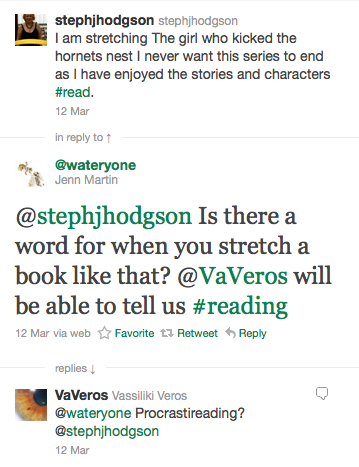
The other day, on Twitter, I took part in a short exchange where @stephjhodgson tweeted that she was stretching the ending of the Stieg Larsson series, @Wateryone asked me if there was a word for that.

I couldn’t find an Oxford Dictionary word or definition for this behaviour . But now, there is a word that we can all use – procrastireading/procrastiread

Over the years there have been few books that I have procrastiread. For the most part, if I am enjoying a book, I need to finish it quickly. I fly through it. I stay up until 3 or 4 in the morning with my obsessive need to know how it finishes despite the fact that I read the ending before I started the book and despite the fact that I will be a mess at work that day. But once in a while I am captured. I am enchanted by every word and phrase. I am lost within the book and I just don’t want it to finish. So I stretch out my reading experience over a number of days.

My most memorable procrastiread has been Bet Me by Jennifer Crusie. Not only are the main characters Cal and Min perfectly matched with their sharp banter from the beginning of the story but their friends also became my friends. I felt captured by them. I was engaged and amused by the narrative and the dialogue. I was invested in these people and as I felt the thickness of the book’s pages in my right hand lessen, I realised that I no longer would have these wonderful friends with me. They would cease to exist. But not if I read only sections at a time. Slowly, savouring each exchange and every nuance. And once I came to the end of the story, I was thankful to Jennifer Crusie who gave me a snapshot epilogue of “Where are they now” for each wonderful character.

I really do miss them.

Have you ever found yourself procrastireading?


Mea Culpa Mea Culpa Mea Bloody Culpa (but then again maybe the bookstores will have to shoulder this one)

Last week, RedGroup went into administration and along with it a number of Australian and New Zealand book chains – Borders, Angus and Robertson and Whitcoulls. Of course, the media have gone crazy blaming the darn internet again (my god – prior to 1994 you could only blame society). With the gradual decline of the print newspaper (hell, they’re giving them away at 8am these days) the media are bitter, enraged and ready to snarl at any hint of online business having healthier sales than a bricks and mortar company.

Now I am being implored by the media to “put my money where my heart is” and support my bricks and mortar independent bookseller and stop buying from those horrid online bookshops.

Well, let me say this to the book chains and indies.  You lost me, and a large chunk of the book buying market (romance readers), by being disdainful of our reading choices. I have spent decades struggling to source romance titles and finally have found places that will not only stock them but will sell them to me at a lower price than venerated bookstores can supply them. Why should I change my buying habits. As it stands, I would still have to source my titles through the online bookstore to give to my indie who has actively chosen not to supply them.

Yes, I do love my indie. Their loyalty program is splendid, their staff are friendly and knowledgeable (and all greet me by name) and for years they would order in books for me (back when I really didn’t feel comfortable with online purchasing). These books were, inevitably, romances.  But did this impact at all upon their book stocks? Well – they always stock Jennifer Crusie. But that is it. Despite the fact that they had staff that enjoyed the genre and and that they had customers that enjoyed the genre and that they had genre sections throughout the shop (Sci-fi, Fantasy, Graphic Novels, Crime) my “beloved” indie chooses to not sell Romance. Somehow, I suspect that independent bookshops would prefer to declare bankruptcy than to dedicate any space to the romance genre.

When you have a mortgage or family  or other responsibilities to look after, your book buying priorities change. Thankfully, I work in a public library so access to millions of books is at my fingertips. These same millions of books are accessible to any Australians who visit their public library. To find these books Trove is the best source for titles held throughout the country. That said, I love my keepers and I am all for the adage of “Buy the best, borrow the rest”. So when I find that I have borrowed and renewed a book multiple times and I am deeply in love with it I will go out and purchase a copy for my home.

I find that I buy approximately 20 books a year for my whole family and I buy these books from various sources. Now, the difference between paying $20 per item by going through my indie/chain or paying $8 for the same book through Book Depository/Amazon – it’s a no brainer. And it is insulting to my intelligence to beseech me to stop buying online. Franky, that “leftover” $12 supplies my home with 10 litres of milk (which lasts 3 days) or 1.5 other book titles. A win/win situation for my family.

And if the issue is “Buy Australian” there are a number of generalist Australian online bookstores who do supply romance titles and promote them, discuss them and enjoy them too. They provide a wonderful service and operate in a similar way to indies (except they know what their customers want to read). And their prices are reasonable, too. A shout out to Booktopia and The Nile.

The question is: do I still buy from my indie? That would be a resounding yes though not as much as I used to. I buy all my Australian and New Zealand authors and publications from them. It is the same price (and in many instances, cheaper) than buying those titles online. Will this save the store? I don’t know. Would I return to my local indie if it set up a romance section? Perhaps. I love reading the last pages of a book before I buy it and I also love skimming through a book to get a sense of the language that is being used. Once again, I can’t do that online. So it would really depend on the price and the quality of the titles being sold.

The important point to observe is that readers who choose to buy their books online do so for a number of reasons, be they cost driven, being too busy to be bothered going into a bookstore or quite importantly, inaccessibility of titles readers want to read.

I am putting my money where my heart is – and my heart is with the suppliers of books that I like to read. So if this means that bricks and mortar bookstores will close down I will be amongst the many who will be saying “Mea Culpa”.

The BookGroup you’re having when you’re not having a bookgroup

or Why pubs make great venues for bookgroups

On the 2nd Wednesday of every month I walk down to my local pub to talk with other readers about thingys we have read. And yes, these get togethers are as vague as that first sentence. But let me start at the beginning.

Nearly 10 years ago, my local barista/friend/reading pal asked if I was interested in starting a bookgroup with her at the coffee shop she owned. She found that she was constantly chatting with her customers about books and this was affecting queues for coffee. The inaugural meeting was held with many of her customers, both male and female, turning up.

On that day there were several things that everyone agreed upon:

1. No-one wanted to feel like they were in a classroom. They did not want book notes, study notes, analysis or anything that might remind them of their school years. [My kind of people!]

2. The idea of 1 book that everyone had to read was distasteful. Choosing a single title that would appeal to the broad group would be too hard. Everyone agreed that a themed bookgroup was best. [Internal cheers]

3. Everyone had an equal voice. There was to be no scoffing, no derision, all reading and all choices were valid. [Yay! I could take romances with the knowledge that I didn’t have to roll my eyes and sneer at literary snobbery]

We eventually came to have a Number 4:

4. Cheers for most tenuous link between the subject and the reading choice. [This has become a highlight in our monthly meetings with the best ever tenuous link being someone who read a biography on Fidel Castro for the topic Infidelity and my own win with Susan Elizabeth Phillips’ Heaven, Texas for the topic of Church and State]

At first, we met up at Muse Cafe in Summer Hill. Once our friend, who owned the cafe,  sold up we chose to also move and after various unsuccessful venue choices we decided upon Summer Hill pub. I must point out that the then owners of Cafe Decolata (another of Summer Hill’s many cafes) were fabulously accommodating! Despite the fact they closed at 5pm they gave the group the keys to the cafe and we met there after hours for as long as we liked which we did for several sessions. But the eating & drinking options weren’t available to us so we had to move on.  The Pub provided us with a relaxed environment where no-one felt obliged to purchase a meal or a drink yet we had the ability to stay for as long as we liked. We have had the occasional clash with a rowdy football game but shouting across a table as to why you loved the latest romance or murder mystery you have read can be surprisingly cathartic.

Over the years, our themes have ranged from the sea, 3, music, blue, elections, feminism, blokes, beer, Russia, design and the list goes on. We also have had a variety of formats. Our reading extends beyond fiction and includes non-fiction, poetry, song lyrics (which on one occassion were sung and accompanied by guitar), plays, picture books, Hansard, essays, films and television scripts. Our members are a varied lot of people. With a good mix of males and females, we’ve had some very interesting people come and go. From teachers, baristas, ministers (well only 1 really but he was with us for a long time & we wish he hadn’t been transferred to Newcastle), librarians [moi!], academics, illustrators, marketers, teens, parents and even the occasional appearance from some of our kids presenting the book that they have read. Some of us have formed friendships over the years yet, for the most part, our strongest connection is meeting at the local to talk about our topic once a month.

In 2006, I saw the first write up of this type of book group in Library Journal as to the value [and in my opinion, a much more welcome model] of thematic book clubs. I was impressed. This article articulated the organic way our group operated. It also highlighted that by opening up to a theme based approach reading choices allowed diverse choices, less structure and suited to people who are not similar in their reading habits but just want an opportunity to share their reading experiences with others.

FAQs:

Do I think a library would be a better venue? No! Libraries close too early and they don’t serve beer.

How can you too have a group like the one I belong too? I don’t know. How does one meet an open-minded, reading friendly publican/coffee shop owner willing to provide the space and spread the word to their customers?

Does this type of bookgroup suit everyone? Not at all. We have had many people turn up for one meeting only to leave exasperated at our lack of focusing on one book and our tangential conversations.

And how does a laissez-faire group of people with no leader manage to keep meeting for 10 years? I’d say common courtesy and a desperation to share their reading experiences with anyone other than their immediate families who may or may not be readers.

Now, I must clarify, that the rest of the group are not Shallow Readers. They have depth……. and they will all happily acknowledged that I am the shallow one.

Prudes, privacy and pompous pissants

A privy of prudes, years ago, decided that their task was to justify reading aloud sex scenes to each other in a closed off room (are alarm bells ringing yet) and then deciding which title didn’t help them get their rocks off. This decision resulted in the establishment of possibly the only literary award for poor writing – The Bad Sex Award.

I am highly amused by this year’s shortlisted author Christos Tsiolkas’s statement in The Guardian:

“I have no idea who is behind the Literary Review’s Bad Sex awards and I may be making an awful assumption but I think their sexual highlight was probably jerking each other off at Eton.”

Let’s not talk about sex – why passion is waning in British books

http://www.guardian.co.uk/books/2010/oct/16/sex-disappearing-from-novels

These literary critics are incapable of behaving like adults when they read a sex scene. They turn into sniggering little boys who blush and snigger when they hear the word “boobs” and have taken it upon themselves to hide the good sex books for their enjoyment and only highlight the crap. Frankly, if there is a short list for the Bad Sex Award – I want access to the titles that didn’t make the list. This says several things about the literary bougeois:

1. They consider themselves to be in a position of moral authority as to what is acceptable, what is modest and righteous and deserved of their qualified attention and that anyone who claims or aspires to be part of the literary community (as opposed to the hoi polloi of the writing world) will adhere to writing in a fashion that meets these Victorian standards – and by gosh, sexy naked scenes will not meet these standards. Who knows what would result in allowing sex to be celebrated. Romance writers (or even, heaven forbid, Mills & Boon authors) may end up contenders for a literary award.

2. They want to keep private that the author of a book wrote in a way that aroused them because, certainly, that is what a well written sex scene should do. To a degree, I can understand wanting to keep private whether a book got you hot and bothered but if that is the case do not set yourself up as a judge of literary merit. A judge is supposed to be impartial and objective and is expected to not bring personal feelings into account when making a decision.

To be honest, I quite enjoy reading about the Bad Sex Award. I believe that it forces literary authors to think more carefully about how they depict a sex scene and what emotion they are trying to arouse in their readers. For example, confusion is not something that a reader should be feeling when reading a seduction scene. My objection is not to the existence of the award but the lack of existence of a Good Sex Award from the same literary institution.

Make me happy – I’m a Libra and I need balance in my life and in literary awards.