No one rips the ass out of Vassiliki

This is an ego post.
20130604-005407.jpg

This post is about my name.

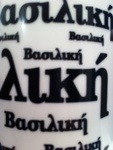
My first name is Vassiliki. In Greek it is spelt Βασιλική. My name is an adjective. It means royal or regal. So if you are speaking of the royal family you would say οι βασιλική οικογενια. It is the feminine of Basil meaning king or kingly. When I was born, my parents had to decide whether they translated my name or transliterated it. Anglo equivalents are Queenie, Regina, Reggie, Regan, Reagan or Royal. None of which my parents liked so they transliterated my name. My name is one of the most common Greek names you can have. It is up there with Maria and Katerini. Continue reading

Writing Longhand

A few weeks ago I wrote a fabulous post. It was superb. The words all flowed, I hardly moved from my seat and after 2 hours of constant writing I was really pleased with my close to 20 pages (let’s not get too excited here – I was using a notebook). However, I am choosing to not type it up.

20130602-212138.jpg


At the beginning of last year I returned to study after a twenty year hiatus. The last assignment I had handed in was in 1991. I had used a word processor for the last two years of my degree but for the most part, the majority of my assignments were written by hand. For many young ‘uns this brings gasps.

I much prefer using a word processor.

In second grade, I won a writing award held by the local bank. My father went to read my entry and left without doing so. He came home and stated that he had no idea how anyone was able to decipher the scrawled gibberish of lines running into themselves.

20130602-212252.jpg

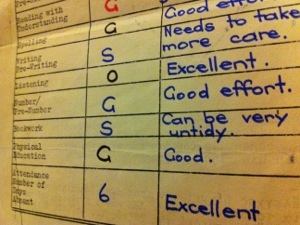
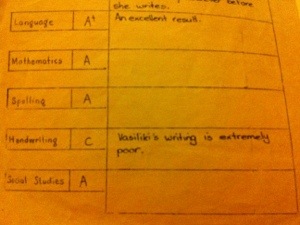
In third grade, my report card was filled with As with the exception of C for my handwriting.This C did not change all the way through to sixth grade.

20130602-213021.jpg

In sixth grade, my teacher who had a mercurial temper and a propensity for using the cane, started shouting at me for my painting. It was a brown boat on a brown sea against a brown sky.I had not aimed to make everything brown. My colours had somehow become mixed and so I drew shapes into the brown. I was genius, I thought. He didn’t. He threw it in the bin (but did not cane me).

Oddly enough my Greek handwriting was (and still is) neat and legible. I enjoy writing in Greek because I can take pride in my penmanship. But alas, there is very little call in Australia for Greek handwriting. But I also think that my Greek handwriting is legible because Greek is a second language for me. My Greek thinking is slower than my English thinking so my hand works at the same pace as my thoughts whereas my English thinking is leaps and bounds faster than my hand. My thoughts flit from seemingly unconnected ideas yet formulate a coherent concept by the time I conclude.

My hand was never able to catch up often cramping up in speedily writing my thoughts down. By Year 11 I had developed a ganglion on my right wrist. I quickly taught myself to write with my left hand so I could write uninterrupted by hand cramps. I became ambidextrous (yeah – yeah – hit me with the old “I’d give my right hand to be ambidextrous” joke). My left hand writing was barely discernable from my right (though I have never mastered my signature with my left hand). However, no-one ever asked to borrow my notes. I believe I was the only person who could decipher what I had written.

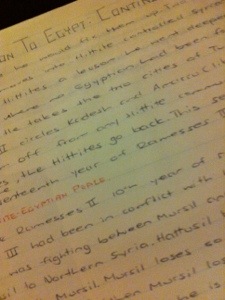
As you can see, there is a pattern here. My penmanship was not of the highest calibre. I was inconsistent. I varied from cursive writing slanting from left to right, rounded print letters and bizarrely enough, in Year 12 I wrote a 130 page assignment on Ancient Egypt with a mixture of a rounded print font with a squared font for titles.

20130602-213112.jpg

By the time I started university I had reinvented my handwriting self. Though I no longer thought my writing to be awful I still did not relish doing it. I loved my sister’s electric typewriter but as we were both at uni at the same time I rarely used it as she was the boss. When my dad bought a computer it revolutionised my writing, my assignments, my everything. I was finally handing in work that was not being judged on how well I rounded my As and Os or how well my cursive letters joined themselves. It was, finally, function over form. And I have never looked back. I did a typing course and at one stage I could type more than 80 words per minute with a 100% accuracy rate (my word count is lower now but my accuracy is still quite high).

I love writing on a computer. I love playing around with my ideas and changing them around. What I have found though, is that in this second round of studying, is though the online reading of articles is fluid and quick, I am less adept at marginalia and side notes online. I am loathe to print out all the articles. My post-it notes are great for notes in books for I am one of those pedantic librarians that cannot bear to write in her books.

(As an aside, I particularly hate when people vandalise *cough* … write in library books. I once, politely, made a borrower sit and rub out all the pencil markings they had made in a book on creating quizzes – they had placed a purchase suggestion and were the first to borrow the book and returned it straight into my hands. I realise this won’t make me popular with the happy clappy “let’s make everyone welcome even if they are violent fuckers” librarian set but pfffft – I have no need to be liked by every library user and the person continued using the library and my professional assistance).

Since I don’t write in books, my notebooks have become full of notes and ideas and quotes. When I first started handwriting after 20 years (let us not count the occasional card that I may have written) I realised my writing had reverted to the ineligible scrawl that my father struggled to read back in second grade. My hand would cramp after five minutes. I was appalled. Eighteen months later, I am quite pleased that I can legibly write for a few hours to formulate my ideas. Even though my thoughts are ten pages ahead of myself, deliberately handwriting has slowed my thinking.

20130602-212835.jpg

It has allowed me to start positioning different aspects of my ideas in areas that I hadn’t considered as I was always rushing to finish the piece in front of me in order to start on my next idea.

I still prefer typing directly onto the computer. However, there comes an idea that deserves the time that handwriting can produce.

20130602-213004.jpg


This post was inspired by posts on handwriting from both @flexnib and @Malbooth many months ago. My inherent laziness keeps me from searching through their blogs to find their posts. So no links for now.

Books, cockroaches and Eroticism in Western Art

I dislike finding cockroaches setting up home in my books. Last week I found 3 boxes of books stored in my garage. Today, I opened one of those boxes to find a favourite old set of art theory books from the 60s and 70s published by Thames and Hudson, and Praeger. I was dusting them off when I reached the bottom of the archived box the books were stored in when 3 coackroaches, not tiny German ones, nor big kinger bush cockies, just brown in between medium sized cockies crawled out of the spine of Eroticism in Western Art. Why this book and not any of the other 20 books in the box? Is it because it is hardback? Did they like the pictures? Why not Surrealist Art or Metaphysical Art?

Can I spray book spines with bug spray? How do I know there are no more vile cockroach eggs waiting to hatch and subsequently populating my home until one night, while I am sleeping, one of those creepy, dirty insects crawls into my eardrum and starts beating to its own beat.

I don’t like cockroaches.

I am late to the Pride and Prejudice party or A long love letter to The Lizzie Bennet Diaries

I’ve never understood the squeeeeing or heart-fluttering fangirling over Pride and Prejudice. This is not to say that I didn’t like the novel. I really enjoyed it. I love Jane Austen. I have sat at her grave at Winchester Cathedral. I have visited the Jane Austen Centre in Bath. I have read her books. I haz done the Jane Austen pilgrimage as a bookish nerd is wont to do. However, I have never understood the obsessive collectors and viewers of all things Pride and Prejudice.

In fact, I didn’t considered Pride and Prejudice to be a romance. To me it was a snarky novel about social classes, relationships, women’s status, their lack of autonomy and the requirement to make a good marital match. Oh, I know that it is romantic but its subtle romance was lost on me as a 17 year old who had already spent the previous 5 years reading intense and focused romance in the form of category series romances. As an adult, I have read the many epistles and scholarly criticisms and journals dedicated to Pride and Prejudice and all that other cerebral stuff but deep down inside – there was nuthin.

I tried to understand the hero status that Mr Darcy inspires. Colin Firth, in the BBC series, looked like he had swallowed a bad oyster throughout every episode until that last scene when he deems it worthy a moment to crack a smile. He’s all muttering and mumbling. Jennifer Ehle’s portrayal of Lizzie Bennet is good but I never feel the connection between her and Mr Darcy – even in the wet shirt scene (and really?! What is the whole kerfuffle about that wet shirt? It isn’t that impressive. All I could think of was the squelching of wet socks in boots and the chafing of wet trousers when walking).

I tried again to watch Bridget Jones’ Diary but once again I was left cold. A ridiculous heroine misjudges Mark Darcy. Once again, Colin Firth has had a plate full of bad oysters until, once again, the last scene where, I will concede, he is a tad sexy with his “Nice boys don’t kiss that way” retort of “Oh yes they fucking do”. I came around a bit with the Knightley/McFadyen version of Pride and Prejudice which seems to be anathema to most fans and I’ve also watched the Laurence Olivier/Greer Garson version which was also ho hum. So you get it. Not a fan.

It took until the 200th anniversary to finally get it, to finally see how wonderfully romantic the book actually is. And not only do I get it but I also am surprised at my score long obtuseness.

How did I not see that Mr Darcy is one of my all time favourite romance hero types – the suited up, billionaire CEO sitting on his high horse, lording it over his minions just to be brought to his knees by an unassuming, often much poorer and plainer but ever so sharp heroine that he initially barely deigns worthy of his time. Elizabeth Bennet, too, is my favourite romance heroine. She is not glitzy, glamorous, ditzy or quirky. She is smart, observant, quick to take offense at perceived slights and really funny. These two are fabulous together and I have finally seen the beauty and the romance of Pride and Prejudice due to The Lizzie Bennet Diaries.

To many of you who also follow me on Twitter this is not a surprise revelation. I have already blogged about The LBD elsewhere. I decided to wait until the last episode before posting my total adoration for this series but I couldn’t bear to post straight away – it has taken me a whole month to deal with my loss. Yes dammit. I have turned into one of those viewers who is grieving the loss of a favourite show. Go ahead. Judge me. Then judge me some more when I tell you that I have struggled writing this post for this month as it is difficult to pull together the many different ways this show has left an impression on me which is why the rest of this post will be a list of why I think this series is teh awesomesauce:

    Secondary Characters

Where in every other adaptation the secondary characters remained unexplained, their motivations left unknown or unrealised this adaptation fleshed out previously disliked characters giving them depth and humanity. From compliant Bing Lee, beautiful calm Jane, practical and insightful Charlotte, conniving Caroline, sweet Gigi, Fitz (my sons’ favourite character “Fitzie”) to the shallow, selfish party girl with hidden depths Lydia! Just a few quick words on Lydia – I honestly don’t think that there can be any subsequent production of Pride and Prejudice that doesn’t take into consideration this brilliant interpretation of a previously two-dimensional grating character. She very nearly stole the whole show. She finally made us understand the appeal of the fun, thoughtless sister. I’m possibly the only person who would have liked to see Lydia end up with George Wickham. I get that the moral to the story is that you don’t need to settle and in this day and age you certainly don’t need to stay in a dysfunctional relationship but – well, call me warped but Lydia became too subdued for my liking and the moralising of the consequences of sleeping around seemed stronger than Austen’s own writing expressed 200 years earlier.

    Lizzie Bennet/Ashley Clements

I have a girl crush on Ashley Clements. I don’t know where to start in praising her interpretation of Lizzie Bennet. She is the Lizzie Bennet that I wish all the other adaptations delivered. Her Lizzie just hands down trumps every other wimpy, soft-spoken, pursed lipped, ditzy dumbass version that I have seen. Clements slams you with snark and lampoons from Episode 1. She delivers a character that is observant and funny and sharp and someone you want as your friend. Her face is beautifully expressive whether she is recounting an event, taking the piss, yearning, crying or happy.

Lizzie’s depictions of family, friends and acquaintances are as caricatures. For the sake of a great story she overdraws the people she comes across in her life. She knows that she is not being truthful to her viewers about the people she is depicting. She admits to being 80% truthful…no make that 50% truthful. As a viewer you know that Lizzie is not an accurate narrator but as a narrator even she knows that she is not an accurate narrator. Hyperbole is her ruler but, just like her sister Lydia, she has a vulnerable side that you get a glimpse of in Episode 7 when she is retelling “The Most Awkward Dance Ever”. It takes 3 episodes for Lizzie to even bring up this event – a whole 10 days after the Gibson wedding. As a viewer you see that Lizzie Bennet was embarrassed and slighted publicly by William Darcy. A public that is a tangible one. One in the physical world of family, friends, neighbours and the whole community watching her being rejected. Lizzie Bennet then goes on to publicly embarrass and slight William Darcy in a virtual space – a space which she doesn’t perceive has the impact that reality does until Episode 61 where we see her hesitance to even meet William Darcy’s eyes.

For a while I have been exploring this idea of the spaces we consider our reality. My interpretation of Lizzie Bennet at the beginning of the series is that Lizzie is detached from this virtual space. Particularly as a communications student her understanding of this medium as a virtual space unlike real life seems to make it OK to speak freely about family and friends once you have altered them, fictionalised them and you the viewer need to work out what aspects of the other characters are truthful. It is after Darcy’s first love declaration and subsequent argument about real events that Lizzie realises that Darcy is a man she has wronged. (And I love the strained look on her face when his objections to her mother and Lydia are also her objections to them). Thankfully for Lizzie, (and perhaps because he is a media communication CEO) he seems to have a similar understanding to her of the reality of the web as an unreal virtual space with somewhat unreal depictions and is able to dismiss her online comments about him. From Episode 60 Ashley Clements slowly turns Lizzie Bennet around from a seemingly oversharing, laughing storyteller to a more reserved person selective in her choice of words for the screen.

    William Darcy/Daniel Vincent Gordh

As you have read above, I have never been a fan of grumble bum Darcy. But for the first time ever, here was a Darcy that appealed. He is a snob. He is realistic that there are class differences in our world. Just as Lizzie portrays her worse self in Episode 60, Darcy too shows us his absolute worse. The beauty is that neither of them are reticent in their exchange. These two are equals who leave their exchange rethinking their approach to each other. From that episode onwards we get to see a softer, more considerate Darcy. One that starts thinking through his attitudes to people outside his usual sphere until the penultimate episode where he is a relaxed, happy man (well – he had spent a week getting it on). For what it is worth, I am not a subscriber to the Darcy has Aspergers theory. I do not like the need to medicinalise behaviour that society has decided is not the norm. Darcy starts the story as a total snob but he is also shy and this combination is the fab reason why it takes nearly a year and 3 minutes to get the girl. And can I say, Daniel V Gordh has the most beautiful sprinkling of silver in his hair. Be still my beating heart! Just what all distinguished, billionaire CEOs should have. And 16 year old me would be pulling apart my Tiger Beat mag and putting up posters of DVG.

To add to this, I loved all the Darcy and Lizzie episodes. There are minor niggling lines that I wish could have been refined. Lizzie is fine calling Darcy a “prick” but shies away from saying that she doesn’t want to be the girl that is sleeping with the boss (c’mon already – who says “dating”?) and Lizzie not acknowledging Darcy in the last episode (a phrase would have sufficed). This doesn’t detract from the fact that these two sparked off each other. They had tension, those deep gazes gave me flutters and it was wonderful to watch the online squeeeeeing from all the other fans and viewers.

    The Writers

How could I even think of writing such a love letter to this wonderful show without acknowledging the wonderful writers who adapted this 200 year old story. These writers went well beyond any movie or any TV series has previously managed. They wrote flawed, real characters. They understood Austen’s characters and that people change due to the people they know and meet in their life. The writers show us all the necessity for forgiveness and that it is possible to overcome our prejudices and change our perception of others. The transmedia fiction, the use of Twitter and Tumblr and Pinterest gave us a deeper understanding of the main characters and allowed us to view them off-screen but still online partaking in a life that is the norm for all of us in this internet connected world. Understandably, production quality – great for a low budget series – did have its own challenges. There are sound quality fluctuations, Mr Microphone peaks at us in a later episode, beltless Bing, Darcy is not that crash hot a dresser for someone who is supposed to be in the 1% (seriously – a buttoned down shirt that isn’t buttoned down). These points though are inconsequential because the storytelling ruled.

The last episode was subdued and though at first I was disappointed with it, I now see it as the quiet farewell it needed to be. This was a journey for Lizzie and Charlotte. Two women finding their professional way in this modern world, each of them with different values and needs yet dedicated to their friendship. Thankfully, the writers were not constrained to only the videos and the transmedia fiction element delivered a wonderful epilogue on Twitter, at once funny, romantic and hopeful for the future. I truly hope we get to see the tweets in the DVD edition as I really feel they were key to the whole story. The writing, and the writers, are the absolute champions of this wonderful web series.

In the end, I invested countless hours in these wonderful characters. Gee they were fabulous! I have invested in the Kickstarter and I am so happy they have brought me to a new love and appreciation for Jane Austen’s wonderful Pride and Prejudice.

What!? You want more! Should my overly long letter not be enough here are a couple of links to read:

Goodby Lizzie Bennet, it has been… so good to see you

http://astillandquietconscience.blogspot.com.au/2013/03/goodbye-lizzie-bennet-it-has-been-so.html

Asian Americans in Jane Austen’s White Sanctum

http://rudegirlmag.wordpress.com/2013/02/18/asian-americans-in-jane-austens-white-sanctum/

I’m in a library (or am I?)

I had an interesting exchange with my son the other day. He was doing a school assignment on life in Ancient Egypt and having the boffin information maven mother that he has been blessed with, he knew he needed to log on to “authoritative information”. I had spent some time with him earlier in the week showing him how to log into library databases rather than using free to the web resources.

My son called out to me to say that he couldn’t find the Ancient and Medieval History database on the website so I went over to him and saw that he had clicked on the “In Library Databases”. Now, by late Thursday afternoon I was already fed up with Ancient Egypt and my son’s assignment so I was a tad cantankerous when I snarkily said to him “Why did you choose the In Library Databases. You need the At Home ones. Are you “in” the library?” Bless my gorgeous son who ignored my sarcasm and said “But Mum – I am “in” the library. Look” and he pointed to the library URL. It is at this point I cringed at my Old Skool 20th Century concept of place, apologised and led him through to the resource he needed.

This did lead me to think about when I am physically “in” a place or virtually “in” a place. For me being “in” a library still means being physically “in” a bricks and mortar building. Yet, for most people, it is the library website that is their first port of call. For many users, once they have received their library card, it is their only port of call. So calling library resources “In-library” and “Home access” – I did a quick (oh so scientific) survey of 6 library services and they all used these terms – is catering towards an older user demographic and not towards younger users whose concept of being “in” a place differs substantially. To add to that, often those valuable In Library/Home resources are secondary to the library catalogue – a tool which necessitates a physical visit to the library to use the resource found. This seems a tad ass-end backwards to me.

From that thought, I moved to my sense of having my nose buried “in” a book. When I visualise this, I have in my mind myself as a reader with book open, nose seemingly pressed against the crease of the open book mind completely focused on the words on the page. Somehow, my nose buried “in” an ebook lacks the same sense of hiding amongst the pages for me. Have I been lost “in” an ebook? Absolutely. I am lost “in” digital reading for hours every day. There are days I need to be reminded that it is time to feed myself and any other dependents that may be around me. But I don’t physically feel as though the ebook provides a shelter for my mind. It is not a space I hide “in”. I could not hide my face in an ebook should it make me cry in public (because we have all been there, damn you Barbra Conklin’s PS I Love You). But in neither experience – traditional print or ebook – am I physically “in” the place that I am reading about. As much as I may escape, or be lost in the story, unless I am reading in situ I am not really there.

I spend hours travelling the world on Google Maps. I discover small towns, I follow roads, I enter places that I doubt I will ever physically visit. Do I consider myself to be “in” those places? My answer is No. I am “in” Google Maps but not the place I am exploring. I need to physically experience that place to be there. Just as I am not really in my books.

However, online gaming allows you to be “in” that space. Whether you are playing Fifa 13 or World of Warcraft or Assassin’s Creed the only place to have this experience is online. As a sideline you can have cosplay, you can attend fan conventions however the virtual space is the primary space.

With these other examples in mind, I am thinking again of the public library as a physical place or as a virtual space*.  The reality is that, unlike the chicken and the egg, the physical place did come first so it is natural that our terminology is still couched with a bricks and mortar mindset. Though the industry has shifted, public library websites need to become the creative library branch where users add value to the site rather than purely being recipients and searchers of information. Some libraries already have some user led content creation particularly in the area of local studies and oral histories but this is mainly engaging with older generations (which is great in itself but needs to now be expanded upon). It won’t be until user led content creation for libraries is driven by youth, who are already engaged in creative screen based and digital culture and already think of the library website as being the main entrance, that the local public library will be a a primarily virtual place for the community to get lost “in”.

*I want to take a moment to highlight that I do not feel the same way about  State and National Libraries which are also public libraries. For many people in Australia, their only experience of the National and state libraries as a place is the website.

Being Thoroughly Busy Blogger

Every now and then, when I don’t feel I have enough to do, I write a few blogs over at Read Watch Play.

I wrote about Picture Book Romances with several recommendations. All of these titles are modern romances and represent whammo! strong women for their protagonists. I would have loved to add an LGBT title but I haven’t come across any really enjoyable ones. I wanted to add Mr Pod and Mr Picallili but I wasn’t sure if I was reading too much into the book.

I also had a bit of a sooky weep over the Lizzie Bennet Diaries ending their filming today. Don’t think that because I blogged over at RWP about Thoroughly Modern Lizzie I won’t write more on this blog. I’ve saved the best for Shallowreader – a Darcy Squeal fest.

Look Ma! I’m on a podcast! or This is what you get when you don’t vet your children’s reading

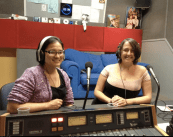
On Valentine’s Day, Kat Mayo and I spent a good part of our day travelling to 2SER studios for an interview on Love and Passion. Anyone that knows both Kat and me would know that we can talk about romance fiction for hours. Put us in front of a microphone and we will amp it up just that tad bit more. I recommend you get yourself a cup of tea, coffee, icecream, cakey and sit back and enjoy.

Love and Passion Show 116 on 2SER

Love and Passion Show 116 on 2SER

The show was aired on a Saturday and unbeknownst to me, one of my sisters went to my mum’s place and translated the interview to mum as it was being aired. During the break in the interview, I received a phone call from my mum.

Mum: When did you start reading romances?

Me: 32 years ago.

Mum: Really? So you just went on the radio to tell everyone?

Me: Yes mum.

Mum: Thank you for letting them know that I don’t read them. But you didn’t tell them I read religious books and biographies of saints.

Me: Sorry mum. I did consider it.

Mum: So what do you know about romance?

Me: Ummm…you know how I went back to uni last year?

Mum: Yes.

Me: That is what I am studying. I told you about it. And you know I read romances. You would always ask me to help you cook and clean and to put down “those romances”.

Mum: I didn’t think you were actually reading romances. I was being ironic.

There you have it. My mum, the original hipster.

Unlike a lot of romance readers I have met, I did not discover romances by finding my mum or grandmum’s stash. If anything, reading is not a shared activity for my mum and I as our interests are quite different. Not now and not when I was a younger either.

For many people, the thought of a parent not knowing what their children are reading seems to be anathema. It is equated as “not caring” or “how can you trust what they have chosen”.

I can tell you that both my parents cared that I was reading. Their main aim was to provide my sisters and I with ample opportunities to read and do homework. That is, ensuring that we didn’t have too many distractions – 1 doll, no video player, 1 TV, regular visits to the library and food at the ready. Both my parents were Greek migrants so Greek was the main conversational language in our home. My mum’s English reading skills were minimal (she worked a day job in a factory, a night shift as a cleaner, a weekend job as a cleaner, ran a boarding house AND raised 4 daughters) and though she was literate in Greek, due to her mindblowing superwoman working life, her rare chance to relax involved her knitting, tatting, gardening and reading the newspaper and the Bible. For mum, food and care was her bonding experience – as well as teaching me how to embroider which I still do on occasion. The only reading I remember sharing with my mum was when I would translate Paris Match from French to Greek for her when they had spreads on the Greek ex-royal family or an article on Cristina and/or Athena Onassis.

As my dad was highly literate in English, mum was quite happy to let him take charge of the homework and reading tasks. Though she did not know the content of the books I was reading, my dad did. Luckily, he was of the mindset that censorship of reading was wrong and never objected to the books I was reading that other friends’ parents were voicing concerns over. Thankfully, he trusted my choices.

My reading path was mine to choose. Influenced by my sisters, my teachers, friends, the books available at the library and my local newsagency, there was a joy in discovering my interests unfettered by close examination of the content of my books by my parents. This is something I try hard to emulate with my sons though it is difficult when you are a librarian to not be involved in their reading lives. Making opportunities for them to read is a much harder task. Gaming and computing distractions abound in our home and are much more addictive than the written word. To be fair, they have both hooked me onto Football Manager and I am crap at it. Its complex rules and processes make me weep for the simplicity of a linear narrative text. I no longer choose books for them. I stopped doing so when they were 8. Unless they ask I won’t read their choices. It is their private party, their little secret. Funnily, both of them at 11 years old have sneakily challenged me with “Mum, there’s lots of snogging and drug taking in the book I’m reading”. My reply has been “That’s good. Would you like something to eat?”.

I never thought of my romance reading as ever being secret. I never felt that they were my private party. I honestly thought I read romances openly for most of my life. That is until last week when I realised that it only took 32 years for my mum to come to the realisation that when she was shouting at me to put away those romances, her daughter was really, truly reading romances.

Things fluttered appropriately – an interview with Sandra Antonelli

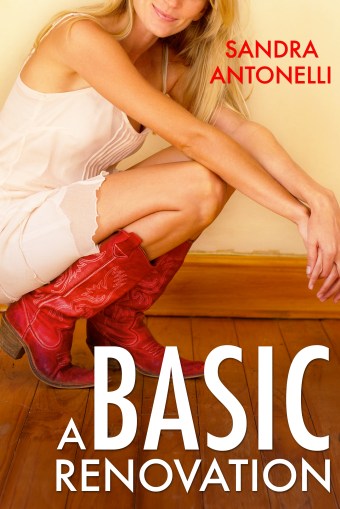
A Basic Renovation is available from Escape Publishing, the Itunes Bookstore, and Amazon.

A Basic Renovation by Sandra Antonelli

Two years ago, I met Sandra Antonelli through her writing on Twitter. Here was an author who I thought was funny, smart, relished earworms, rat terriers and spider scares, and could tell great stories all in 140 characters. Following her twitter feed was a given for me and she followed me back resulting in many interesting exchanges. Last week I ventured into reading her first published book with Escape Publishing.

Property renovator Lesley thinks she can combine a little business with her annual visit to her parents in Los Alamos, but that’s before she runs into Dominic. Single father Dominic, quantum physicist turned hardware store owner believes Lesley is A) poison; B) a lesbian who ruined his little brother’s life; and C) the detonator to a 50 megaton secret. What starts as cold fury turns into nuclear attraction, and naturally, they fall for each other, but can their love survive the fallout when Dominic’s little atomic bomb goes off?

This is a contemporary romance set in New Mexico, USA. I already liked Sandra’s writing style (why else would I have followed her on Twitter for so long) but would that style extend to reading a 314 page novel? I was nervous! Well, by page twenty, to quote her character Lesley, “things fluttered appropriately”. I fell in love with this story. And just a teeny weeny bit more in love with Sandra, who was kind enough to agree to being my first ever Shallowreader interview.

Shallowreader: Hello Sandra! Thank you for agreeing to be interviewed by me today. You are popping my interviewer cherry so please be gentle.

Sandra: ‪I’ll use coffee as a lubricant.

Shallowreader: ‪Oooh! Now you are even more appealing 😉

Sandra: ‪Coffee fixes everything.

Shallowreader: ‪Let’s get straight into your book – there were no cherries popped in this book. Tell me why you chose to write a romance with older characters than you find in traditional romances?

Sandra: A variety of reasons really. First, why not? I’ve always appreciated characters who had interesting life experiences. When I was thirteen I was reading about Jane Eyre and the second Mrs DeWinter (from Rebecca) and they were older than me. When I was seventeen I was reading about women who were older than me. Then in my twenties I was reading about women who were roughly the same age—and they bored the crap out of me because they were so inexperienced. By the time I was thirty I found it harder and harder to relate to the heroines in romance because they were younger with very little life experience under their feet. The harder I looked for a more mature-aged heroine, the more I was led to Women’s Fiction—which to me, is not romance. That annoyed me. Chronological age becomes irrelevant if the story engages you or the reader—if you connect to something. I wanted to read romance not Women’s Fiction ‘relationship’ novels about best friends and cheatin’ husbands. Writers are often told to ‘write what you know’ or to ‘write the book you want to read.’ So that’s what I started doing. I took that life experience and life baggage and jumped on the romance train.

‪Shallowreader: I’m so glad you jumped on that train! As a reader, women’s fiction and finding-one’s-true-self-due-to-broken-relationships books have never appealed to me either yet so few romances depict older women. Do you think cultural expectations (and by default publishers predicting readers expectations) still relate back to the juvenile attitude of “Ewwww! It’s like knowing that your mum and dad still do it“?

Sandra: ‪To some extent yes, there is that ick factor inherent for some. For others it’s a matter of ‘romance is fantasy and I don’t want an ageing body in MY fantasy’ or ‘I want to picture pretty, not as I am, I don’t want a reminder I’m getting older’. Then there are readers (like me) who are fine with more realism in the fantasy, fine with getting older and would like to see that translated into romance fiction. The heroine’s beauty/allure is in the eye of the hero; he finds her crow’s feet sexy or her big ass sexy. People over forty fall in love and have sex like demented bunnies. Why not have that fantasy in romance?

Shallowreader: ‪I agree. I have owned demented bunnies. I loved the part in the book where Dominic points to a hair that Lesley thought she had removed and their ensuing aging body banter. I swooned!

Sandra: ‪I think some people think, as one editor did, that forty plus sex scenes are gong to include long descriptions of sagging boobs and flaccid penises—which of course would spoil any romantic fantasy. As a side note here: One of my favourite romance novels has two romances running simultaneously. Jenny Crusie’s Trust Me On This—to me the more engaging romance was between Harry and Victoria and they were sixty somethings. Harry was so turned on by the sight of Victoria’s skin. It was fantastic! They deserved the entire BOOK!

Shallowreader: I was still in my twenties when I read Jenny Crusie’s Anyone But You. Her female character was in her forties and this was a non-issue for me as a reader as the story was wonderful. I feel the same way about Lesley and Dominic in A Basic Renovation. They are in their forties and this just makes the romance stronger.

‪Sandra: As I said earlier, chronological age becomes irrelevant if the story engages the reader. I have read a few twenty-something heroines who, because of their circumstances have more experience than most women their age, and those stories have enthralled me. In fact, unless it’s specified or it constantly hammers me in the face—which happens more than I like—I forget about the heroine’s age as I read. It’s, as you said, a non-issue because I’ve engaged with the story and the heroine’s age becomes irrelevant. Her age is not driving the plot; the romance is driving the plot. That being said, if I were to read a romance with a mature-aged heroine who was all wrapped up in her age and worried about ageing (and I’ve read two) I would feel hammered in the face. I don’t want to read about someone ageing, I want to read about someone falling in love and getting a happily ever after despite their age because that is what happens in life.


Shallowreader: Is Crusie a big influence on your writing? Who else has influenced you?

Sandra: I really love Elmore Leonard. He writes crime and Westerns. Some readers may know him. Movie lovers will know his work like Get Shorty, Out of Sight (and the oh-so-sexy boot/trunk scene with George Clooney and Jennifer Lopez) and Jackie Brown. He has the most fantastic characters and THE most sublime dialogue. Right now his work is on TV with the show Justified. I adore his character Jackie Brown from Rum Punch—she’s an over forty flight attendant/smuggler who beats the mob. Jackie’s awesome and I can only pretend my romance emulates Leonard. I admire Suzanne Brockmann, Rachel Gibson and Susan Elizabeth Phillips and Jo Goodman because they write such multilayered and engaging stories, so I supposed they influenced me though osmosis. Or I like to think they have.

‪Shallowreader: I certainly see the Elmore Leonard influence – particularly your dialogue. I love that she nicknames Dominic “Walks-with-hard-on” and the verbal slamming was great. Your use of “fuck” and flipping the bird just made me want to read more books by you. I saw, not only Leonard, but a touch of Tarantino too but without the blood and gore, just with all the juicy language and wit. And I found your book really funny. I struggle to find books that are funny. I think writing humour is the most difficult of all writing crafts as timing and intonation is key. The act of reading internally differs so greatly from dramatisations or audio books where the actors or readers help convey the humour. I was snorting and laughing out loud as I read through this book. Did you find the humour writing difficult?

‪Sandra: You’re being very nice to me. I’d like to see a Leonard-esqueness in my writing. My sense of humour is that of a 12 or 13 year old boy, but I have a rule when I write: Sort of. I try not to do fart jokes or poop humour because, while I appreciate them, I know they’re not, uh, everyone’s cup of tea. I laugh like hell when I write the comedy scenes, but I never know if someone else if going to find the scene funny. I can only hope the readers do. Your snorting and laughing out loud is a good sign!

‪ Shallowreader: Farts can even be romantic in the right context

Sandra: Yes, farts can be romantic if the situation is right–say like in a car…

‪Hang on….Tarantino? Me? Oh, if you could only hear MY soundtrack for A Basic Renovation…

Shallowreader: ‪That IS my next question! Music and food are a big part of your book. What would be your soundtrack to your book and what do you recommend your readers to eat while they read it. For the record, I ate lots of cashews and salt and vinegar chips while drinking rosé – I’m a classy shallowreader.

Sandra: ‪Salt and vinegar with rosé? Coffee. Coffee and cookies. Or Cherry Limes from Sonic. Or apple pies from McDonald’s (if only Oz MCDonald’s had the cherry pies!). Music…well, I had to edit out the references to the songs Lesley listens to because not everyone would care or know the music but I have a playlist. It’s a little long…

Shallowreader: Do share it!

Sandra: ‪Here are a few of the songs. Any more and we’d be here for a week.

  • ‪In-A-Gadda-Da-Vida Iron Butterfly–very important
  • ‪From My Head to My Heart Evan & Jaron Evan and Jaron
  • ‪Glory Days Bruce Springsteen
  • ‪Goodbye Girl Squeeze
  • ‪New Shoes Paolo Nutini
  • ‪Phantom Limb The Shins
  • ‪Buy a Dog LUCE
  • ‪Red Dragon Tattoo Fountains of Wayne
  • ‪Seven Nation Army The White Stripes
  • ‪Supernova Liz Phair
  • ‪Worn Me Down Rachael Yamagata
  • ‪Wounded Nik Kershaw
  • ‪You Can Bring Me Flowers Ray LaMontagne
  • ‪That’s Just What You Are Aimee Mann
  • ‪Trust Me To Open My Mouth Squeeze
  • ‪Fought the Law Bobby Fuller Four
  • ‪No I In Threesome Interpol

Shallowreader: Can I say that I started reading your book with a bit of trepidation. We have known each other for a while as we met on Twitter as romance reading and studying followers so reviewing a tweep’s book could have gone belly up for both of us, and you used my least favourite romance trope in that Lesley was married to Dominic’s brother over 16 years earlier. This always creeps me out yet in your book you address this relationship and it is an issue and it isn’t all resolved despite getting past Regis‘s point of ritual death and the betrothal. I was interested to see that you added one of her optional elements “The Scapegoat exiled”. You took this disliked trope and turned it around for me. You also left a couple of unresolved issues which I liked because life is not nice and tidy yet so many books end with a “life will be perfect from here on” view.

Sandra: They were married but not really married and not divorced….I liked playing with that. I like when an author can turn a trope on its ear. I hate Secret babies in Contemporary romance. I mean I really, really hate them, but Susan Donovan took the secret baby (Girl Most Likely To) and make it work for me, and like you, I was shocked that she reeled me in! I’m glad I did that to you!

Hitchcock said you don’t need to give every little detail, you simply have to reel the movie-goer in. It’s a MacGuffin of a sort, to have a few devices or hooks that keep the reader reading… And did you notice that Lesley thought Dominic was having an issue about her past with his brother/her ex Terry before she realised what the REAL issue was?

A very lovely, well-established author was kind enough to look at this book when I stated writing it. She told me she thought readers would have an issue with the two brothers thing—which made me all the more determined to keep it in! Even a character in the book, Fabian, Dominic’s buddy mentions this too.

Shallowreader: Do you kill fairies?

Sandra: ‪Nope. I like to be surprised. And it bugs me if there’s a ‘baby epilogue.’ Come on leave something to my imagination.

Shallowreader: ‪Baby epilogues don’t bother me – and I love a secret baby plot too .

I’ll finish with saying: Your book oozes romance on many levels, from Dominic’s son Kyle on his first dates, Lesley’s still in-love parents and her sharp-tongued grandfather with ‘tude courting a woman for the first time in thirty years, as well as the wonderful primary romance between Lesley and Dominic. Thank you so much for writing this book and for being gentle with my first time interview. I’d like to say that I lay back and did it for my blog.

Sandra: Thank you for reading it and thank you more for enjoying it, for laughing out loud, and thank you for letting me get there before anyone else! I used protection.

A Basic Renovation is available from EscapePublishing, the iTunes Bookstore, and Amazon.

You can find Sandra on twitter @SandrAntonelli

and Facebook http://facebook.com/AuthorSandraAntonelli

Emerging from January

All month I have had a number of posts stewing in my brain yet I managed to not write any of them until now – so this is a super long blog post.

January was a culmination of several events for me. I have finally finished my Certificate IV in Training and Assessment allowing me to teach in the TAFE system. I used to teach at TAFE 10 years ago when I was not required to have a qualification beyond Train the Trainer. I found the teaching rather harrowing as there were times I was being handed the lesson plan 10 minutes before the class itself. With this certificate I feel much more prepared – now to pick up some casual hours!

I completed a 10 thousand word assessment for university. Even as I sit here all I can think is that there is so much more I wanted to write. I could have easily added another 5 K. I’ve since met with my supervisors who are trying to convince me to move from a Masters program to a Doctorate program. They keep saying “doctorate” as though it is a forgone conclusion but for me it is a much harder decision. I’m loving the study but I am finding the whole parenting/studying/working balance difficult.  As much as I would love to be a Doctor of Rrrrrromance in libraries I may just settle to be a Mistress of Rrrrromance in libraries instead.

I managed to get slammed by an anonymous blogger called Annoyed Librarian over at Library Journal. There seems to be a badge of honour amongst a few librarian bloggers such as @ScrewyDecimal and @Catagator who have also been slammed. I felt spesh. Am I the only antipodean to merit this treatment *preen*?  The slamming came while I was in the midst of my 10K assessment and TAFE resubmissions. As much as I wanted to get in there and comment again I was a very good student and focused on my assessments. In brief, the blogger made a number of derogatory comments about housebound romance readers to which I questioned her professionalism. In the slamming, she questioned public librarians and readers’ advisors professionalism and how she was “happy to have a little fun goading romance readers and writers”. And here is the irony. My aforementioned 10K assessment is about the marginalisation of ordinary culture by cultural institutions – namely libraries/librarians marginalising romance fiction: Romance fiction and its authors and readers. I came across the first post in searching for more current examples of librarians showing derision towards the readers of the most highly read fiction genre. Not only had I found more evidence for my paper but by her responding in the form of another blog rather than a simple reply she gave me even more material. Just as I was thinking that perhaps the library situation wasn’t all that bad she gave me plenty of fodder that was instantly added to my research.

By the time I had a moment to make my own comment a number of people had already made enough comments rejecting her blog stance against public librarians so I happily did not leave my own. But here’s the thing: when her blog was first pubished I had a number of people contact me – some through public tweets and others through email and Twitter DMs in support of my comments, which I appreciated. But the comments and discussion outside of the official website will not remain part of a digital record. The comments dismissing the blogger for not having the courage to write under her own name, the comments dismissing Library Journal as a credible opinion source in the industry due to their validating a”library troll”, and the incredulity that there were still readers of the blog, are not part of an official record. Researchers in 100 years will be going to the industry stalwart, Library Journal, but how they will connect to the conversation that is happening in other online forums about their articles, particularly discussions held elsewhere as most librarians are hesitant to post comments on LJ as they know they will be the next librarian to be ridiculed? What sort of legacy of information will allow for these informal (yet illuminating) conversation to be found. I’ve been told that there is research into this question but I have become the lazy researcher at this stage of January and I haven’t searched for more information. If I find some links I will post them on a later blog.

Since I finished writing my papers 10 days ago I have chilled out with my kids, I’ve watched lots of TV – reruns of Coupling, Scrubs, Friends, Big Bang Theory and Ben Stiller movies. I love Hank Azaria in Along came Polly saying “Rueben, look me in the eyeball” and the extreme sports corporate Bryan Brown. After 366 books in 2012, I have begun 2013 in fine form and I have read only 2 books The Amorous Education of Celia Seaton by Miranda Neville which was lovely and A Basic Renovation by Sandra Antonelli which was fab fab fab and I will be writing a separate blog post for next week. My family and I spent a lovely week in Wollombi in the Hunter Valley at my sister-in-law’s farm. We swam in the dam daily, we watched kangaroos grazing, we played lots of Wii and generally did the holiday pleaser of nothing much.

Coming up, I am going to be on a romance panel on Valentine’s Day with Isolde Martyn and Jane Austen Society journal editor Joanna Penglase to discuss 200 years and the romance focus of Pride and Prejudice. I’m really excited to be involved in such an event seeing the pretty much universal appeal of the book. I’m pretty sure I have been asked along to bring in the contemporary romance tie-in. Though I liked Pride and Prejudice when I first read it I have not been part of the fandom. I have not reread it (but plan to before the event) and I don’t think much of Colin Firth. My husband really wanted to give our oldest son the middle name of D’Arcy, after his great-g-g-g-g-g-g-grandfather D’Arcy Wentworth, to which I objected as I wasn’t all that chuffed at naming my son after a highwayman despite the fact that he came good upon coming to the colony of New South Wales as the second fleet’s doctor and as a free settler (oh – the irony as my son tells me he would have loved to have D’Arcy as his name). In my research for this panel  I discovered the Lizzie Bennet Diaries just to discover my favouritest ever Darcy. I have become obsessed with this vlog and transmedia fiction. I follow the characters on twitter, I read Jane’s Tumblr and Lydia is totally understood. And the whole “Socially Awkward Darcy” meme is fun. And most importantly, The Lizzie Bennet Diaries have given me that jolt in my stomach. That feeling that romance readers get when they come across a couple that you know should be together, and despite the fact that I know there is a happy ever after, the anticipation that only a good adaptation and dramatisation can affect, that feeling that perhaps these two will not get past Regis’s point of ritual death. I do love the well retold romance.

366 books wrap up or how I will never ever ever again set a daily book reading target

It’s a few days into 2013 and I have finally looked at my 2012 reading. At the beginning of the year I stupidly set myself a target of 366 books in 366 days. Yes STUPIDLY. I had been doing challenges for several years but I decided to up the ante in the National Year of Reading. My definition of book was any publication with an ISBN. It did not need to be long narrative, it could be picture books, photo essays, interior decorating and cooking along with novels of any sort. By September I was ready to declare reading bankruptcy. I was setting aside nights for reading as well as spending a few hours a fortnight at a library. I found my casual reading had become a chore that was to be added to my many other tasks. This of course was ontop of all my journal reading and news reading and twitter reading and blog reading and work reading and report reading and all the other peripheral reading that comes with life. It was tiring. And all I can say is thank god for picture books and rereading for they were the only way I was going to meet my ridiculous target. And in particular, my rereading of old favourite romances that I had stowed away or found at op shops made me feel enlightened as I was viewing them with middle aged eyes when previously I had viewed them as a teenager. For some books, such as Charlotte Lamb’s Desire and Sara Craven’s Sup with the Devil I retained my love for them but others had not aged well over three decades such as Jo Calloway’s A Classic Love that I thought was totally romantic as a 15 year old but as a 43 year old I was horrified by the psychotic, stalker behaviour.

Oddly enough, I had 2 months where I was ill with severe asthma and I read less in that time than the rest of the year and I still met my target. It wasn’t all grumpy reader though. I did discover some amazing authors that I have added to my “must read” list.

Another thing that happened this year is that after 6 years of being on WeReads I transferred all my books over to GoodReads which has a social interaction that I never felt over at WeReads. This has proven to be both good and limiting for reasons that I won’t go into on this post. My actual reading is much broader than is represented on GoodReads and certainly I can’t list my favourite blogs so I am interested in keeping a list of my blog reading somehow and I am open to suggestions.

Here is a link to all my 2012 books: http://www.goodreads.com/review/list/4452547-shallowreader-vaveros?read_at=2012

As for some of my 2012 stats and my favourite reads of the year:

366 books:

137 novels (including graphic novels, junior and young adult novels)

160 picture books with 42 library storytime recommendations.

29 non-fiction narrative books and 44 non-fiction pictorial books (cookbooks, interior decorating, humour etc).

My first (It’s Always Been You) and last (Close Enough to Touch) books were by Victoria Dahl and I also read one other book (Real Men Will) by her during the year. All three were enjoyable reads (2 got five stars and 1 got 4 stars).

Most read author: Charlotte Lamb (10 books) followed closely by Sara Craven (8 books).

Gender:

Female  266 (49 Australian Women Writers)

Male 130

This number is a misrepresentation as I only counted the first author listed for each book which means some wonderful illustrators were not counted in the male/female divide. I am surprised at the high number of male authors though I think that the picture books I read may have skewed this number.

My favourite books

I read 77 five star books (and only 16 one star books) so I have chosen the wonderful titles that stand out for me. I have also chosen to list first time reads only and not to list any favourite rereads.

 Novels:

A Lady Awakened by Cecilia Grant filled me with wonder. Beautiful language, awkward sex and land economics. Wonderful!

Temptation by Charlotte Lamb. A retro romance read that with a lyrical first half and a vicious, bitter second half that tore the hero to bits. This book blew me away!

Easy by Tammara Webber. A book that had me anxious throughout. Beautifully written characters. Loved it.

The Devil and the Deep by Amy Andrews. I grinned throughout this book. A story within a story, contemporary romance with glimpses of a historical romance that the author character had written. A childhood crush, great dialogue and hot hot hotness. I nearly didn’t add this book as I wasn’t sure if I was influenced by the fact the author sent me a copy of the book but a week after I finished it I can’t wait to reread it.

What I Did For a Duke by Julie Anne Long. I loved the private discussions in this book. They were cheeky and made me anticipate each page.

Ride With Me by Ruthie Knox. The trans-American bike ride as the setting for this fab romance carried the story for me. I used google maps to follow the relationship.

Picture Book romances:

Lilli-Pilli: the Frog Princess by Vashti Farrer is gorgeous. It is a picture book historical regency romance with a ball and a handsome prince and overall awesomesauce.

The Fierce Little Woman and the Wicked Pirate by Joy Cowley is a pirate romance. A feisty heroine sparring with the pirate hero and sparks do fly. Spectacular!

Picture Books:

The Dreadful Fluff by Aaron Blabey. A book about killer belly button fluff being hunted down by a kickass heroine. Fan-bloody-tastic! Blabey is brilliant!

Hunting for Dragons by Bruce Whatley. I love Whatley’s books. Cool, ambling, fun!

King Jack and the Dragon by Peter Bentley. Ever so sweet a story of kids playing castles in their back yard. Gorgeous illustrations, heroic and fun with a touch of young child angst.

The Aunties Three by Nick Bland. Snarky fun. Auntie humour. This book may thrill me purely because I have 3 sisters and all our kids will relate to this fab book.

The Singing Mermaid by Julia Donaldson. As usual, the rhythm and rhymes of Donaldson’s books are perfect with a wonderful storytelling of a captive mermaid.