Reading in Action (that is two words) Challenge 2013

I am on the verge of completing my 2012 reading challenge. I set myself the aim of reading 366 books. I am currently reading number 365 and I am quietly confident that I will make my target. I will write a separate blog post about it. This post however is my challenge for 2013. I did not want to post it next week as it would strike me too much of a New Year’s Resolution and too easy to break.

I have spent the last 4 years doing reading challenges and book binges. I can honestly say that though they stretch me timewise, they do not challenge me as I love reading. I have noted that my reading was much broader 4 years ago when I look at previous years’ books. I now read romance novels almost exclusively but this does not concern me. 20 years ago I read literature almost exclusively. Reading preferences change over time. But what reading does is make me sedentary and this is not good. I need to get up, stretch, walk and exercise and I am going to do a Reading in Action challenge.

My Reading in Action challenge is the following:

To walk 5 kilometres for every book I read with more than 100 pages

To walk 1 kilometre for every 20 pages for books with less than 100 pages

To not start another book until I have completed my associated walking, the exception being picture books as I usually read 4 or 5 in a sitting at which point I will do the cumulative walking after the one sitting

If it is a rainy season, I will use my rowing machine as a substitute to cover the same distance.

I will continue reading at my own pace and I will keep track of books on Goodreads as I have been doing for many years (on WeRead before I moved to GR). I will specifically be noting my Australian Women Writer’s Reading and Reviewing books (AWW13) and following the www.readwatchplay.wordpress.com monthly themes but I am not going to set any targets.

I guess my next step after writing this blog post is buying a pair of walking shoes.

On reading, intelligence and heroes

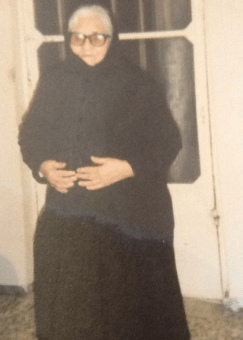
My grandmother

One of the most broadminded, intelligent people I have known was my illiterate maternal grandmother. My grandmother, orphaned by 17, had been widowed twice by the time she was 43, she outlived eight of her twelve children and was blind for her last five years of life before dying aged 86 after a number of strokes after severe radiation sickness caused during the Chernobyl disaster. She lived the majority of her life in the northern Pindus mountains of Greece; her only time away was the three years she lived in Australia with my family in the 1970s. My grandmother was kindly towards everyone. Even those that said hurtful things to her. She would encourage her kids to play with the gypsy tsingani kids when the Greek kids picked on them because their dad had died. She taught her children escape routes to bomb shelters and how to shelter in the snow. She opened her doors to people regardless of their ethnic or religious backgrounds – Turks, Germans, Italians and British even though a few of her children had died in battle due to their countrymen. She stood up to the husbands in her village that abused their wives. One occasion had her defending a beaten woman with “You have a blond baby because your wife is blond and your mother is blond not because she slept with a blond man. Look at your kin!”. She was a keen economist, measuring food stores for her large family, managing her family’s agricultural land and the care of their sheep and goats, calculating their winter needs, never running out of food yet having enough to help out families that never planned ahead. When villagers sneered and spat at her grandchildren’s partners for being unmarried and non-Greeks she would stand up and say “If they are in my home that means I accept them. And if I accept them you have no right to come near my home and behave in such a way”.

My mother, observing the village priest walking around with a rifle slung over his shoulder during the Greek Civil War, asked her mother “Why does the priest carry a gun?”. My grandmother answered “You never do as the priest does, you only do as he says”.

My grandmother, who could not read or write, knew that it was the words that mattered and not the format in which the words were delivered. My grandmother is a model of Popperian cosmology. My grandmother knew how to listen and understood that the words did not belong to those who said them. “You only do as he says”. She knew that this man standing at the pulpit was reading from The Bible and these were not his words. She understood that the products of thought were not associated with the person orating the thoughts. She considered the words she heard, she played with them in her mind and in her strong intelligent manner decided on how she would allow those words to affect her.

I have been reading a lot of books and reports this past year on reading and to a lesser degree, literacy. I have found there is a lot of rhetoric around about the power of the written word, how reading gives you access to new worlds, more empathy and a deeper understanding of humanity. Sometimes, when I am reading about the importance of literacy, I get this sense that illiteracy and low-literacy is equated with being narrow-minded, simple, weak willed and being a victim. As though, illiterate people lack intelligence, lack the ability to listen to stories with focus and to employ an analytical mind that engages and observes the actions and feelings associated with the story or the information that they are hearing. There isn’t any example I can pinpoint. This sense I get is implicit. I am mindful that having low literacy does not mean you are not engaged in culture and politics or that you are unable to feel empathy for others. I have met many literate people in my life who are bigots. These are people who read broadly, yet they make racist and elitist comments, belittling others because they feel superior in their intelligence. Do I think I am smarter than others because I can read and write? Not at all. Do I feel that I possess more empathy for others purely because I read a lot and that the reader of one book a year has less empathy? Once again, no. For we are made up of the whole of our experiences and not only those associated with the words we read. I do think that my reading provides me more sources to draw from and I feel fortunate because I can enjoy storytelling in both oral and written forms but this does not make me a more empathetic person. But we are in a world that values the written word over the spoken word. Even now, in the 21st century, the majority of examinations in schooling are still written. There is no oral examination for native students of English in Australia (at least that I am aware of). You could be a lively, expressive student with deep cultural knowledge and an enquiring nature yet if your handwriting is slow or clumsy you are most likely going to be awarded a basic mark and will be described as having limited knowledge. This injustice angers me, astounds me, upsets me. Low literacy is not a mark of low intelligence.

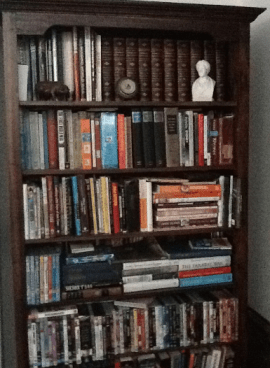
Nobel Prize winner George Seferis considered General Yiannis Makriyannis to be one of Greece’s masters of Modern Greek Prose. General Makriyannis is one of the heroes of the Greek War of Independence and only taught himself to read and write, at age 35, after becoming the General Leader of the Executive Authority of the Peloponnese after the war. He taught himself to read and write because he was frustrated at the misreporting of the War of Independence and he wanted to leave his memoirs, his account. I first heard about Makriyannis from my incredibly well-read father. When I look upon my father’s bookshelves I find Aristotle, St Paul, Shakespeare, Boccaccio, Dante, Georgette Heyer, Dale Carnegie, Cicero, Grace Metalious, Patrick Dennis and tomes of encyclopeadias that he would read cover to cover. My dad never received any formal schooling. He grew up high in Central Greece’s mountains in a shangri-la. He taught himself to read when his village priest allowed him to access the church bible and the psalter and he received an occasional lesson from a passing teacher. His first formal education came with being drafted to the army where he was given charge of Sunday ecclesiastical lessons and the army sponsored his entry to study theology at the University of Athens. He completed 2 years of his studies before migrating to Australia. My dad, having taught himself to read and write in Greek, proceeded to teach himself to read and write in English and prided himself for being a white collar worker. I remember visiting him in his office in East Sydney where he sat at his desk puffing away at his cigarettes, ashtray piled high and his secretary at the desk next to him. My favourite story about my dad’s obsessive reading is from my uncle Arthur. It was the late 1950’s and my dad’s sister had been worried for she hadn’t heard from him for over a month so she sent her husband in search of my dad. My uncle Arthur asked around and discovered that dad was renting a bedsit in Kings Cross. He knocked at the door, when it opened from a thick plume of smoke emerged my father. My uncle asked him “Where did you disappear to?” to which my dad exclaimed “Into my books!”. Now, I realise there was a certain insensitivity in that my dad forgot to contact his sister to even say hello but imagine the glory of uninterrupted reading, drowning in the sea of storytelling. And as funny as this story is, the fact remains that his reading did not make him empathetic as to the needs of his worried sister.

There is not doubt that being literate, being well-read, opens many doors and gives people opportunities that would have been impossible without the skills to read and write. I am always grateful that I was born at a time, in a place and to parents, where learning to read and write was a core necessity as it is a skill that has given me many opportunities. Literacy programs are a necessity as they empower people in our print-based culture. But I am always conscious that being literate does not make me kinder, smarter or more motivated than someone who isn’t highly literate. When there is a call to promote a love of reading as a literacy tool, librarians, booksellers, publishers, authors, educators, all of us bookish souls must take care to not diminish the visual, aural, oral and personal experiences, as well as the intellectual capacities of people with low literacy for not only are they our equals but in many instances far surpass us as they have navigated a contrary life.

Scholarly publication

Screen shot 2012-12-10 at 1.27.38 PMLast week I had my first scholarly journal article published. It is called the Romance Reader and the Public Library and it has been published by The Australian Library Journal Volume 61 No 4 in their Special Issue on Reading.  The abstract is included at the end of my blog. This paper is an amalgam of my Supping with the Devil that is romance fiction talk at the ALIA Biennial Conference and my What the Librarian Did talk at PopCAANZ.
This article is available through public library database subscriptions, university libraries and ALIA membership. It is not free to the web. If you are going through your public library (in Australia) you will need to log on to the “Australia/New Zealand Reference Centre”. Please contact me in the comments if you are having difficulties (or ask your local librarian to show you how to log in). Is there method in my madness? Damn it – yes! I expect you all to have a library card. If you don’t – go out and get one today. This is a blog about romance fiction AND libraries, after all!

Abstract:

Romance fiction, romance authors and readers have been routinely marginalised, in spite of their significant role in contemporary popular culture. Sales figures for the book trade indicate that romance fiction is the most popular of all genres with ebook technologies being led by romance and erotica publishers. Yet, many public libraries have not collected romance fiction or collect only token examples of this genre. Drawing from data in the Australian Romance Readers Association annual survey on reader usage, this paper will discuss how the romance reader accesses their reading choices, impediments to the romance reader accessing reading materials, and the role of the public library and how library practitioners, through Readers’ Advisory practices, can meet the romance reader’s needs.

Bookshelfporn….or is it?

Close to 18 months ago I was approached by those wonderful erotica authors Rhian Cahill, Lexxie Couper, Jess Dee and Sami Lee over at Down Under Divas to write a guest blog for them. I spent a month struggling to think of something….and then I wrote this:

BookshelvesI’ve been thinking and dreaming about bookshelves for many years. And I think that, for most readers, this is quite normal. So, when I discovered the Tumblr site BooksShelfPorn. I found myself in the midst of ecstasy. Everyday this site gives me the short satisfying pleasure of viewing bookshelves from around the world; in bookshops, libraries, marketplaces and in private homes.

These are images that excite my visual senses, they tease me with their sexy lines, their tight corners and the promise of discovering reading sensations. Soft-focus photographs bring to life the much used, much handled, bookshelves fondled by the hands of many lovers, and the newer buildings, with untouched, erect shelves, standing proud, beckoning, open wide to virgin crowds pouring over their tomes.

These images are just fleeting dreams, and though I fantasize about visiting these bookshelves, running my hand along their banisters, mounting their stairs and losing myself in the sumptuous moment of being surrounded by unknown books, I can only sample some of their wares. Some will leave me wanting, some will not be satisfying and yet others leave me gasping for more… but this voyeurism is only momentary.

However, my own bookshelves, I would never call Bookshelfporn. I have a relationship with my bookshelves, they have served me as I have served them. I have run my hand along my rows of books, gently fingering their spines, lovingly turning their pages, hearing their words whispered in my ears. These wonderful, hard, timber shelves hold up my books that I have chosen to keep close forever, positioning them for my pleasure, my exultation in their words and my revelling in the fortune that they are mine.

Some of my books are old, weathered and loved, other books are newer but all of them have touched my heart, captured my soul, and have allowed me to lose myself in the ecstasy of reading their pages until that breathless moment when the world goes quiet at the sound of a book reaching its end. And then, I gently find a space on my still-rigid shelves who will keep my love safe. For what I feel for them is not gratuitous, it is not a fleeting slamming of books against shelf waiting for the next patron to try them out. It is the thrill, the joy and the comfort that the bookshelves, and all that they carry, are a part of me. For this is Bookshelferotica.

*Originally posted here: http://downunderdivas.wordpress.com/tag/bookshelf-porn/

My books are worth their weight in silver

Like most homes, we have a small stash of 5 cent, 10 cent and 20 cent coins that pile up in a coin jar. This coin jar is used regularly so there is rarely any more money than five dollars in it. My youngest son can only take canteen money from that jar to pay for his garlic bread or frozen oranges  and I get to use my handful of silver when I head down to my local opshop/charity shop.

Books at my opshop cost anywhere from $1 to $5. I will often throw some coins in my bag and head down to buy myself a book. When I did this today, I was overjoyed to find some Charlotte Lamb, Carole Mortimer, Anne Mather and Penny Jordan reprints on sale. These were reprints from their later books but even these reprints are nearly 10 years old and out of print. I counted my silver and found I had enough money to buy 3 books, all with 2 novels in each binding. I chose the ones I would buy, went to the front of the shop and waited to be served. The woman ahead of me was buying some interior decorating magazines. These were being sold for $1, too. There was a woman hovering to my side and when it came to my turn to be served she said to the woman at the checkout “Give her the Mills & Boon 3 for a dollar. I just want to get rid of them”. It turns out hover woman was the manager.

Now her comment took me aback somewhat. This is an opshop. Is there a place for snobbery in an opshop? I expect a certain egalitarianism from my opshop. I have often seen Target shirts hanging beside Ben Sherman shirts here. I have seen Sportsgirl skirts next to Jigsaw skirts. Frankly, my Mills & Boons, clutched closely to my bosom, had, just moments ago, been sitting on a shelf alongside John Banville’s the Sea and V. S. Naipaul’s Half a Life (ah! the sweet irony that they still sit on those shelves unpurchased). Isn’t shopping at an opshop an opportunity to give to a charity while benefitting from finding an item that is no longer easily purchased from mainstream retailers? For others it is a way to dress and clothe themselves while on a tight budget and for others it is a thumbing it to the big corporates in an attempt to be alternative.

Now this opshop only had 20 M&B titles which is quite a low amount in comparison with the opshop in the neighbouring suburb which has hundreds. And this was a good day! It often has none. Though on the one hand I was quite excited at the lower price so I hurried over to the shelves and chose another 6 books and bought 9 books for $3 (which being doubles means that I scored 18 new books today!) I was also angered. I wanted to shake my fist at the sky and shout “How could you denigrate these wonderfully written books. How could you value them less than a three year old tattered House and Garden”. But I didn’t. I did make a comment about literature snobs after I gave her my pennies.

I am offended on behalf of my reading love. My offense won’t last long as you develop a thick skin as an out-of-the-closet romance reader. But I choose to be affronted when my reading choices meet disdain, scorn and ridicule. I am going to love my books. And they are worth their weight in silver.

Postscript: Like most people, I buy my books from a broad range of places. Retailers, online, markets, opshops and second-hand bookshops. In anticipation of anyone reading this accusing me that if I felt that strongly about Mills & Boon why don’t I buy them new I would like to say that I only buy my in print Mills & Boon at full retail prices. And they are the books that are worth their weight in gold.

Crying

As a readers’ advisory librarian, you get asked for book recommendations that are sometimes quite difficult to find. For me the hardest was finding romances that would not make my borrowers cry. Read more about my experience over at Love2Read.

Schmoozing with a Smart Bitch and a vulgar amount of name-dropping

Up until last week, I had not attended a high tea since 2000. 12 years ago I had the good fortune to attend a high tea in the Queen’s Ballroom whilst journeying through the Whitsunday Islands along the North East coast of Australia on a leg of the millenium world cruise of the QE2, as one does. There were marvellous sandwiches, petit fours and loose leaf tea served in fine bone china teacups. It was all very very proper. A string quartet played while well-dressed couples danced to music from the early twentieth century when I was asked if I would like to dance and I found myself doing the cha-cha with a gentleman host beside the Queen’s bust.

This is a travelling highlight for me and I had not felt the need to go to another high tea as it would be a hard act to follow. But last week I finally attended one as Sarah Wendell from Smart Bitches Trashy Books was attending along with a number of romance readers, writers and bloggers. It was a loud and raucous afternoon spent with some fabulous women and a lot of fun was had by all. Sarah Wendell was in Sydney as an international guest for the inaugural Genre Convention and I was fortunate enough to be asked to be on a panel discussion with Sarah. The panel was called Not Just a Narrator where, along with Sarah, speculative fiction author Kirstyn McDermott and Harlequin Escape managing editor Kate Cuthbert, we spoke about the many people who promote books and reading, on and offline, from authors, bloggers and librarians *cough* yours truly *cough*. I spoke about the collaborative work NSW librarians and the NSW Readers’ Advisory group are doing to promote readership in developing their monthly themes, facilitating a monthly twitterchat group and blogs Love2Read2012 for the National Year of Reading and next year’s readwatchplay. As the sole librarian speaking at the convention, and only my second non-library talk, I was eager to see how libraries fit into the broader reader, author and book industry discourse. In my opinion, the library aspect was well received and it intersected well with the blogger and author experiences being relayed by the rest of the panel. I think that we need more librarians being part of readers conventions, literary festivals and book fairs as there is a natural overlap for these industries.

The convention itself was fantastic. With a swathe of amazing Australian authors discussing their readership and their craft, the atmosphere was exciting. I heard several of the speakers discussing that we are in an era of writing abundance and it was evident with the number of aspiring, emergent and established authors present and the fabulous editors and publishers that enable their work to be distributed broadly. There were so many fabulous people I spoke with such as Anna Campbell, Shannon Curtis, Christina Brooke, Kat @bookthingo, Rosie @fangbooks, @Rudi_Bee, Kate Eltham, Peter Ball, Denise Rosetti, Bronwyn Parry, Nicky Strickland, Kylie Mason, Haylee and Lilia from Harlequin, Caitlyn Nicholas and many more (and my apologies if I didn’t mention you).

However, I cannot be blasé about Sarah Wendell. Sure, I’d be much cooler if I didn’t gush all over her on my blog. But I have never been a cool kid and I think Sarah was lovely and funny and so generous with her time despite her concerns for her family and friends in the wake of hurricane Sandy. Back in 2008, I gave a Romance 101 presentation at the NSW Readers’ Advisory annual seminar where I introduced the Smart Bitches blog (and a number of other romance literature resources) to over 140 librarians. So to find myself four years later, onstage speaking with Sarah has been a career highlight.

There was no Queen’s ballroom or Queen’s bust, there weren’t any views of the South Pacific or tropical islands and there were no gentlemen hosts or string quartets. But we did have Tim Tams and lamingtons, and there was snark and there was awesomesauce. And it ranks up there with my high seas high tea cha-cha.

Doing justice to Desire

The other week I guest posted a Five Word Review on Charlotte Lamb’s Desire. The review reads “Drunk Fuck Pregnancy Equals Luurve”. I stand by this review. It relays the exact premise of the book. But what it doesn’t relay is the love I have for this book.

The heroine, Natasha, gets drunk after breaking up with her fiance. She goes out with friends and becomes uninhibited after drinking champagne and takes off with a hottie called Lee Farrell with whom she has a one-night stand. When she wakes up the next morning she is mortified and he drives her home upset that it was the alcohol and not her desire for him. She falls pregnant and doesn’t keep the baby secret. Inevitably they marry for convenience but are stand offish and suspect of each other until the grand grovel and love reveal at the end. It is a fab read that very much reflects the mores of the early eighties.

I have reread Desire at least once a year for the past 25 years and I still love it. Published in 1981, the year that Charles and Diana married (why is this relevant), the protaganists have a 16 year age gap (Charles and Diana had a 13 year gap so it is relevant to set it in context) which I find irksome when the heroine is 17 but seeing that 20 is my tipping point into acceptability these two characters are fine by my measure as she is 21 to his 37.

The standout for me is that Natasha has been brought up conservatively and to believe that love is soft and gentle. After breaking up with her fiance “Natasha had always played the submissive, female role…” it is through alcohol that she feel uninhibited. She feels desire and she matches Lee’s desire as an equal.

She had been conditioned to see herself in that yielding female role, to accept the qualities which society expected in a woman, to be soft and gentle and pliant, to submit and give what was demanded. She had not been taught to demand in her turn, to be strong and self-sufficient, to claim her right as a woman, to match the male on her own terms

It is paragraphs like these that I feel are lacking from many romances today. As a 12 year old the sex flew over my head. However the concept of not being subservient, not being shy and reticent, stating my terms and refusing to compromise those values is what stays with me. It is finding a partner who matches you, not a partner who subsumes you that clicked in my reading.

They start conditioning you when you [are] in your cradle

                                                                                        Natasha

My belief is that many romances (particularly from the 70s and 80s) may write what at face value is an unbalanced relationship but it is the reading between the lines that I am interested in. The relationship may fade but the knowledge that with this man, Lee Farrell, Natasha feels strong and self-sufficient yet with others she was submissive. Natasha recognises society’s expectations of her and chooses to not adhere to them but it takes courage to do so.

The book is pretty much angsty from beginning to end. Angsty in that good, melodramatic way with fainting, fisticuffs, jealous fits over beaux and belles, alphabrute chest beating and other ridiculous misunderstandings that drive the story.

You have some crazy notion that love and sex are separate issues

                                                                                                           Lee

This book is about sexual love. Not a love of companionship which no doubt will eventuate in years to come but a love of physical desires firing the soul and Charlotte Lamb’s aim is to allow Natasha to not feel shame and guilt for her sexuality. The book also gives a passing nod to Jane Austen’s Pride and Prejudice for that is really what drives their inability to communicate. Natasha is prejudiced against Lee believing in his public image rather than the man she was attracted to. Lee’s pride takes a battering every time Natasha claims she loved Mike, her ex-fiance, and she was ashamed of her actions with Lee and, as is expected in a Mills and Boon, these issues are resolved at the end of the book in their declaration of love for each other. But not before Lamb uses Natasha as a vehicle to remind the reader

Men have organised the world for their own convenience for years. They made the laws, moral and otherwise, and it was men who sold women the idea that sexual desire is okay for a man but shameful for a woman

I believe that Lamb uses romance to subliminally embed ideas of feminism in her reader’s mind (remember its 1981 publication date). But even more importantly, she uses Lee to remind the reader it is love in its many variations that drives us

Love is what we want it to be, what we need. It doesn’t have any rules. There’s no such thing as law or morals where love is concerned. It’s just a question of feeling, of real emotion, of caring for one person rather than another, of needing one person rather than another.

The reader, social media, exosomatic stores of knowledge and a brand new made up word

I have been thinking about social reading, the move from an information society to a communication society and the impact that this shift has on our understanding of the exosomatic stores of knowledge. Karl Popper’s third world, his “Objective Knowledge” explains that exosomatic stores of knowledge have an existence independent of those who created them. I’m going to go all “My Big Fat Greek Wedding” here and point out that exo comes from the Greek word meaning out and somatic comes from the Greek word for body thus exosomatic being knowledge no longer contained within the body. In the mid 20th century Karl Popper conceptualised objective knowledge as the knowledge that is held in books, libraries, galleries, museums, archives and records. Once these creations were independent of their creator they could not be controlled by their creator and the user could interact with objective knowledge anyway they chose.

So a book would get published and sent into the bookshops, libraries and homes of readers and potential readers. As soon as that author signed off on their final manuscript they no longer had any control over their book and its use. If groups of people wanted to meet up at their local library to talk about the book, unless the author lived in the next town or was on tour and invited to attend, the discussion was purely about the users relationship with the author’s exosomatic brain (the object that he/she conceptualised and produced). Even a published correspondence between an author/artist/creator and a critic became a part of the exosomatic knowledge store.

However, with digital media exosomatic stores are much more vulnerable. Creators can make changes through the removal or editing of information through DRM (which ends up being an even bigger topic but for the purpose of this blog piece, only a tangent) but they can also influence changes that cannot be tracked. That is, the creator blurs the exosomatic knowledge stores. Last week, @Liz_Mc2 posted about authors misusing their influence to get readers and reviewers to change their negative reviews and that she doesn’t feel it is good customer service to contact the reader/reviewer. Read her post “Hey Author, I don’t want to be your ‘Customer'” As I have been known to do, I start a comment on Liz’s blog that ends up as a slightly related blog piece over here. Thankfully, most authors have the good sense (and possibly their publisher’s advice) to never comment on reviews or reader discussions. However, a small minority of authors view approaching readers and reviewers on third party social and commercial aggregators such as Amazon and goodreads as “good customer service”, others take the simplistic view of “If you don’t agree with me you must be simple so I will explain it to you a gazillion times – as an author I can intervene in any conversation about my work” without realising that it curtails dialogue. In the example that Liz disucsses the author in question feels that through approaching the writers of negative reviews and coercing them through dialogue to give her books a higher rating she is performing a “good customer service”. This is loaded with problems. The first of which I will illustrate with a hypothetical question I posed to my 14 year old son and his friend:

You create a Facebook group to discuss your favourite TV show. You post discussions about the show and one discussion has you bringing up some lines that you both hated. The writer of the show joins in and explains why he wrote those lines. How do you feel?

BOY 1: Flattered!
BOY 2: That would be really cool!

The writer has very politely told you why you are wrong for disliking those lines he wrote.

BOY 1: That’s cool too. You can defend your work.

The writer has told you that as he has explained why you are wrong that you should delete your comments (on your FB group not the TV show’s). How do you feel?

BOY 1: I’d consider him a dick.

Would you do it?

BOY 2: No. And I would probably stop watching his show.

I love teens. They understand the implications quicker than most adults (though they might not be able to articulate them without the use of genital expressions).

The implication is that a creator can try, and in many instances succeed, to control his/her product when it is no longer somatic. And the more concerning problem is not whether readers, reviewers, recommenders, bloggers or commenters choose to change their opinions due to undue pressure from the creator but the lack of being able to follow the thread that led this decision to be made. In most cases the original work is being altered rather than a postscript stating the changing view. I have no issue with people changing their mind about a piece of work. Hell – my Goodreads profile states that I reserve my right to make changes at a whim. But then I put my Information Science cap on and I start grappling with the implications of these unrecorded changes. Whether they are due to a whim, a genuine change of mind or due to intimidatory practices that vary from passive aggressive to outright stalker behaviour from a creator there is no way that a dissenting voice can be researched by future historians. The only record they will see is the last one that was edited. Digital records may be preserved such as through the Pandora project but emails on individual creator’s computers are not likely to be attached to digitally preserved sites. The process of thought, the growth of knowledge and understanding, dissenting views, open dialogue and even the pivotal moment where a view has been changed is no longer traceable.

In an age where we are shifting from an information to a communication society, I believe we have transcended the exosomatic stores and we have shifted to a metasomatic (and yes – I made up this word for the purpose of my blog) stage where we need to question the pathways that led to digital information and opinions on social media and commercial review sites and their veracity. Metasomatic stores, in my mind’s definition is where the knowledge has exited the creator but the creator, through digital interactions can still manipulate it’s use but without hard evidence. Can this behaviour be halted? I don’t believe it can be halted. But it can be acknowledged and understood. Unless it is published by a source independent of the creator and third party aggregator, such as digital publishers, due to the poor behaviour of the few intimidatory creators, reviews from unknown persons will always be read with cynicism and doubt. Let’s just hope that future historians will be aware of these issues and will take the same stance.


*Added a day later*

I realise that I have muddled up my exosomatic brains and knowledge and stores. My only excuse is that I wrote the comment-turned-into-blog at midnight. At this stage, I am not inclined to change anything as I was playing with an idea and not writing a factual essay.


Growing Up: Reading 7 Up style

It is a 7 Up year. The premise of Michael Apted’s 7 Up of “Give me a child until he is seven and I will give you the man.” sparked an interest in me. I decided to explore my favourite books at the 7 Up points and see if the child reader I was at 7 shows you the adult reader I have become.

7 years

My absolutely favorite book was Bennett Cerf’s Book of Riddles that I thought were hilarious and Edward Lear’s Book of Nonsense. I read out the jokes section of the library (793.7). I also read fairy tales and Aesop’s Fables. Humour, happiness and absurd writing appeals to my sense of ridiculous.

14 years

My reading obsession was well and truly established. I loved MAD Magazine and stole as many as I could from my cousin John (who tells me he was aware of what I was doing and felt that every MAD reader should steal their first copies). I loved reading Elizabeth Enright, Edward Eager, Eleanor Estes and the beautiful fairytales of Eleanor Farjeon. I loved Archie comics (love triangle though I like Betty best). By 14 I had outgrown my love of Sweet Dreams and had only just embarked on reading Mills and Boon, Candlelight Supremes and Silhouettes. I loved teen fiction – Judy Blume, SE Hinton and Paul Zindel. I had also just discovered scaring myself with Horror reading. Stephen King, James Herbert and Virginia Andrews. Though I liked ghosts and magic I liked them firmly based on reality and I was never interested in alternate fantasy worlds.

21 years

At 21 my reading was deep and meaningful. I read Euripides and Aristophanes, I turned my nose up to Roman writers (how stupid was that). I read Milan Kundera, Gabriel Garcia Marquez, Isabelle Allende, John Irving, Tama Janowitz and Spalding Gray. I would spend hours talking about the meaning of life and the art of writing. I was a tad hipster. I had ceased reading any crime and could not bear gruesome murder description in my books. Meanwhile my category romance reading remained healthy though I never read larger romances. My opinion at the time was that if you couldn’t write a romance in 180 pages you were a waffler. Also, I didn’t consider the longer stories to be romances. They were novels along with all other books on the Fiction shelves. Marketing, genre identification and stereotyping books had not occured to me as the libraries I worked in shelved books in a democratic, non-judgemental rollcall of authors.

28 years

By the time I was 28 my interest in literature had started to wane. I found the soul searching frustrating, the deep insights snort-worthy and the storytelling stilted and uninspiring. I was searching for joyful reads and the sense of a silver lining was not delivering what I needed. I had found Janet Evanovich by this time and I loved her hilarious books. I also had discovered Jennifer Crusie whose books were completely different to my previous Category romance reading. I also had lots of people recommending Chicklit to me but I never managed to engage with chicklit. Helen Fielding and Marian Keyes were both OK but they lacked the relationship intensity of category romances. My opinion of waffling longer romances still remained but I continued reading literary fiction.

35 years

These 7 years I refer to as my black hole reading years. I had 2 babies and had no time to immerse myself in novels – for the first five years that included the shorter category romances. I read a number of history books, particularly the Penguin Atlas of history series. I enjoyed dipping in an out of non-fiction and I didn’t have to invest time in emotional connections with fictional characters. My reading was centred on picture books and board books. I loved searching for books that would bring chortles of laughter from my toddlers. This is quite a hard task. To date, our favourite funny reads have to be Sandra Boynton’s Red Hat, Blue Hat and But Not the Hippopotamus and Peter Catalonotto’s Matthew A.B.C. In the last couple of years I started reading novels again and discovered Suzanne Brockmann’s category romances. My love for her books led me to reading *shock horror* longer romances.

42 years

It is the eve before I turn 43. My last 7 years of reading have involved me becoming a readers’ advisory librarian and my whole reading life has been turned on its head. I won’t go into my non-book reading here but let it be said that I read non-book items much more than books. My fiction reading has shifted to almost exclusively romance reading. Unlike previous years, I now read longer romances and adore them. I no longer consider them waffle but they are also less intense than category romances which I still read but lately I have become disinterested in them. It took me many years to develop but I now love historical romances. Perhaps because they still allow for tension and courtship which I find is less common in contemporary romance. What I love most is the euphoric joy I feel at the end of a well-written heart rending romance.

7 Up Sum up

“Give me a child until he is seven and I will give you the man.”

Upon first glance, one could say that my reading at the age of 7 is wildly different to my reading today. However, for me, it is comedy and happiness that is my reading gateway. Pamela Regis expanded definition of the romance novel in “A Natural History of the Romance Novel” places romance within the broader genre of comedy. Which takes me right back to being 7 years old and reading out the 793.7 jokes and riddles section of the library. So for me, my reading at 7 is a reflection of me as a reader at 42.