Australian romance authors – how many have you read? VaVeros’s list

So I’ve been a lazy blogger and done a straight cut and paste from Bookthingo. Read on!

How many Aussie romance authors do you know?

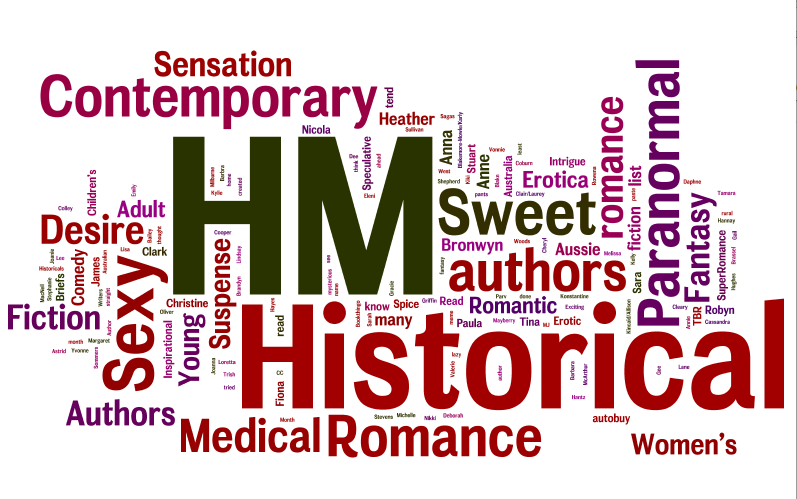
Australia is home to a lot of talented authors in the romance genre. Here’s a list of romance authors from the Romance Writers of Australia website. How many authors do you know?

Authors in BOLD are authors you’ve tried at least once.
Authors UNDERLINED are in your To Be Read pile.
Authors in ITALICS are authors whose work you’re planning to try soon.
Mark autobuy authors with an asterisk (*).
If an author has written a keeper for you, add the book title next to the author’s name.

This meme was created to celebrate Aussie Author Month 2011.

1. Alison Stuart – Historical
2. Alli Kincaid/Allison Rushby – Women’s Fiction, Young Adult
3. Ally Blake – HM&B Sweet, Sexy Sensation
4. Amy Andrews – HM&B Medical
5. Anna Campbell – Historical
6. Anna Cleary – HM&B Sexy Sensation
7. Anna Jacobs – Historical Sagas, Contemporary
8. Anne Gracie – Historical, Romantic Comedy
9. Anne Oliver – HM&B Sexy Sensation
10. Anne Whitfield – Historical
11. Annie West – HM&B Sexy, Sexy Sensation
12. Astrid Cooper – Speculative Fantasy, Paranormal
13. Barbara Hannay – HM&B Sweet
14. Barbra Novac – Erotic Romance
15. Beverley Eikli – Historical Intrigue
16. Bronwen Evans – Regency Historicals
17. Bronwyn Jameson – HM&B Desire
18. Bronwyn Parry – Romantic Suspense
19. Bronwyn Stuart
20. Carol Warner – Rural, Contemporary
21. Cassandra Cornell
22. Cathleen Ross – Erotica, HM&B Spice Briefs
23. Cathryn Brunet – Contemporary
24. CC Coburn – HM&B American Romance
25. Charmaine Attalla
26. Cheryl Wright – Romance
27. Christina Phillips – Ancient Historical Romance
28. Christine Stinson – Women’s Fiction
29. Christine Wells – Historical
30. Claire Baxter – HM&B Sweet
31. Daphne Clair/Laurey Bright – Historical
32. Deborah Challinor – Historical fiction
33. Denise Rossetti – Erotica
34. Dora Braden
35. Eleni Konstantine
36. Elisabeth Rose – Contemporary
37. Elizabeth Rolls – HM&B Historical
38. Emily Gee – Fantasy
39. Erica Hayes – Fantasy
40. Fiona Lowe – HM&B Medical
41. Fiona McArthur – HM&B Medical
42. Gail Symmonds – Time Travel/Historical
43. Heather Boyd
44. Heather Brown – Historical
45. Heather Garside – Historical
46. Helen Kirkman – HM&B HQN
47. Helene Young – Suspense
48. Isolde Martyn – Historical
49. Jan Colley – HM&B Desire
50. Janet Woods – Women’s Fiction
51. Jennie Adams – HM&B Sweet
52. Jennifer Brassel – Contemporary, Young Adult
53. Jess Dee – Sexy romance
54. Joan Kilby – HM&B SuperRomance
55. Joanie MacNeil
56. Joanna Challis – Historical
57. Kandy Shepherd – Romantic Comedy
58. Karlene Blakemore-Mowle/Karly Lane – Romantic Suspense
59. Kate Loveday – Contemporary, Historical
60. Kelly Hunter – HM&B Sexy Sensation
61. Keri Arthur – Urban Fantasy, Paranormal
62. Keziah Hill – Erotica
63. Kiki Lon – Young Adult
64. Kirsty Brooks – Crime Comedy Romance
65. Kylie Griffin – Paranormal Romance
65. Laura O’Connell – Inspirational Women’s Fiction
66. Lilian Darcy – HM&B Medical
67. Lillian Grant – Romance
68. Lisa Heidke – Women’s Fiction
69. Loretta Brabant – Contemporary
70. Louise Cusack – Fantasy
71. Lucinda Brant – Historical romance & mystery
72. Lucy Clark – HM&B Medical
73. Lynsey Stevens – HM&B Sweet
74. Maggi Andersen – Historical
75. Maggie Nash – Erotica, Paranormal, Suspense
76. Mandy Magro – Australian rural fiction
77. Maree Anderson – Paranormal, speculative fiction, fantasy
78. Margaret Tanner – Historical
79. Marion Lennox – HM&B Medical, Sweet
80. Mary Hawkins – Inspirational
81. Maxine Sullivan – HM&B Desire
82. Melanie Milburne – HM&B Medical, Sexy
83. Melissa James – HM&B Sweet
84. Michelle Douglas – HM&B Sweet
85. MJ Scott
86. Nicola Marsh – HM&B Sweet, Sexy Sensation
87. Nicola E. Sheridan – Fantasy / Paranormal romance
88. Nicole Murphy – Paranormal
89. Nikki Logan – HM&B Sweet
90. Noelene Jenkinson – Contemporary
91. Paula Roe – HM&B Desire
92. Paula Vince – Exciting, mysterious and suspenseful romance
93. Rachel Bailey – Silhouette Desire
94. Rhian Cahill – Erotic Romance
95. Robyn Donald – HM&B Sexy
96. Robyn Grady – HM&B Desire
97. Rowena Cory Daniells – Speculative Fiction, Children’s
98. Sandy Curtis – Suspense
99. Sara Bennett/Sara Mackenzie – Historical, Paranormal
100. Sami Lee – Contemporary
101. Sara Hantz – Young Adult
102. Sarah Mayberry – HM&B SuperRomance, Blaze
103. Sharon Archer – HM&B Medical
104. Shona Husk – Paranormal
105. Stephanie Laurens – Historical
106. Sophia James – Harlequin Historical
107. Suzanne Brandyn – Contemporary
108. Tamara Gill – Historical
109. Tina Marie Clark – Children’s
110. Tina Duncan – HM&B Sexy
111. Tracey O’Hara – Paranormal
112. Tracie Sommers – HM&B Spice Briefs
113. Trish Morey – HM&B Sexy
114. Valerie Parv – HM&B Sweet
115. Vonnie Hughes – Historical Intrigue
116. Yvonne Lindsay – HM&B Desire
117. Zana Bell – Historical, Superromance

Authors read: 19
Authors in TBR: 3
Autobuy authors: 0

I’ve read more Aussie Romance Authors than I thought I had. I tend to choose many of the overseas authors (which probably explains why I have no autobuy authors off this list). I think that I’m also a fly by the seat of your pants reader as I don’t tend to plan ahead with my TBR list.

So let’s see what this month brings!

Australian Romance Readers Convention 2011 – Part 2

In my day to day life, I have a few acquaintances who read and enjoy romance novels but it is a rare occasion to be surrounded by romance novel enthusiasts and authors and attending the Australian Romance Readers Convention gives you a chance to talk talk talk about romance novels without the fear that you are getting tiresome.

Here is the second part of my twitter influenced take (that is: 140 words or less per session)

Dinner – Bling and the 2010 Australian Romance Readers Awards – Winners

The ARRC2011 dinner was a dressed up, blinged up affair. An unofficial bling off had been issued and everyone came dressed to the nines. I felt that my tiara might give me the edge on others but unfortunately, Christine Darcas out-blinged everyone in her ballroom dancing, white sequin dress. It was bright & beautiful and her win was well deserved. For more pics there’s Bookthingo and ObsidianTears13 Flickr sets.

As for the favourite authors – there really was a strong Australian/New Zealand bias. Congratulations to Anna Campbell, Nalini Singh, Paula Roe, Jess Dee, Kandy Shepherd and Helene Young. For more details on the winners go to ARRA or Bookthingo.

The food was lovely and the company was splendid. There was much talking and cheer amongst all that attended.

DAY 2

Keynote: Cindy Gerard

Coming from Iowa, corn-fed Cindy Gerard had no idea that romance was the ugly step-sister of the publishing world. She (naively) sent her manuscript to LaVryle Spencer to critique who suggested CG send it to RWA .

Cindy addressed that she knew that she was talking to readers not writers so her talk was not going to be on her craft. She spoke about how, regardless of what you undertake in your life, it is the ability “to confine, control and dominate self-doubt” that will help you succeed. “Self doubt is a sneaky bitch” and can derail any career.

Cindy Gerard was funny, friendly and a lovely person throughout the convention. Stupidly, on each day I kept forgetting to bring my Marriage, Outlaw Style fave Cindy Gerard Silhouette for her to autograph but we did talk cowboy heroes!

Contemporary – The Resurrection of Contemporary Romances

Cathleen Ross, Amy Andrews, Lisa Heidke, Christine Darcas, Ros Baxter

Moderator: Kandy Shepherd

I was excited about this session as it’s my fave sub-genre. Unfortunately, the title was a misnomer as only 2 of the authors wrote contemporary romance. The rest were chick lit authors writing in the first person not the third. This difference was evident when asked for their fave authors. The contemporary authors listed SEP, Rachel Gibson, Crusie, Roberts whereas the chicklit authors listed Marion Keyes & Maggie Alderson.

That said, discussion was fun and lively. Authors articulated their craft, drawing on life experiences. Lisa Hiedke openly admitted to stealing from her own life, Amy Andrews & Ros Baxter on collaborative writing, the use/non-use of children, how much sexual description is enough (at which point Denise Rosetti’s books were described as 3 knicker reads) and the use/non-use of condoms in romance (do they get in the way or is it necessary).

Overall, a great session which would have set different expectations if it had been named Contemporary Romance vs Chicklit.

Category Series – 100 years and still going strong

Kelly Hunter, Melanie Milburne, Michelle Douglas, Paula Roe, Haylee Kerans (Harlequin staff)

Moderator: Annie West

I adore this sub-genres’s short, intense, contemporary stories so attending an intimate talk with these authors was a bonus. Annie West opened questions not only to the panel but to the audience too. Everyone discussed their first ever category read and why they chose to write in the genre.

The authors discussed how satisfying it is to read about alpha males who are at the mercy of the heroine. Kelly Hunter finds the power balance in relationships is important. Paula Roe is still mourning the cancellation of Harlequin Temptations.

Other topics were male virgins, the economy of words and tightly delivered emotions in the short story, tackling issues and the 40 year shift from low sensuality yet broader moral views to high sensuality with more conservative views.

The love promise has stayed core to the category series. The authors said criticism is fine – the reader always owns their response to the story.

By invitation – delegates panel

Cindy Gerard, Helene Young, Anna Campbell, Nalini Singh, Lexxie Couper, Keri Arthur

Moderator: Pamela Diaz (Convention Co-ordinator)

I chose to not take notes at this session. I enjoyed listening to the authors banter with each other about their writing experiences, their favoured genres, what they imagine they would be doi

ng if they weren’t authors. Bookthingo asked them whether they read the last page of a book (I won’t steal BookThingo’s thunder here but I will say that it was a fifty/fifty response). For more details please go to her website!

The convention was wrapped up at this point. It was another fantastic, intense weekend full of romance reading suggestions. My highlight of the convention has to be meeting all the wonderful Twitter folk I have been tweeting with over the last two years. Authors, bloggers, booksellers and readers….oh – and meeting Cindy Gerard, author of one of my favourite ever category romance rereads.

Australian Romance Readers Convention 2011 – Part 1

In my day to day life, I have a few acquaintances who read and enjoy romance novels but it is a rare occasion to be surrounded by romance novel enthusiasts and authors and attending the Australian Romance Readers Convention gives you a chance to talk talk talk about romance novels without the fear that you are getting tiresome.

Here is my twitter influenced take (that is: 140 words or less per session)

Friday Night Cocktails

Ditto!

The cocktail party was an intimate affair overlooking Bondi Beach with readers, bloggers, tweeps and authors mingling and schmoozing. The funny thing is that I didn’t look out at the view even once. The company was so engaging and enjoyable.

It was very exciting to meet up with friends from 2009 and even more so to meet friends whom I have met through Twitter and with whom I have shared many a twitversation. Some were instantly recognisable due to their twitter pictures and names but others who use a pseudonym or pseudophoto would sometimes be talking to you for a while before you realised who they were.

After the cocktails there was an impromptu meet-up in BookThingo’s room where we continued to talk books, romance fiction and bling.

Saturday

Keynote: Anna Campbell

Anna Campbell loves reading about intense relationships. Her first romance was by Joyce Dingwell, a Mills & Boon which she read at 8. Anna gave us a who’s who of Australian. Helen Bianchin, Margaret Way, Lindsay Armstrong, Valerie Parv, Emma Darcy. Up until this point, authors were published out of London by Mills & Boon. Then Harlequin published Bronwyn Jameson along with Annie West, Rachel Bailey, Amy Andrews, Michelle Douglas, Paula Roe, Sarah Mayberry and Melanie Milburne.

Australian single title authors are Stephanie Laurens, Anne Gracie, Mel Scott, Keri Arthur, Erica Hayes, Denise Rosetti, Helene Young, Bronwyn Parry, Anna Campbell and many more.

Anna ended her talk saying that Australia is a good place to be as a romance author because it is culturally aligned between the US & England therefore appealing to a very broad audience.

Book Launch – Helene Young’s Shattered Sky

Helene Young launched her new romantic suspense book Shattered Sky set in North Queensland.

This One Time – Panel discussion

Jess Dee (erotic), Anna Campbell (Historical), Shannon Curtis (Category), Helene Young (Romantic Suspense)

Moderator: Erica Hayes (Urban Fiction)

This one Time:

Discussion ranged from where authors get ideas. Both from their life experiences and their reading influences.

All the writers seemed to draw from their own experiences. Helene Young had the tragic misfortune of finding a dead body on the beach which years later acted as the foundation for her latest book Shattered Sky. Anna Campbell though has never met a Spanish duke in the 19th century and finds that she pulls a lot more out of her captive years at a Dickensian boarding school. For Shannon Curtis trying to get published was turned on its head when she took her blind father’s advice to sex up her writing though she w=ould prefer that he didn’t listen to audiobooks of her writing. Australian’s take blaspheming lightly but the American’s don’t. She gets a lot of complaints about the JC’s but not the fucks. This is a stand out in cultural differences.

This was a funny session with some lovely anecdotes from all the authors.

Romantic Suspense – panel discussion

Cindy Gerard, Helene young, Karlene Blakemore-Mowle, Shannon Curtis

Moderator: Bronwyn Parry

The authors talked about character development and the research they did so they can ensure their story was an entertaining escape and researched with sensitivity and authenticity. Keeping the romance story present in the romantic suspense can be difficult. There is an intensity that lends itself to adrenaline when lots of characters are dying that warrants hot sex quickly for others.

Cindy Gerard has a lot of military fans and her characters tend to be ex-soldiers. She’s vulnerable to her readers that have become friends and feels a responsibility in writing for them.

Research for all the authors plays a large role. Helene Young, also a pilot, needs to keep the flight information realistic without boring the layman yet not dumbing it down either. Cindy uses travel guidebooks and Bronwyn loves Google Earth to work out just how isolated can she make her settings.

Another interesting session.

Auction Booty

I bid on several items at the auction. I missed out on the retro Mills and Boon notebooks and Kathleen O’Reilly books. However I won the following

Kandy Shepherd:

Yay, for Kandy! Despite being an Australian author (and Sydney based) Kandy had been published in the US but not in Australia. I fell in lover with her book covers and she is a funny, scream of an author who was just as excited as I was when I got the winning bid *cheering*

Eloisa James’s Desperate Duchesses and An Affair Before Christmas because she’s one of the author’s I suggest for romance novel sceptics.

Sarah Mayberry’s Her Best Friend, Home for the Holidays and A Natural Father because I wanted to trial an author I hadn’t yet discovered.


The Rule of Five

1. Choose a book based on its author/title/cover design

2. Read the blurb

3. Read the last pages #afairydies (optional)

4. Read the first five pages

5. If you don’t feel compelled to read page six – move on to another book. If you have looked up and it’s page 36 – this one’s a reader!

Everyone has different approaches for how they will read a book.  Some people insist on reading everything they choose from cover to cover regardless of whether they like the book or not. Others will use Nancy Pearl’s Rule of 50 of which I am a major fan – how can I not be a fan. I was fortunate enough to meet Nancy Pearl a few years ago and while we were chatting discovered that we both wanted to be Miranda Melendy in The Saturdays by Elizabeth Enright when we were kids (I digress). But I have lately found that I can’t even apply this rule. I have found that I am now applying my very own Rule of Five in which you judge a book by its cover, get hooked by its blurb, discover the outcome and let those first five pages lead you to a more permanent reading decision.

Of course, there is always an exception to the rule: if you have been told that a particular book is set reading for school/university/work – suck it up and read the bloody thing.

Now for all the bookgroups out there chanting “Exempt me! Exempt me!” – bookgroups are not exceptions to the rule. Life is too short even for bookgroup members. If page six is unbearable download the cribnotes, even if the book had been your choice. If your bookgroup members disparage your choice to not continue reading I would suggest that you find another bookgroup.

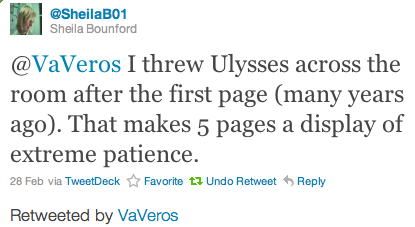
So what has led me to this Rule of Five? Late in February, I decided to read Nalini Singh’s Archangel’s Kiss. Many people I know have praised her books to me. They love her and adore her writing but, as I am not a big fan of paranormal romance (I have previously read MaryJanice Davidson, JR Ward and Sherrilyn Kenyon), I have not pursued reading much in this sub-genre. In March, however, I was attending the NSW Readers Advisory Seminar on Fantasy and though I had read several fantasy titles in preparation I thought it would be best that I attempt a title that crossed over with my favourite genre – romance. I was quite enthusiastic in reading this book as I looked forward to discussing it with friends. It starts in a train station, there was some sort of gadget involved in the capture of an errant (was it) angel, there was narrative comparing her capturing tactics with her friend’s tactics etc etc. And then I vagued out and I can’t remember anything beyond that. I was on page five when I gave up and moved on to read a fab kids fantasy book called Urgum the Axeman by Kjartan Poskitt.

Once I gave up reading this book I tweeted the following:

Only one person objected. The other five who answered all agreed and felt that it was fine to give up and move on…and in one case, seemed to suggest that five pages were admirable.

A week later, I was struck again by the importance of a book engaging the reader in those first pages while I was listening to Brent Weeks at the NSW RA Seminar answering an audience question on how to make books appealing to reluctant readers. He spoke about how he consciously has action in the very first page of his books as he knows that this is a hook for many readers, himself included.

This led me to think of my favourite books and there isn’t a single one that I would say I struggled past the first pages. I remember reading Melina Marchetta’s Looking For Alibrandi in a single inhalation and I did the same with Jennifer Crusie’s Charlie All Night, Audrey Niffenegger’s The Time Traveller’s Wife, Matthew Rubinstein’s Solstice, Rachel Gibson’s See Jane Score, and the list goes on and on. I was not distracted after opening these books. I did not feel the need to put my book down and call a friend just to have a break and, in some reading cases, I wholly forgot to feed my children.

Another point I’d like to make is the attention given by the literary world to the first line of highly regarded books. There are books published on first lines, there are websites dedicated to them and there are infinite trivia quizzes on that all important first line. That first line is the hook and those first five pages are the bait that should draw you into the rest of the book.

I then think about the books that I have picked up, I have liked their covers, I have liked their premise based on a good blurb yet for some elusive reason, be it the writing style, unlikeable characters, too much violence or some vague intangible element, I have decided to move on to a greener reading pasture.

Giving up on a book in its opening pages does not mean that the book is not good. It may have some wonderful qualities and you may decide to revisit the book, or some other book by that author, at some later stage, as I plan to do eventually with Nalini Singh’s books. It just wasn’t the right book for you at this point of your life.

So I beseech you all to not slog through a whole book; don’t labour the first 50 pages. Let your senses take over and make a snap judgement on whether to read on in those introductory five pages.

Procrastireading

Procrastiread / prô’kræstairid/ verb (procrastiread, procrastireading) – 1. to delay finishing a book: I procrastiread my last book for three days. 2. purposely reading slowly so as to not reach the end of a book: the reader was procrastireading because of an emotional connection with the characters of a book in such a deep-felt way that to end the book would result in severing the relationship. [Latin]  – procrastireader, n.

Have you ever found yourself reading a book whose characters endear you, become your friends, become your soulmates and envelop you into their lives to the point that soon you realise that you are half way through your book? And with every page you are getting closer to the end of your relationship with these people. Sure, you are the passive person in this relationship where all others are walking, talking and interacting with each other yet ignoring you. But you are the one who is setting the pace, you are the one that decides when the next words in their story will be read. You are the one that can evoke a procrastiread.

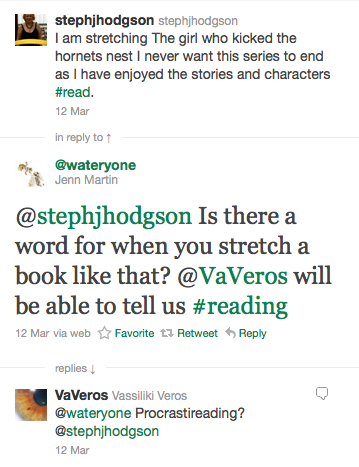
The other day, on Twitter, I took part in a short exchange where @stephjhodgson tweeted that she was stretching the ending of the Stieg Larsson series, @Wateryone asked me if there was a word for that.

I couldn’t find an Oxford Dictionary word or definition for this behaviour . But now, there is a word that we can all use – procrastireading/procrastiread

Over the years there have been few books that I have procrastiread. For the most part, if I am enjoying a book, I need to finish it quickly. I fly through it. I stay up until 3 or 4 in the morning with my obsessive need to know how it finishes despite the fact that I read the ending before I started the book and despite the fact that I will be a mess at work that day. But once in a while I am captured. I am enchanted by every word and phrase. I am lost within the book and I just don’t want it to finish. So I stretch out my reading experience over a number of days.

My most memorable procrastiread has been Bet Me by Jennifer Crusie. Not only are the main characters Cal and Min perfectly matched with their sharp banter from the beginning of the story but their friends also became my friends. I felt captured by them. I was engaged and amused by the narrative and the dialogue. I was invested in these people and as I felt the thickness of the book’s pages in my right hand lessen, I realised that I no longer would have these wonderful friends with me. They would cease to exist. But not if I read only sections at a time. Slowly, savouring each exchange and every nuance. And once I came to the end of the story, I was thankful to Jennifer Crusie who gave me a snapshot epilogue of “Where are they now” for each wonderful character.

I really do miss them.

Have you ever found yourself procrastireading?


No Touching Rule in a Touchy-Feely-Needy Library World

I love being a librarian. And as a librarian I will take up most causes, promotions, events. I will willing give you whatever information you want and don’t want (but hey! maybe one day you’ll realise I was right and you did need it and you’re welcome). I (humbly big noting myself here) am a dedicated librarian.

When the powers that be asked me to celebrate National Simultaneous Storytime. Great, I did it! When I was asked to take part in National Science Week – I was there with safety glasses on! Four years in a row now (but who is counting). When I was asked to take part in Public Lending Rights counting (in pre Online Catalogue days) I volunteered. And so the story goes from ALIA week, to Library Lovers’ Day to Heritage Week even threatening to make “Avast! ye’ll walk the plank, ye landlubbing, fine dodging curmudgeon” on Talk Like a Pirate Day. I am hands on!

Even when twibrarians get in the swing and start library #hashtags trending – I get involved. Yup. I’m there, in the midst of the #savelibraries, #followalibrary, #followalibrarian, #readit2011, #AliaIoc, #reading, #nswra, #hcod, #followreader, #spbkchat….you get my drift. I’m there with bells on. And I’m there with bells on because I want to be there.

But today, my lovely leaders in the ether whoever you are. Today, you declared the day to be the International Hug a Librarian Day. I’m sorry but I cannot support this program. I cannot open up myself to strangers throwing their arms around me, I cannot endorse this touchy feely program. With Hug a Librarian I feel that you have entered my personal bubble, that cone of silence that I hold sacred – my body.

I am quite happily a “No touching” type of person.

When I am with my family, I am affectionate. I hug my children, I kiss them and adore them. I hold my husband’s hand in public (really – I do!), I kiss him and adore him. But that is my “Out of work” personal life and even there I am not overly touchy, feely.

But in the workplace, I am a professional and a “No Touching” rule prevails. Affection does not come into it. As it stands, I really don’t appreciate having to approach the occassional amorous, horizontal teenage couple in the corner of the library to tell them to keep it vertical and frankly, I don’t want any of the 1000’s of borrowers that cross the library threshold to feel that I am in need of affection of any kind. I am happy in my answering questions objectively, contributing to someone-else’s information needs. And damn it, no one is walking around proclaiming it’s “Hug an Actuary” day or “Hug a Surveyor” day. Is this another stupid way of perpetuating the grim, spinster librarian stereotype?

So, please, leave me alone to do my job. Do not encourage strangers to give me unsolicited affection. I don’t want dead-pigeons-down-her-top lady hugging me, or the guy-who-exposes-himself hugging me nor do I want that over-perfumed-botox woman giving me “Mwah!”. I just want to do my job. And needy affection is not in my job description. Hell, I don’t know where members of the public have been and frankly they don’t know where I have been either. And we’re all covered with germy germs.

P.S I think that I would have accepted “High 5 a Librarian” Day. Though that too would have entailed touching.


Mea Culpa Mea Culpa Mea Bloody Culpa (but then again maybe the bookstores will have to shoulder this one)

Last week, RedGroup went into administration and along with it a number of Australian and New Zealand book chains – Borders, Angus and Robertson and Whitcoulls. Of course, the media have gone crazy blaming the darn internet again (my god – prior to 1994 you could only blame society). With the gradual decline of the print newspaper (hell, they’re giving them away at 8am these days) the media are bitter, enraged and ready to snarl at any hint of online business having healthier sales than a bricks and mortar company.

Now I am being implored by the media to “put my money where my heart is” and support my bricks and mortar independent bookseller and stop buying from those horrid online bookshops.

Well, let me say this to the book chains and indies.  You lost me, and a large chunk of the book buying market (romance readers), by being disdainful of our reading choices. I have spent decades struggling to source romance titles and finally have found places that will not only stock them but will sell them to me at a lower price than venerated bookstores can supply them. Why should I change my buying habits. As it stands, I would still have to source my titles through the online bookstore to give to my indie who has actively chosen not to supply them.

Yes, I do love my indie. Their loyalty program is splendid, their staff are friendly and knowledgeable (and all greet me by name) and for years they would order in books for me (back when I really didn’t feel comfortable with online purchasing). These books were, inevitably, romances.  But did this impact at all upon their book stocks? Well – they always stock Jennifer Crusie. But that is it. Despite the fact that they had staff that enjoyed the genre and and that they had customers that enjoyed the genre and that they had genre sections throughout the shop (Sci-fi, Fantasy, Graphic Novels, Crime) my “beloved” indie chooses to not sell Romance. Somehow, I suspect that independent bookshops would prefer to declare bankruptcy than to dedicate any space to the romance genre.

When you have a mortgage or family  or other responsibilities to look after, your book buying priorities change. Thankfully, I work in a public library so access to millions of books is at my fingertips. These same millions of books are accessible to any Australians who visit their public library. To find these books Trove is the best source for titles held throughout the country. That said, I love my keepers and I am all for the adage of “Buy the best, borrow the rest”. So when I find that I have borrowed and renewed a book multiple times and I am deeply in love with it I will go out and purchase a copy for my home.

I find that I buy approximately 20 books a year for my whole family and I buy these books from various sources. Now, the difference between paying $20 per item by going through my indie/chain or paying $8 for the same book through Book Depository/Amazon – it’s a no brainer. And it is insulting to my intelligence to beseech me to stop buying online. Franky, that “leftover” $12 supplies my home with 10 litres of milk (which lasts 3 days) or 1.5 other book titles. A win/win situation for my family.

And if the issue is “Buy Australian” there are a number of generalist Australian online bookstores who do supply romance titles and promote them, discuss them and enjoy them too. They provide a wonderful service and operate in a similar way to indies (except they know what their customers want to read). And their prices are reasonable, too. A shout out to Booktopia and The Nile.

The question is: do I still buy from my indie? That would be a resounding yes though not as much as I used to. I buy all my Australian and New Zealand authors and publications from them. It is the same price (and in many instances, cheaper) than buying those titles online. Will this save the store? I don’t know. Would I return to my local indie if it set up a romance section? Perhaps. I love reading the last pages of a book before I buy it and I also love skimming through a book to get a sense of the language that is being used. Once again, I can’t do that online. So it would really depend on the price and the quality of the titles being sold.

The important point to observe is that readers who choose to buy their books online do so for a number of reasons, be they cost driven, being too busy to be bothered going into a bookstore or quite importantly, inaccessibility of titles readers want to read.

I am putting my money where my heart is – and my heart is with the suppliers of books that I like to read. So if this means that bricks and mortar bookstores will close down I will be amongst the many who will be saying “Mea Culpa”.

Sex, love and passion: the appeal of romance novels: the moderator responds

On Friday the 11th of February, I moderated a Romance Panel for the City of Sydney at Ultimo Library.

Kick off your Friday night talking about Sex, Passion and Love with our romance panel discussion. Join Mills and Boon author Annie West, romance scholar Sandra Barletta and book blogger, Kat Mayo along with Ultimo’s romance reading librarians in discussing romance fiction in the 21st century…

It was a fabulous night with an engaged audience, a wonderful panel and fantastic discussion that ensued. So fantastic that Ultimo Community Centre staff had to push us out of the building as we went beyond their closing time.

As the moderator for the panel I had my questions prepped and I knew that I wouldn’t have to prepare meaningful answers (ever the shallowreader).

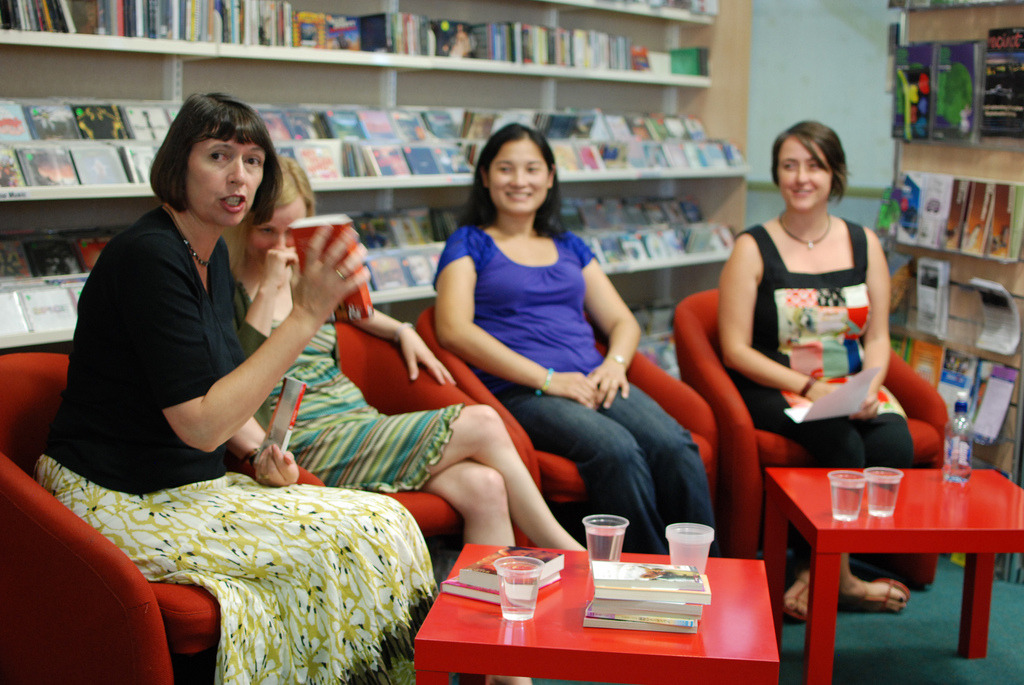
From the left: Annie West, Sandra Barletta, Kat Mayo and Vassiliki Veros Photograph courtesy from BookThingo http://www.flickr.com/photos/bookthingo/

However, as the panel discussion progressed I found that I really wanted to give my point of view, too. I behaved and, with the exception of the last question and some library promotion, I left the answers to the panel. A transcript of the panel’s answers is available on BookThingo’s blog. I now would like to share my answers to the questions on the night:

Why do you do what you do in romance, of all genres (I’ll answer this in the vein of why do I promote romance reading as a librarian)

Public libraries are charged with providing equity and access of information to all.  My feeling had been that libraries and librarians were not treating genre fiction and it’s readers with equity. Throughout all my years as a librarian, romances not only were not purchased for library collections but there was also a certain attitude amongst staff and some borrowers that romance reading was secondary and that library budget money would not be devoted towards the genre. This annoyed me so I decided to support the underdog, climb onto my soap box and declare romance King until the shelves were populated and the staff accepting  of readers choices.

What have you observed as differences between romance in the past decade as opposed to romance in the 80s?

For me there are 2 standout differences:

1. Like Annie, the 80’s and prior were predominately written from the female point of view. During the 90’s and now in the 21st century there was a gradual shift to both the female and male point’s of view being written into a novel. In my opinion, this shift has been so strong that the way I personally categorise the books I read is that if it has both the protagonists’ points of view then it is a romance. If it is only a female or male point of view it is categorised as Chicklit or Ladlit.

2. The sex is much more explicit and, thankfully, turgid shafts and manhoods have made way for erections and dicks. A much more realistic reflection of contemporary language.

Some people think that reading the last page first is sacrilege. Do you?

I always read the last page. I  feel that “fairies must die” and have previously blogged about this.

Now about male leads. Why do we love rakes, rogues, cowboys, tycoons, sheikhs?

My favourite leads are Montana cowboys and the best friend/sibling’s best friend hook up. Journeys into someone else’s life, journey’s into a world quite foreign and the complete escape from the reality of our own lives. I tend to avoid romances set in Sydney and in Australia as I keep finding myself distracted by the setting of the book.

Kat, you said people get bored with just a kiss, but the obvious exception is Twilight. Can you discuss why it was successful?

As I haven’t read Twilight nor have I watched the movies I cannot answer this question. Though on a purely aesthetic basis – Team Edward.

Do you think romance has lost its stigma?

I think that some of the stigma associated with reading romance has dissipated for the following reasons.

1. Romance readers and romance publishers are leading the ebook revolution. This is acknowledged further by traditional book review magazines taking on romance reviewers.

2. The establishment of the International Association for the Study of Popular Romance and the Journal for Popular Romance have made inroads in bringing academic merit to the study of popular romance literature. Having been established for under 3 years it will be interesting the changes that will come forth over the next decade.

That said, there is still  a large amount of bias towards romance literature and a lot more work is needed from not only the reading and reviewing public but the publishers of romance, also.

What books would you suggest to a new romance reader?

My 1st question to the person venturing into reading romance would be: What do you normally enjoy and then I would select titles from there. I’m a strong believer in merging someone into a genre by using cross-over fiction titles though there are some definite titles that I never hesitate to recommend:

Agnes and the Hitman by Jennifer Crusie

A Matter of Class by Mary Balogh

How come book stores don’t have a romance section? Where can we buy romance?

Unfortunately, romance isn’t stocked in most bookstores because it relates back to the stigma question and bookstores don’t value their readers. I get my romance books from 2 sources Kmart/Target and from overseas. Either the Book depository or Amazon. I also get most of my books from the library but, it too, has it’s biases.

Fave authors? (the only one I answered on the night)

Vassiliki: Anne McAllisterJennifer CrusieVictoria DahlSusan Elizabeth PhillipsSuzanne BrockmannAnne Stuart, Rachel Gibson, Julie James and Melanie La’Brooy)

It was a very successful event and I feel it is apt that my moderator’s cherry was painlessly popped at a romance literature panel.

On why more fairies will die

It is a well known fact that every time someone reads the ending of a book before they start – a fairy dies.  I am not making this up. It is true. If you want to know more about the origins of fairies dying you must read BookThingo’s Spoiling a Happy Ending where the whole idea is explained, in depth.

Readers, in general, fall into two categories – those that can’t bear to know the ending of a book, who enjoy a story unravelling around them and read in anticipation of the final moments, and then there are readere who like knowing how a book ends so that they can enjoy the journey without the page turning anxiety of needing to know if the hero and heroine will make it in the end. I am of the latter proclivity. I will read the ending, assure myself that ends in a way that satisfies me and then I will start the journey. It is particularly good for me to read reviews with *spoilers* so I don’t have to read the endings.

In the case of spoilers, a fairy is only maimed. Perhaps a missing limb.

But let me tell you why I am this way:

I started reading the end of books at about 12 years of age. Up until then, for the most part, I had grown up reading children’s fiction which was funny, positively conclusive, life affirming and, in general, a happy read. Then I started entering the world of tear jerkers. Books where you are torn apart with grief.

I remember sitting in Marrickville Children’s Library reading Lois Lowry’s A Summer To Die horrified that Meg’s sister Molly dies. Horrified! Firstly, I was reading and sobbing in a public space that I was not comfortable in. (That may sound odd but, in actual fact, my local library branch The Warren Library in South Marrickville had been closed down a year earlier. I no longer visited the library daily but could go only once a fortnight)…..so anyway….I’m sitting in the corner sobbing with red blotchy eyes but yet unable to stop reading a compelling, touching story.

I learnt my lesson that day. I never again read a book in the library. All books were to be consumed at home. Reading was no longer public.

By the time I read Katherine Paterson’s Jacob Have I Loved I became used to the idea that crying was just part of the story, as were dying people, manipulative relationships and finding your own way in life. To counter-balance these sadness filled novels I discovered the wonderful world of romance novels. And in particular, Mills and Boon.

Short and contemporary, they were easy to hide in your foolscap folder so that your father couldn’t see them when he was checking that you were doing your homework. And best of all they ended happily.

That is, until Anne Weale’s A Portrait for Bethany. In A Portrait for Bethany, Bethany ends up with the WRONG man. WRONG MAN! YES I AM SHOUTING! IT’S IS NEARLY 25 YEARS LATER AND I STILL HAVEN’T RECOVERED. After traumatic Bethany, I never trusted a book again.

So it would have been about…ummm…let say…..25 years ago that I started reading the back page of every novel I read. I read about 100 books a year so that comes to approximately 2500 dead fairies. Now, I did slip into complacency at one stage and stopped reading the last pages of any Harlequin Mills and Boon that I purchased. They were a given Happily Ever After. Guaranteed. The “formula” said so. I was safe! (let’s quickly re-calculate that number. Perhaps drop it to 1800 dead fairies).

Then disaster struck. Late last year, I purchased an auto-buy Harlequin Mills and Boon author, Lynne Graham. Now I adore Lynne Graham’s books. They have incredulous plots with engaging, emotional narratives leading the reader to be enthralled at how she manages to pull it all together. I was on the edge with The Pregnancy Shock but when it ended without closure I was horrified. I would have loved to have thrown the book at my wall but my wall has some lovely prints hanging off it so the floor had to do.

How could the author, editor, publisher, marketing group, janitor and building supervisor do this to Harlequin Mills and Boon readers. How could they do this to fairies? How could they misunderstand the reasons that any woman will tolerate those awful titles and mostly stupid covers is because the HEA is king. Forget Content is King. HEA is the absolute rule here. As romance readers, we will tolerate awful plots, shocking phrases (I’m looking at you Miss Paullina “she looked up at his face but it was as closed as a bank on a public holiday” Simons), ludicrous premises and sometimes Alpha-Brutes that you wouldn’t let approach you with a ten-foot barge pole. We readers will put up with all that for an HEA.

(Please Note: most romances are beautiful, brilliant, well constructed , wonderfully researched, emotionally charged and full of snappy dialogue that would make Al Jaffee proud).

The thing is that since The Pregnancy Shock I now distrust Harlequin Mills and Boon again. I now read their back pages just as I read the back pages of all novels. And sadly, I have come across several that end in an “…there’s more to come” way. And even more sadly, more fairies are dying than needs to be the case.

PS. Should you be a fairy killer and use twitter, remember to use #afairydies.

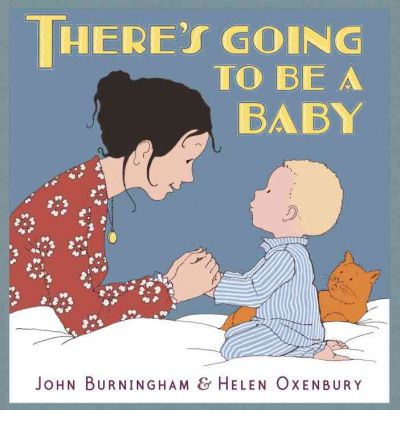
So, you’re going to have a baby picture book review

There’s Going to be a Baby

by John Burningham

illustrated by Helen Oxenbury

a shallow reader review

This is one of the best picture books I have read on preparing a child for the arrival of a sibling. Helen Oxenbury uses two different illustrating styles to deliver a delightful story that follows a mum with her young child throughout a 9 month gestation. The mum and child’s interactions are straight illustrations whereas the younger child imaging how life with a new sibling will be is illustrated in a comic book style. An enjoyable and highly recommended read, particularly if you have a 2nd baby on the way.