I had an great reaction to my post about my name with lots of comments and people posting their name stories on their own blogs which made for interesting reading. Something I did pick up on was that many people seemed to think that the habit of changing names was an exclusively “Anglo” thing. I don’t agree. This happens across all cultures. People have a predilection to adapt names, traditions, behaviours to fit within their own comfort zones.
There is a wonderful book called “So Many Henrys” by Letta Schatz with trippy seventies illustrations by John Kuzich.
In this book Henry Emory Demery discovers that he is not the only person with the name Henry. From realising that he shares the same name with his grandfather, Henry then travels the world to discover all the many variations to his name. I loved reading this book to my sons as we would replace Henry’s name with either Peter or Paul and we would continue the journey discovering the many variants of their names and to this day I will call out to them choosing the country of the day from Boutros to Ferris and Pablo to Pol.
My husband’s name is John. Yes John – with a silent “h” not a silent “athan”. He is of an English background, named for his grandfather and great-Uncle who used to tell his mum “Every child should have an uncle John”. As an aside – I have 5 uncle Johns, many of my cousins, friends and even a nephew are called John and many friends and relatives are married to Johns often necessitating me to say “My John” which can somewhat be misconstrued. My uncle John, who is married to my Aunt Vassiliki (I kid you not), would say
Σπιτι χωρις Γιαννη, προκοπη δεν κανει – A house with out a John, makes no progress
John is such a great and flexible name yet it seems to be out of fashion with the current generation. Whether that is because all their father’s are already called John and we will have a new wave in the next generation remains to be seen.
When my John met my mum she told him that his name in Greek is “Yianni”. My mum calls him both John and Yianni, which my husband tells me he loves.
He has no issue with my many Greek relatives that have Hellenised his name. And I am sure that had I been Italian he would have been Giovanni, or French to Jean or Russian to Ivan and Sean or Ian or Zane or Ewan or Juan, Hansel, Jack, Johan, Jan, Vanya and so on…
I don’t think that changing names to fit within a cultural norm is the domain, nor an act of oppression deliberately brought on by Anglos. Every culture does it. The change can be a comfort, a diminutive of sorts. How we feel about having our name changed is unique to all of us. Some of us balk at it and others love it and in no way can it be predicted by our cultural background.
Thanks to Sandra Antonelli for her assistance with this post. She too has her own John.
I have tweeted out 40000 tweets in the last 4 years and 4 months and I need a scapegoat.
10011100010000002 tweets
That’s right. 5 million characters. Yes – I can count. Really it could be 5600000 characters but not all my tweets use all 140 characters so I am rounding down.
I needed to blame someone for this landmark number – I cannot be held accountable. For many non-tweeting readers this will seem a phenomenal amount of tweets. Some might even say a phenomenal waste of time. For me, it has turned my life around.
Previous to twitter I considered myself connected. I had Facebook, I had worked in hypermedia engineering research, I had run a virtual library and written HTML coding, I used ALIA elists, weRead book aggragator and subscribed to Fiction-L. I was there – ha! I was so faraway from there. I may have worked at these things, I may have known they existed but I did not engage with them. They were peripheral. Twitter immersed me to an online life.
@merejames is to blame.
In February 2009 I had myself booked in to go to the inaugural Australian Romance Readers Convention. My friend Meredith had come over and suggested I live tweet from this convention. “It’s a thing” she told me. She was right.
@Bookthingo is to blame.
Sometime in 2007 (? could it be earlier) I recommended some Thomas the Tank Engine books and a healthy dose of Suzanne Brockmann to a borrower called Kat Mayo. I have no idea if she enjoyed the Thomas books but Brockmann started our romance as librarian and borrower to dueling tweeps to friends that go on date nights. We both tweet and we both agree on the “vomit” book.
@cbishops is to blame.
One of my first follows and follow backs, my friend Chris Bishops. He was a serious business tweep. He tweeted serious digital media information links. I thought “I better tweet serious library information links”. We had opposing views, and long debates, on the role of libraries in the digital media world and publishing which kept my *snort* altruistic librarian self grounded. Chris passed away nearly two years ago yet I still can’t bring myself to unfollow him.
@oldbitey and @fangbooks are to blame.
The two/three of them. I have no idea when they started #badsongfriday and it has been several years since we played but they both wasted my Fridays. No housework was done, no reading, no cooking all in aim of trying to outdo each other with awful music. BEST FRIDAYS EVAH!
@Huzbah/@The_JohnElliott is to blame.
Best husband in the world. And best kids in the world. I think the three of them were more than happy for me to hangout on twitter while they watched rugby league without my whining that I was bored. And they also allow me to tweet out funny things they say.
Twitter introduced me to @SarahFrantz, @EricSelinger and the International Association for the Study of Popular Romance in 2009. An idea twigged in me. Maybe, just maybe I could return to study romance fiction in libraries. I hadn’t considered it before our exchanges. I blame them too.
The readers I met put me to shame. I thought I read a lot but then I met online readers. They are a scary lot. The most awesome @MargReads. I am in awe of her. I love her blogs, I love her Library Loot event and I love that she has spent four years running one of the best online book discussion groups – the weekly South Pacific Book Chat #spbkchat. I blame Marg.
Actually, I blame you all. I blame everyone of the follows, unfollows and tweets and retweets over the past four years. You grabbed my attention and it has hardly wavered.
From blaming library engagement with @ellenforsyth, @janholmquist and @genrelibrarian to blaming romance tweeps @THRJessica, @VictoriaDahl, @Liz_Mc2, @JanetNorCal, @MerrianW, @AnnaCowan, @jodiMcA, @j_aallan who ask serious questions and discuss sparkly ballz, virgins, cacophony, chest hair, Abbey Girls and many other eyebrow raising topics. They are to blame.
How do I list all the other fabbo fabulosum tweeps that I have had countless conversations with? The wonderful tweeps I have met, several of whom have become dear friends. The authors, editors, bookshop owners, grammarians, publishers, teachers, librarians and fictional characters. I can’t do justice to them here. If I have not listed your name it is not from forgetfulness but for lack of space. I say go to my twitter page and follow all 540 of them for I blame you all.
I spent 2009 through to 2012 upping my reading ante. Going from a reasonable 50 books a year to a mind-boggling 365 last year. My print reading diminished yet the volume of news and journal reading I was reading via Twitter feeds was huge. Professionally, I was livetweeting all the seminars and conferences I was attending, I was doing reading challenges, like in April 2010 when I did a bookbinge month and read 23 books in 31 days and my children learnt that Brinner is a thing.
In 2010 I could no longer contain my ideas to tweets. The 140 characters were too restrictive. I turned to blogging. And then at the end of 2011 the blog was not enough. I returned to university to undertake a Masters by research at the University of Technology, Sydney. And dammit, that too was not enough. Next month, I am filling out all the paperwork to transfer from a masters program to a doctoral program.
My first name is Vassiliki. In Greek it is spelt Βασιλική. My name is an adjective. It means royal or regal. So if you are speaking of the royal family you would say οι βασιλική οικογενια. It is the feminine of Basil meaning king or kingly. When I was born, my parents had to decide whether they translated my name or transliterated it. Anglo equivalents are Queenie, Regina, Reggie, Regan, Reagan or Royal. None of which my parents liked so they transliterated my name. My name is one of the most common Greek names you can have. It is up there with Maria and Katerini. Continue reading →
A few weeks ago I wrote a fabulous post. It was superb. The words all flowed, I hardly moved from my seat and after 2 hours of constant writing I was really pleased with my close to 20 pages (let’s not get too excited here – I was using a notebook). However, I am choosing to not type it up.
At the beginning of last year I returned to study after a twenty year hiatus. The last assignment I had handed in was in 1991. I had used a word processor for the last two years of my degree but for the most part, the majority of my assignments were written by hand. For many young ‘uns this brings gasps.
I much prefer using a word processor.
In second grade, I won a writing award held by the local bank. My father went to read my entry and left without doing so. He came home and stated that he had no idea how anyone was able to decipher the scrawled gibberish of lines running into themselves.
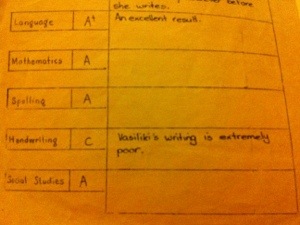
In third grade, my report card was filled with As with the exception of C for my handwriting.This C did not change all the way through to sixth grade.
In sixth grade, my teacher who had a mercurial temper and a propensity for using the cane, started shouting at me for my painting. It was a brown boat on a brown sea against a brown sky.I had not aimed to make everything brown. My colours had somehow become mixed and so I drew shapes into the brown. I was genius, I thought. He didn’t. He threw it in the bin (but did not cane me).
Oddly enough my Greek handwriting was (and still is) neat and legible. I enjoy writing in Greek because I can take pride in my penmanship. But alas, there is very little call in Australia for Greek handwriting. But I also think that my Greek handwriting is legible because Greek is a second language for me. My Greek thinking is slower than my English thinking so my hand works at the same pace as my thoughts whereas my English thinking is leaps and bounds faster than my hand. My thoughts flit from seemingly unconnected ideas yet formulate a coherent concept by the time I conclude.
My hand was never able to catch up often cramping up in speedily writing my thoughts down. By Year 11 I had developed a ganglion on my right wrist. I quickly taught myself to write with my left hand so I could write uninterrupted by hand cramps. I became ambidextrous (yeah – yeah – hit me with the old “I’d give my right hand to be ambidextrous” joke). My left hand writing was barely discernable from my right (though I have never mastered my signature with my left hand). However, no-one ever asked to borrow my notes. I believe I was the only person who could decipher what I had written.
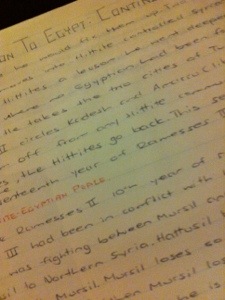
As you can see, there is a pattern here. My penmanship was not of the highest calibre. I was inconsistent. I varied from cursive writing slanting from left to right, rounded print letters and bizarrely enough, in Year 12 I wrote a 130 page assignment on Ancient Egypt with a mixture of a rounded print font with a squared font for titles.
By the time I started university I had reinvented my handwriting self. Though I no longer thought my writing to be awful I still did not relish doing it. I loved my sister’s electric typewriter but as we were both at uni at the same time I rarely used it as she was the boss. When my dad bought a computer it revolutionised my writing, my assignments, my everything. I was finally handing in work that was not being judged on how well I rounded my As and Os or how well my cursive letters joined themselves. It was, finally, function over form. And I have never looked back. I did a typing course and at one stage I could type more than 80 words per minute with a 100% accuracy rate (my word count is lower now but my accuracy is still quite high).
I love writing on a computer. I love playing around with my ideas and changing them around. What I have found though, is that in this second round of studying, is though the online reading of articles is fluid and quick, I am less adept at marginalia and side notes online. I am loathe to print out all the articles. My post-it notes are great for notes in books for I am one of those pedantic librarians that cannot bear to write in her books.
(As an aside, I particularly hate when people vandalise *cough* … write in library books. I once, politely, made a borrower sit and rub out all the pencil markings they had made in a book on creating quizzes – they had placed a purchase suggestion and were the first to borrow the book and returned it straight into my hands. I realise this won’t make me popular with the happy clappy “let’s make everyone welcome even if they are violent fuckers” librarian set but pfffft – I have no need to be liked by every library user and the person continued using the library and my professional assistance).
Since I don’t write in books, my notebooks have become full of notes and ideas and quotes. When I first started handwriting after 20 years (let us not count the occasional card that I may have written) I realised my writing had reverted to the ineligible scrawl that my father struggled to read back in second grade. My hand would cramp after five minutes. I was appalled. Eighteen months later, I am quite pleased that I can legibly write for a few hours to formulate my ideas. Even though my thoughts are ten pages ahead of myself, deliberately handwriting has slowed my thinking.
It has allowed me to start positioning different aspects of my ideas in areas that I hadn’t considered as I was always rushing to finish the piece in front of me in order to start on my next idea.
I still prefer typing directly onto the computer. However, there comes an idea that deserves the time that handwriting can produce.
This post was inspired by posts on handwriting from both @flexnib and @Malbooth many months ago. My inherent laziness keeps me from searching through their blogs to find their posts. So no links for now.
I dislike finding cockroaches setting up home in my books. Last week I found 3 boxes of books stored in my garage. Today, I opened one of those boxes to find a favourite old set of art theory books from the 60s and 70s published by Thames and Hudson, and Praeger. I was dusting them off when I reached the bottom of the archived box the books were stored in when 3 coackroaches, not tiny German ones, nor big kinger bush cockies, just brown in between medium sized cockies crawled out of the spine of Eroticism in Western Art. Why this book and not any of the other 20 books in the box? Is it because it is hardback? Did they like the pictures? Why not Surrealist Art or Metaphysical Art?
Can I spray book spines with bug spray? How do I know there are no more vile cockroach eggs waiting to hatch and subsequently populating my home until one night, while I am sleeping, one of those creepy, dirty insects crawls into my eardrum and starts beating to its own beat.
I’ve never understood the squeeeeing or heart-fluttering fangirling over Pride and Prejudice. This is not to say that I didn’t like the novel. I really enjoyed it. I love Jane Austen. I have sat at her grave at Winchester Cathedral. I have visited the Jane Austen Centre in Bath. I have read her books. I haz done the Jane Austen pilgrimage as a bookish nerd is wont to do. However, I have never understood the obsessive collectors and viewers of all things Pride and Prejudice.
In fact, I didn’t considered Pride and Prejudice to be a romance. To me it was a snarky novel about social classes, relationships, women’s status, their lack of autonomy and the requirement to make a good marital match. Oh, I know that it is romantic but its subtle romance was lost on me as a 17 year old who had already spent the previous 5 years reading intense and focused romance in the form of category series romances. As an adult, I have read the many epistles and scholarly criticisms and journals dedicated to Pride and Prejudice and all that other cerebral stuff but deep down inside – there was nuthin.
I tried to understand the hero status that Mr Darcy inspires. Colin Firth, in the BBC series, looked like he had swallowed a bad oyster throughout every episode until that last scene when he deems it worthy a moment to crack a smile. He’s all muttering and mumbling. Jennifer Ehle’s portrayal of Lizzie Bennet is good but I never feel the connection between her and Mr Darcy – even in the wet shirt scene (and really?! What is the whole kerfuffle about that wet shirt? It isn’t that impressive. All I could think of was the squelching of wet socks in boots and the chafing of wet trousers when walking).
I tried again to watch Bridget Jones’ Diary but once again I was left cold. A ridiculous heroine misjudges Mark Darcy. Once again, Colin Firth has had a plate full of bad oysters until, once again, the last scene where, I will concede, he is a tad sexy with his “Nice boys don’t kiss that way” retort of “Oh yes they fucking do”. I came around a bit with the Knightley/McFadyen version of Pride and Prejudice which seems to be anathema to most fans and I’ve also watched the Laurence Olivier/Greer Garson version which was also ho hum. So you get it. Not a fan.
It took until the 200th anniversary to finally get it, to finally see how wonderfully romantic the book actually is. And not only do I get it but I also am surprised at my score long obtuseness.
How did I not see that Mr Darcy is one of my all time favourite romance hero types – the suited up, billionaire CEO sitting on his high horse, lording it over his minions just to be brought to his knees by an unassuming, often much poorer and plainer but ever so sharp heroine that he initially barely deigns worthy of his time. Elizabeth Bennet, too, is my favourite romance heroine. She is not glitzy, glamorous, ditzy or quirky. She is smart, observant, quick to take offense at perceived slights and really funny. These two are fabulous together and I have finally seen the beauty and the romance of Pride and Prejudice due to The Lizzie Bennet Diaries.
To many of you who also follow me on Twitter this is not a surprise revelation. I have already blogged about The LBD elsewhere. I decided to wait until the last episode before posting my total adoration for this series but I couldn’t bear to post straight away – it has taken me a whole month to deal with my loss. Yes dammit. I have turned into one of those viewers who is grieving the loss of a favourite show. Go ahead. Judge me. Then judge me some more when I tell you that I have struggled writing this post for this month as it is difficult to pull together the many different ways this show has left an impression on me which is why the rest of this post will be a list of why I think this series is teh awesomesauce:
Secondary Characters
Where in every other adaptation the secondary characters remained unexplained, their motivations left unknown or unrealised this adaptation fleshed out previously disliked characters giving them depth and humanity. From compliant Bing Lee, beautiful calm Jane, practical and insightful Charlotte, conniving Caroline, sweet Gigi, Fitz (my sons’ favourite character “Fitzie”) to the shallow, selfish party girl with hidden depths Lydia! Just a few quick words on Lydia – I honestly don’t think that there can be any subsequent production of Pride and Prejudice that doesn’t take into consideration this brilliant interpretation of a previously two-dimensional grating character. She very nearly stole the whole show. She finally made us understand the appeal of the fun, thoughtless sister. I’m possibly the only person who would have liked to see Lydia end up with George Wickham. I get that the moral to the story is that you don’t need to settle and in this day and age you certainly don’t need to stay in a dysfunctional relationship but – well, call me warped but Lydia became too subdued for my liking and the moralising of the consequences of sleeping around seemed stronger than Austen’s own writing expressed 200 years earlier.
Lizzie Bennet/Ashley Clements
I have a girl crush on Ashley Clements. I don’t know where to start in praising her interpretation of Lizzie Bennet. She is the Lizzie Bennet that I wish all the other adaptations delivered. Her Lizzie just hands down trumps every other wimpy, soft-spoken, pursed lipped, ditzy dumbass version that I have seen. Clements slams you with snark and lampoons from Episode 1. She delivers a character that is observant and funny and sharp and someone you want as your friend. Her face is beautifully expressive whether she is recounting an event, taking the piss, yearning, crying or happy.
Lizzie’s depictions of family, friends and acquaintances are as caricatures. For the sake of a great story she overdraws the people she comes across in her life. She knows that she is not being truthful to her viewers about the people she is depicting. She admits to being 80% truthful…no make that 50% truthful. As a viewer you know that Lizzie is not an accurate narrator but as a narrator even she knows that she is not an accurate narrator. Hyperbole is her ruler but, just like her sister Lydia, she has a vulnerable side that you get a glimpse of in Episode 7 when she is retelling “The Most Awkward Dance Ever”. It takes 3 episodes for Lizzie to even bring up this event – a whole 10 days after the Gibson wedding. As a viewer you see that Lizzie Bennet was embarrassed and slighted publicly by William Darcy. A public that is a tangible one. One in the physical world of family, friends, neighbours and the whole community watching her being rejected. Lizzie Bennet then goes on to publicly embarrass and slight William Darcy in a virtual space – a space which she doesn’t perceive has the impact that reality does until Episode 61 where we see her hesitance to even meet William Darcy’s eyes.
For a while I have been exploring this idea of the spaces we consider our reality. My interpretation of Lizzie Bennet at the beginning of the series is that Lizzie is detached from this virtual space. Particularly as a communications student her understanding of this medium as a virtual space unlike real life seems to make it OK to speak freely about family and friends once you have altered them, fictionalised them and you the viewer need to work out what aspects of the other characters are truthful. It is after Darcy’s first love declaration and subsequent argument about real events that Lizzie realises that Darcy is a man she has wronged. (And I love the strained look on her face when his objections to her mother and Lydia are also her objections to them). Thankfully for Lizzie, (and perhaps because he is a media communication CEO) he seems to have a similar understanding to her of the reality of the web as an unreal virtual space with somewhat unreal depictions and is able to dismiss her online comments about him. From Episode 60 Ashley Clements slowly turns Lizzie Bennet around from a seemingly oversharing, laughing storyteller to a more reserved person selective in her choice of words for the screen.
William Darcy/Daniel Vincent Gordh
As you have read above, I have never been a fan of grumble bum Darcy. But for the first time ever, here was a Darcy that appealed. He is a snob. He is realistic that there are class differences in our world. Just as Lizzie portrays her worse self in Episode 60, Darcy too shows us his absolute worse. The beauty is that neither of them are reticent in their exchange. These two are equals who leave their exchange rethinking their approach to each other. From that episode onwards we get to see a softer, more considerate Darcy. One that starts thinking through his attitudes to people outside his usual sphere until the penultimate episode where he is a relaxed, happy man (well – he had spent a week getting it on). For what it is worth, I am not a subscriber to the Darcy has Aspergers theory. I do not like the need to medicinalise behaviour that society has decided is not the norm. Darcy starts the story as a total snob but he is also shy and this combination is the fab reason why it takes nearly a year and 3 minutes to get the girl. And can I say, Daniel V Gordh has the most beautiful sprinkling of silver in his hair. Be still my beating heart! Just what all distinguished, billionaire CEOs should have. And 16 year old me would be pulling apart my Tiger Beat mag and putting up posters of DVG.
To add to this, I loved all the Darcy and Lizzie episodes. There are minor niggling lines that I wish could have been refined. Lizzie is fine calling Darcy a “prick” but shies away from saying that she doesn’t want to be the girl that is sleeping with the boss (c’mon already – who says “dating”?) and Lizzie not acknowledging Darcy in the last episode (a phrase would have sufficed). This doesn’t detract from the fact that these two sparked off each other. They had tension, those deep gazes gave me flutters and it was wonderful to watch the online squeeeeeing from all the other fans and viewers.
The Writers
How could I even think of writing such a love letter to this wonderful show without acknowledging the wonderful writers who adapted this 200 year old story. These writers went well beyond any movie or any TV series has previously managed. They wrote flawed, real characters. They understood Austen’s characters and that people change due to the people they know and meet in their life. The writers show us all the necessity for forgiveness and that it is possible to overcome our prejudices and change our perception of others. The transmedia fiction, the use of Twitter and Tumblr and Pinterest gave us a deeper understanding of the main characters and allowed us to view them off-screen but still online partaking in a life that is the norm for all of us in this internet connected world. Understandably, production quality – great for a low budget series – did have its own challenges. There are sound quality fluctuations, Mr Microphone peaks at us in a later episode, beltless Bing, Darcy is not that crash hot a dresser for someone who is supposed to be in the 1% (seriously – a buttoned down shirt that isn’t buttoned down). These points though are inconsequential because the storytelling ruled.
The last episode was subdued and though at first I was disappointed with it, I now see it as the quiet farewell it needed to be. This was a journey for Lizzie and Charlotte. Two women finding their professional way in this modern world, each of them with different values and needs yet dedicated to their friendship. Thankfully, the writers were not constrained to only the videos and the transmedia fiction element delivered a wonderful epilogue on Twitter, at once funny, romantic and hopeful for the future. I truly hope we get to see the tweets in the DVD edition as I really feel they were key to the whole story. The writing, and the writers, are the absolute champions of this wonderful web series.
In the end, I invested countless hours in these wonderful characters. Gee they were fabulous! I have invested in the Kickstarter and I am so happy they have brought me to a new love and appreciation for Jane Austen’s wonderful Pride and Prejudice.
What!? You want more! Should my overly long letter not be enough here are a couple of links to read:
Goodby Lizzie Bennet, it has been… so good to see you
Janet’s series of opinion posts over on Dear Author about historical North American captivity narratives and the antecedents of the romance genre have led me to try and think out what I know about Australian settlement history – a very general laywoman’s view and to wonder what our captivity narratives would be like. These are the three posts with discussion that form the background to this blog post.
I started writing a comment to Janet’s “Life During Wartime” post but it became very long and Vassiliki kindly volunteered her blog as a place to share my ramblings.
I can describe three forms of captivity for women that arose from the way in which settlement happened here in Australia but I’m not sure we have equivalent Australian captivity narratives unless we count stories such as Henry Lawson’s fiction of the 1890’s “The Drover’s Wife” about a woman who is captive to her husband’s absence, the bush and the snake, and who does not have her own name.
Women Convicts
Male and female convicts arrived on the First Fleet in 1788 and the last convicts to be transported to Australia arrived in Western Australia in 1868. Female convicts made up 20% of the convict population. Nearly all white women who arrived in Australia in the late 18th and early 19th were convicts; that is, they were captives of the government. To grow the colony, women were needed to breed the next generation. This meant that in Britain women received the harsher penalty of transportation for offences. Women, especially those of marrying age were transported mainly for petty theft and property crimes. Their function was to give sexual gratification to the men of the colony and have babies. The government turned female convicts into unpaid sex workers. Crowds of men would meet the arriving ships to pick whom they wanted. Male convicts had the capacity to earn their passage back to Britain after their term had expired. The reality for women, especially once children were born, was that transportation was a life sentence.
Effectively any existing marriages of all female convicts arriving on Australian shores were set aside. Female convicts were initially sent to ‘factories’ and their way out of these harsh holding cells was to be taken as servants (often a euphemism for concubine) or directly into a co-habiting relationship. Men could go and view the women; there are descriptions from the Parramatta Factory of men dropping a handkerchief at the feet of the one they selected. The women had the choice as to whether they picked up the handkerchief but given the limited options they faced, was it really a choice? The female convicts’ agreeing to be one man’s partner obtained some protection for the importunities of the many, although even so they were still considered whores. This attitude to women in the colony was so prevalent that even free women who settled in Australia before the 1830’s wore the same label. Legal marriage was very difficult to achieve for convicts due to the cost of the licence and the lack of Anglican clergy. If convict women had any bargaining power it was because of the scarcity of women, an issue in Australia throughout the 19th century.
Consequently, settler Australia grew into a very sexist, misogynistic culture with very distinct male and female worlds of opportunity and action. Men had great power over women; this made Australia a land where women waited for the man to claim to them and to change things for them where men despised them for this and even as they were desired as wives and de facto partners, they were seen as corrupting whores. The process of settlement built a greater power imbalance into male/female relationships than already existed in the British culture of the times. Free women migrating as potential wives and mothers were subsumed into this culture.
Women and settlement
This leads to a story I was told by a local man about life on the Atherton Tablelands in the hinterland behind Cairns in Queensland. Roads into much of the interior of Australia are an essentially 20th century invention; movement around Australia until around WW1 was mostly via coastal steamers and latterly railways. The vast distances (today it takes around 19 hours to drive 1704 km from Brisbane to Cairns) meant that regional areas could be incredibly isolated. Men who had taken up land in the Tablelands would go down to Cairns, Brisbane or Townsville to find a wife, woo her and marry her then bring her back to their properties. They would deliberately take a long and convoluted trip from Cairns into the Tablelands so the woman would not be able to find her own way back over the distance of several days journey. The isolation of life in these places was a known cause for women wanting to leave; the problem was solved by making sure she couldn’t leave because she didn’t know the way out.
White men abducted Aboriginal women as sexual and working slaves. This was a common practice of stockmen moving large cattle herds over great distances and particularly of Sealers working in Bass Strait who abducted women from Tasmania.
White women living with Aboriginal tribes was so rare as to be regarded as mythical and only potentially occurring when ships were wrecked on the coast, not because of abduction.
Beginning in the 1830’s, the Government assisted the immigration of single women between the ages of eighteen and thirty to work as domestic servants and to become wives. Migration to Australia boomed with the discovery of gold in the 1850’s. The population tripled in the next 20 years bringing migrants from countries outside the British Empire. It was not uncommon for migrant women from Europe to marry fellow countrymen by proxy who had already settled in Australia. They made long journeys alone to a new future with nothing but their hope that they were married to good men. Often not speaking any English, their point of contact with the wider Australian world was dependent on their husbands.
Women and the land
Female captivity in Australian historical terms cannot be considered without thinking about our relationship with the land and the great, absorbing silence of the bush. The dominant myth of 19th century settlement was that of the lost child who wanders into the bush never to be seen again. There are many sad stories of real events. Children traditionally represent the future in stories and poems. So these are stories about the harsh and alien environment and European uncertainties and fears about being swallowed whole by the realities of making a life here. Aboriginal people were never the abductors in real life or in stories, they were the ‘black trackers’ who searched for and hopefully found the missing; able to do so because of their relationship to the land and under the direction of white men leading the search parties and dominating their environment. Many free settlers were remittance men, disgraced in some way or unable to fit into British society so sent to, or escaping to Australia with the intention they vanish into the Terra Nullius; the empty land. The long sea journey to Australia meant that settlers were unlikely to see family or friends ever again e.g. until late in 19th century letters back to Britain could take two years to receive a reply, so the land and its distances itself was the captor.
What’s in a name…?
Female life in early settler Australia was determined by strong systemic, social and cultural imperatives implemented through government policy of the day and shaped by the geography of our silent landscape. A whole category of women whose sexual consent was neither needed nor required were created by government fiat. The actual process of settlement turned women as a group and as individuals into nameless objects. “The convict stain” is the colloquial term for having a family heritage of descent from convicts (1 in 7 Australians has convict blood). It was not until well into the 20th century that the stain was regarded without shame. It seems to me the shame wasn’t in the transportation for crime but in what happened on these shores. Australian women settlers were made nameless and silent and ashamed. Their self-reliance, loyalty to each other, determination and economic successes were hidden away by the general view taken of female convicts and inherent cultural misogyny. In the North American captivity narratives, women and children are named and have some form of individual agency in contrast to the nameless, silenced women of early Australian settlement.
Further questions
In her post “Take The Long Way Home” Janet says: “Romance, beyond its focus on a romantic relationship, is also very much preoccupied with the relationship between the individual and society, between freely chosen love and social obligation, between personal aspirations and social roles.” In the case of the female convicts – personal aspirations are likely to have been reduced to being raped less and their relationships primarily instrumental – what can you do for me and what must I exchange for it? Where is the romance? Are any meaningful mutual obligations possible between individuals? If the state is your rapist what do you owe the social contract? Convict women and the Aboriginal women who survived these early years of settlement were seen as recalcitrant and always ready to battle authority, they were always other.
How does our Australian settler cultural history and mythology construct and engage with the romance genre? How do the captivity, marriage of convenience and ‘fated mate’ tropes of the romance genre then speak to our historical experience of convict and immigrant women and proxy brides for strangers?
If we accept the modern romance genre as seeded from the history and myth of the North American captivity narratives does this enforce markedly American approaches to thinking, writing and reading the romance genre even when readers and writers come from other cultures?
I had an interesting exchange with my son the other day. He was doing a school assignment on life in Ancient Egypt and having the boffin information maven mother that he has been blessed with, he knew he needed to log on to “authoritative information”. I had spent some time with him earlier in the week showing him how to log into library databases rather than using free to the web resources.
My son called out to me to say that he couldn’t find the Ancient and Medieval History database on the website so I went over to him and saw that he had clicked on the “In Library Databases”. Now, by late Thursday afternoon I was already fed up with Ancient Egypt and my son’s assignment so I was a tad cantankerous when I snarkily said to him “Why did you choose the In Library Databases. You need the At Home ones. Are you “in” the library?” Bless my gorgeous son who ignored my sarcasm and said “But Mum – I am “in” the library. Look” and he pointed to the library URL. It is at this point I cringed at my Old Skool 20th Century concept of place, apologised and led him through to the resource he needed.
This did lead me to think about when I am physically “in” a place or virtually “in” a place. For me being “in” a library still means being physically “in” a bricks and mortar building. Yet, for most people, it is the library website that is their first port of call. For many users, once they have received their library card, it is their only port of call. So calling library resources “In-library” and “Home access” – I did a quick (oh so scientific) survey of 6 library services and they all used these terms – is catering towards an older user demographic and not towards younger users whose concept of being “in” a place differs substantially. To add to that, often those valuable In Library/Home resources are secondary to the library catalogue – a tool which necessitates a physical visit to the library to use the resource found. This seems a tad ass-end backwards to me.
From that thought, I moved to my sense of having my nose buried “in” a book. When I visualise this, I have in my mind myself as a reader with book open, nose seemingly pressed against the crease of the open book mind completely focused on the words on the page. Somehow, my nose buried “in” an ebook lacks the same sense of hiding amongst the pages for me. Have I been lost “in” an ebook? Absolutely. I am lost “in” digital reading for hours every day. There are days I need to be reminded that it is time to feed myself and any other dependents that may be around me. But I don’t physically feel as though the ebook provides a shelter for my mind. It is not a space I hide “in”. I could not hide my face in an ebook should it make me cry in public (because we have all been there, damn you Barbra Conklin’s PS I Love You). But in neither experience – traditional print or ebook – am I physically “in” the place that I am reading about. As much as I may escape, or be lost in the story, unless I am reading in situ I am not really there.
I spend hours travelling the world on Google Maps. I discover small towns, I follow roads, I enter places that I doubt I will ever physically visit. Do I consider myself to be “in” those places? My answer is No. I am “in” Google Maps but not the place I am exploring. I need to physically experience that place to be there. Just as I am not really in my books.
However, online gaming allows you to be “in” that space. Whether you are playing Fifa 13 or World of Warcraft or Assassin’s Creed the only place to have this experience is online. As a sideline you can have cosplay, you can attend fan conventions however the virtual space is the primary space.
With these other examples in mind, I am thinking again of the public library as a physical place or as a virtual space*. The reality is that, unlike the chicken and the egg, the physical place did come first so it is natural that our terminology is still couched with a bricks and mortar mindset. Though the industry has shifted, public library websites need to become the creative library branch where users add value to the site rather than purely being recipients and searchers of information. Some libraries already have some user led content creation particularly in the area of local studies and oral histories but this is mainly engaging with older generations (which is great in itself but needs to now be expanded upon). It won’t be until user led content creation for libraries is driven by youth, who are already engaged in creative screen based and digital culture and already think of the library website as being the main entrance, that the local public library will be a a primarily virtual place for the community to get lost “in”.
*I want to take a moment to highlight that I do not feel the same way about State and National Libraries which are also public libraries. For many people in Australia, their only experience of the National and state libraries as a place is the website.
Every now and then, when I don’t feel I have enough to do, I write a few blogs over at Read Watch Play.
I wrote about Picture Book Romances with several recommendations. All of these titles are modern romances and represent whammo! strong women for their protagonists. I would have loved to add an LGBT title but I haven’t come across any really enjoyable ones. I wanted to add Mr Pod and Mr Picallili but I wasn’t sure if I was reading too much into the book.
I also had a bit of a sooky weep over the Lizzie Bennet Diaries ending their filming today. Don’t think that because I blogged over at RWP about Thoroughly Modern Lizzie I won’t write more on this blog. I’ve saved the best for Shallowreader – a Darcy Squeal fest.
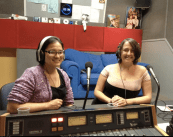
On Valentine’s Day, Kat Mayo and I spent a good part of our day travelling to 2SER studios for an interview on Love and Passion. Anyone that knows both Kat and me would know that we can talk about romance fiction for hours. Put us in front of a microphone and we will amp it up just that tad bit more. I recommend you get yourself a cup of tea, coffee, icecream, cakey and sit back and enjoy.
The show was aired on a Saturday and unbeknownst to me, one of my sisters went to my mum’s place and translated the interview to mum as it was being aired. During the break in the interview, I received a phone call from my mum.
Mum: When did you start reading romances?
Me: 32 years ago.
Mum: Really? So you just went on the radio to tell everyone?
Me: Yes mum.
Mum: Thank you for letting them know that I don’t read them. But you didn’t tell them I read religious books and biographies of saints.
Me: Sorry mum. I did consider it.
Mum: So what do you know about romance?
Me: Ummm…you know how I went back to uni last year?
Mum: Yes.
Me: That is what I am studying. I told you about it. And you know I read romances. You would always ask me to help you cook and clean and to put down “those romances”.
Mum: I didn’t think you were actually reading romances. I was being ironic.
There you have it. My mum, the original hipster.
Unlike a lot of romance readers I have met, I did not discover romances by finding my mum or grandmum’s stash. If anything, reading is not a shared activity for my mum and I as our interests are quite different. Not now and not when I was a younger either.
For many people, the thought of a parent not knowing what their children are reading seems to be anathema. It is equated as “not caring” or “how can you trust what they have chosen”.
I can tell you that both my parents cared that I was reading. Their main aim was to provide my sisters and I with ample opportunities to read and do homework. That is, ensuring that we didn’t have too many distractions – 1 doll, no video player, 1 TV, regular visits to the library and food at the ready. Both my parents were Greek migrants so Greek was the main conversational language in our home. My mum’s English reading skills were minimal (she worked a day job in a factory, a night shift as a cleaner, a weekend job as a cleaner, ran a boarding house AND raised 4 daughters) and though she was literate in Greek, due to her mindblowing superwoman working life, her rare chance to relax involved her knitting, tatting, gardening and reading the newspaper and the Bible. For mum, food and care was her bonding experience – as well as teaching me how to embroider which I still do on occasion. The only reading I remember sharing with my mum was when I would translate Paris Match from French to Greek for her when they had spreads on the Greek ex-royal family or an article on Cristina and/or Athena Onassis.
As my dad was highly literate in English, mum was quite happy to let him take charge of the homework and reading tasks. Though she did not know the content of the books I was reading, my dad did. Luckily, he was of the mindset that censorship of reading was wrong and never objected to the books I was reading that other friends’ parents were voicing concerns over. Thankfully, he trusted my choices.
My reading path was mine to choose. Influenced by my sisters, my teachers, friends, the books available at the library and my local newsagency, there was a joy in discovering my interests unfettered by close examination of the content of my books by my parents. This is something I try hard to emulate with my sons though it is difficult when you are a librarian to not be involved in their reading lives. Making opportunities for them to read is a much harder task. Gaming and computing distractions abound in our home and are much more addictive than the written word. To be fair, they have both hooked me onto Football Manager and I am crap at it. Its complex rules and processes make me weep for the simplicity of a linear narrative text. I no longer choose books for them. I stopped doing so when they were 8. Unless they ask I won’t read their choices. It is their private party, their little secret. Funnily, both of them at 11 years old have sneakily challenged me with “Mum, there’s lots of snogging and drug taking in the book I’m reading”. My reply has been “That’s good. Would you like something to eat?”.
I never thought of my romance reading as ever being secret. I never felt that they were my private party. I honestly thought I read romances openly for most of my life. That is until last week when I realised that it only took 32 years for my mum to come to the realisation that when she was shouting at me to put away those romances, her daughter was really, truly reading romances.





 Shallowreader