Doing justice to Desire

The other week I guest posted a Five Word Review on Charlotte Lamb’s Desire. The review reads “Drunk Fuck Pregnancy Equals Luurve”. I stand by this review. It relays the exact premise of the book. But what it doesn’t relay is the love I have for this book.

The heroine, Natasha, gets drunk after breaking up with her fiance. She goes out with friends and becomes uninhibited after drinking champagne and takes off with a hottie called Lee Farrell with whom she has a one-night stand. When she wakes up the next morning she is mortified and he drives her home upset that it was the alcohol and not her desire for him. She falls pregnant and doesn’t keep the baby secret. Inevitably they marry for convenience but are stand offish and suspect of each other until the grand grovel and love reveal at the end. It is a fab read that very much reflects the mores of the early eighties.

I have reread Desire at least once a year for the past 25 years and I still love it. Published in 1981, the year that Charles and Diana married (why is this relevant), the protaganists have a 16 year age gap (Charles and Diana had a 13 year gap so it is relevant to set it in context) which I find irksome when the heroine is 17 but seeing that 20 is my tipping point into acceptability these two characters are fine by my measure as she is 21 to his 37.

The standout for me is that Natasha has been brought up conservatively and to believe that love is soft and gentle. After breaking up with her fiance “Natasha had always played the submissive, female role…” it is through alcohol that she feel uninhibited. She feels desire and she matches Lee’s desire as an equal.

She had been conditioned to see herself in that yielding female role, to accept the qualities which society expected in a woman, to be soft and gentle and pliant, to submit and give what was demanded. She had not been taught to demand in her turn, to be strong and self-sufficient, to claim her right as a woman, to match the male on her own terms

It is paragraphs like these that I feel are lacking from many romances today. As a 12 year old the sex flew over my head. However the concept of not being subservient, not being shy and reticent, stating my terms and refusing to compromise those values is what stays with me. It is finding a partner who matches you, not a partner who subsumes you that clicked in my reading.

They start conditioning you when you [are] in your cradle

                                                                                        Natasha

My belief is that many romances (particularly from the 70s and 80s) may write what at face value is an unbalanced relationship but it is the reading between the lines that I am interested in. The relationship may fade but the knowledge that with this man, Lee Farrell, Natasha feels strong and self-sufficient yet with others she was submissive. Natasha recognises society’s expectations of her and chooses to not adhere to them but it takes courage to do so.

The book is pretty much angsty from beginning to end. Angsty in that good, melodramatic way with fainting, fisticuffs, jealous fits over beaux and belles, alphabrute chest beating and other ridiculous misunderstandings that drive the story.

You have some crazy notion that love and sex are separate issues

                                                                                                           Lee

This book is about sexual love. Not a love of companionship which no doubt will eventuate in years to come but a love of physical desires firing the soul and Charlotte Lamb’s aim is to allow Natasha to not feel shame and guilt for her sexuality. The book also gives a passing nod to Jane Austen’s Pride and Prejudice for that is really what drives their inability to communicate. Natasha is prejudiced against Lee believing in his public image rather than the man she was attracted to. Lee’s pride takes a battering every time Natasha claims she loved Mike, her ex-fiance, and she was ashamed of her actions with Lee and, as is expected in a Mills and Boon, these issues are resolved at the end of the book in their declaration of love for each other. But not before Lamb uses Natasha as a vehicle to remind the reader

Men have organised the world for their own convenience for years. They made the laws, moral and otherwise, and it was men who sold women the idea that sexual desire is okay for a man but shameful for a woman

I believe that Lamb uses romance to subliminally embed ideas of feminism in her reader’s mind (remember its 1981 publication date). But even more importantly, she uses Lee to remind the reader it is love in its many variations that drives us

Love is what we want it to be, what we need. It doesn’t have any rules. There’s no such thing as law or morals where love is concerned. It’s just a question of feeling, of real emotion, of caring for one person rather than another, of needing one person rather than another.

The reader, social media, exosomatic stores of knowledge and a brand new made up word

I have been thinking about social reading, the move from an information society to a communication society and the impact that this shift has on our understanding of the exosomatic stores of knowledge. Karl Popper’s third world, his “Objective Knowledge” explains that exosomatic stores of knowledge have an existence independent of those who created them. I’m going to go all “My Big Fat Greek Wedding” here and point out that exo comes from the Greek word meaning out and somatic comes from the Greek word for body thus exosomatic being knowledge no longer contained within the body. In the mid 20th century Karl Popper conceptualised objective knowledge as the knowledge that is held in books, libraries, galleries, museums, archives and records. Once these creations were independent of their creator they could not be controlled by their creator and the user could interact with objective knowledge anyway they chose.

So a book would get published and sent into the bookshops, libraries and homes of readers and potential readers. As soon as that author signed off on their final manuscript they no longer had any control over their book and its use. If groups of people wanted to meet up at their local library to talk about the book, unless the author lived in the next town or was on tour and invited to attend, the discussion was purely about the users relationship with the author’s exosomatic brain (the object that he/she conceptualised and produced). Even a published correspondence between an author/artist/creator and a critic became a part of the exosomatic knowledge store.

However, with digital media exosomatic stores are much more vulnerable. Creators can make changes through the removal or editing of information through DRM (which ends up being an even bigger topic but for the purpose of this blog piece, only a tangent) but they can also influence changes that cannot be tracked. That is, the creator blurs the exosomatic knowledge stores. Last week, @Liz_Mc2 posted about authors misusing their influence to get readers and reviewers to change their negative reviews and that she doesn’t feel it is good customer service to contact the reader/reviewer. Read her post “Hey Author, I don’t want to be your ‘Customer'” As I have been known to do, I start a comment on Liz’s blog that ends up as a slightly related blog piece over here. Thankfully, most authors have the good sense (and possibly their publisher’s advice) to never comment on reviews or reader discussions. However, a small minority of authors view approaching readers and reviewers on third party social and commercial aggregators such as Amazon and goodreads as “good customer service”, others take the simplistic view of “If you don’t agree with me you must be simple so I will explain it to you a gazillion times – as an author I can intervene in any conversation about my work” without realising that it curtails dialogue. In the example that Liz disucsses the author in question feels that through approaching the writers of negative reviews and coercing them through dialogue to give her books a higher rating she is performing a “good customer service”. This is loaded with problems. The first of which I will illustrate with a hypothetical question I posed to my 14 year old son and his friend:

You create a Facebook group to discuss your favourite TV show. You post discussions about the show and one discussion has you bringing up some lines that you both hated. The writer of the show joins in and explains why he wrote those lines. How do you feel?

BOY 1: Flattered!
BOY 2: That would be really cool!

The writer has very politely told you why you are wrong for disliking those lines he wrote.

BOY 1: That’s cool too. You can defend your work.

The writer has told you that as he has explained why you are wrong that you should delete your comments (on your FB group not the TV show’s). How do you feel?

BOY 1: I’d consider him a dick.

Would you do it?

BOY 2: No. And I would probably stop watching his show.

I love teens. They understand the implications quicker than most adults (though they might not be able to articulate them without the use of genital expressions).

The implication is that a creator can try, and in many instances succeed, to control his/her product when it is no longer somatic. And the more concerning problem is not whether readers, reviewers, recommenders, bloggers or commenters choose to change their opinions due to undue pressure from the creator but the lack of being able to follow the thread that led this decision to be made. In most cases the original work is being altered rather than a postscript stating the changing view. I have no issue with people changing their mind about a piece of work. Hell – my Goodreads profile states that I reserve my right to make changes at a whim. But then I put my Information Science cap on and I start grappling with the implications of these unrecorded changes. Whether they are due to a whim, a genuine change of mind or due to intimidatory practices that vary from passive aggressive to outright stalker behaviour from a creator there is no way that a dissenting voice can be researched by future historians. The only record they will see is the last one that was edited. Digital records may be preserved such as through the Pandora project but emails on individual creator’s computers are not likely to be attached to digitally preserved sites. The process of thought, the growth of knowledge and understanding, dissenting views, open dialogue and even the pivotal moment where a view has been changed is no longer traceable.

In an age where we are shifting from an information to a communication society, I believe we have transcended the exosomatic stores and we have shifted to a metasomatic (and yes – I made up this word for the purpose of my blog) stage where we need to question the pathways that led to digital information and opinions on social media and commercial review sites and their veracity. Metasomatic stores, in my mind’s definition is where the knowledge has exited the creator but the creator, through digital interactions can still manipulate it’s use but without hard evidence. Can this behaviour be halted? I don’t believe it can be halted. But it can be acknowledged and understood. Unless it is published by a source independent of the creator and third party aggregator, such as digital publishers, due to the poor behaviour of the few intimidatory creators, reviews from unknown persons will always be read with cynicism and doubt. Let’s just hope that future historians will be aware of these issues and will take the same stance.


*Added a day later*

I realise that I have muddled up my exosomatic brains and knowledge and stores. My only excuse is that I wrote the comment-turned-into-blog at midnight. At this stage, I am not inclined to change anything as I was playing with an idea and not writing a factual essay.


Growing Up: Reading 7 Up style

It is a 7 Up year. The premise of Michael Apted’s 7 Up of “Give me a child until he is seven and I will give you the man.” sparked an interest in me. I decided to explore my favourite books at the 7 Up points and see if the child reader I was at 7 shows you the adult reader I have become.

7 years

My absolutely favorite book was Bennett Cerf’s Book of Riddles that I thought were hilarious and Edward Lear’s Book of Nonsense. I read out the jokes section of the library (793.7). I also read fairy tales and Aesop’s Fables. Humour, happiness and absurd writing appeals to my sense of ridiculous.

14 years

My reading obsession was well and truly established. I loved MAD Magazine and stole as many as I could from my cousin John (who tells me he was aware of what I was doing and felt that every MAD reader should steal their first copies). I loved reading Elizabeth Enright, Edward Eager, Eleanor Estes and the beautiful fairytales of Eleanor Farjeon. I loved Archie comics (love triangle though I like Betty best). By 14 I had outgrown my love of Sweet Dreams and had only just embarked on reading Mills and Boon, Candlelight Supremes and Silhouettes. I loved teen fiction – Judy Blume, SE Hinton and Paul Zindel. I had also just discovered scaring myself with Horror reading. Stephen King, James Herbert and Virginia Andrews. Though I liked ghosts and magic I liked them firmly based on reality and I was never interested in alternate fantasy worlds.

21 years

At 21 my reading was deep and meaningful. I read Euripides and Aristophanes, I turned my nose up to Roman writers (how stupid was that). I read Milan Kundera, Gabriel Garcia Marquez, Isabelle Allende, John Irving, Tama Janowitz and Spalding Gray. I would spend hours talking about the meaning of life and the art of writing. I was a tad hipster. I had ceased reading any crime and could not bear gruesome murder description in my books. Meanwhile my category romance reading remained healthy though I never read larger romances. My opinion at the time was that if you couldn’t write a romance in 180 pages you were a waffler. Also, I didn’t consider the longer stories to be romances. They were novels along with all other books on the Fiction shelves. Marketing, genre identification and stereotyping books had not occured to me as the libraries I worked in shelved books in a democratic, non-judgemental rollcall of authors.

28 years

By the time I was 28 my interest in literature had started to wane. I found the soul searching frustrating, the deep insights snort-worthy and the storytelling stilted and uninspiring. I was searching for joyful reads and the sense of a silver lining was not delivering what I needed. I had found Janet Evanovich by this time and I loved her hilarious books. I also had discovered Jennifer Crusie whose books were completely different to my previous Category romance reading. I also had lots of people recommending Chicklit to me but I never managed to engage with chicklit. Helen Fielding and Marian Keyes were both OK but they lacked the relationship intensity of category romances. My opinion of waffling longer romances still remained but I continued reading literary fiction.

35 years

These 7 years I refer to as my black hole reading years. I had 2 babies and had no time to immerse myself in novels – for the first five years that included the shorter category romances. I read a number of history books, particularly the Penguin Atlas of history series. I enjoyed dipping in an out of non-fiction and I didn’t have to invest time in emotional connections with fictional characters. My reading was centred on picture books and board books. I loved searching for books that would bring chortles of laughter from my toddlers. This is quite a hard task. To date, our favourite funny reads have to be Sandra Boynton’s Red Hat, Blue Hat and But Not the Hippopotamus and Peter Catalonotto’s Matthew A.B.C. In the last couple of years I started reading novels again and discovered Suzanne Brockmann’s category romances. My love for her books led me to reading *shock horror* longer romances.

42 years

It is the eve before I turn 43. My last 7 years of reading have involved me becoming a readers’ advisory librarian and my whole reading life has been turned on its head. I won’t go into my non-book reading here but let it be said that I read non-book items much more than books. My fiction reading has shifted to almost exclusively romance reading. Unlike previous years, I now read longer romances and adore them. I no longer consider them waffle but they are also less intense than category romances which I still read but lately I have become disinterested in them. It took me many years to develop but I now love historical romances. Perhaps because they still allow for tension and courtship which I find is less common in contemporary romance. What I love most is the euphoric joy I feel at the end of a well-written heart rending romance.

7 Up Sum up

“Give me a child until he is seven and I will give you the man.”

Upon first glance, one could say that my reading at the age of 7 is wildly different to my reading today. However, for me, it is comedy and happiness that is my reading gateway. Pamela Regis expanded definition of the romance novel in “A Natural History of the Romance Novel” places romance within the broader genre of comedy. Which takes me right back to being 7 years old and reading out the 793.7 jokes and riddles section of the library. So for me, my reading at 7 is a reflection of me as a reader at 42.

I don’t need to like the characters or the story to enjoy reading a romance novel

This post started its life as a comment over at the blog Something More but it morphed and took on a life of its own but is still tangentially related to @Liz_Mc2‘s piece.

When I was 15, my friend (who was 17) came to my home with her fiance (who was in his 30s) with wedding invites. It was an arranged marriage as her parents felt that their daughters must marry young otherwise they will stray from God’s path. I recall my dad asking my friend if she was going to continue her studies to which her fiance answered that she will not need to complete studying as her task will be to take care of their children and home and it was his job to provide for the family. He then said to my father “If women are equals to men then why is it the man who is on top in the marital bed”. She giggled while the rest of us were stunned. At 15 I knew that there was more than missionary yet this smarmy, arrogant man at 30 had not imagined a life beyond it,  but also felt missionary was a divine sign of man’s superiority to women and that he expected a wife that submitted to his patriarchal needs. At 15, I recognised that this man was controlling, possessive and dismissive of his wife-to-be’s capacity to think. However, she accepted and married him (and is still married to him) and is always smiling and happy when I see her and their many children.

They have a romance story which I don’t particularly like. But it is theirs. And there are many dysfunctional marriages and relationships that I see around me daily that creep me out – but it is their story.

And that is why I read romances. Romances, for the most part, are character driven. They are about the slow reveals of humanity, vulnerability, conflict, anger, humour, the struggle of deciding whether to compromise personal values in order to accept someone who may not have the same values as oneself. Romances are reflections of that most personal interpersonal decision – finding a life partner.

Some romances are wonderful and I truly believe that the couple will be happy together for a long time. And other romances are awful. Not awful as in poorly written – but awful in the portrayal of the abhorrent characters. I may not like who the main characters are, I may not like the way they came together or why they came together but I revel in their engaging story. As a reader, I have never felt the need to like the characters I read about. I need to gain some understanding of why people who think differently to me, whose values and ideas are polar to mine, function the way that they do and how they find themselves in the situation that they are in. I can believe their story is likely without liking their story.

And there are many romances that when I finish reading them I mentally create my own epilogue in which I calculate the date of the divorce and how that divorce came about (was it an SMS, was it an amicable separation, was it a covert project that involved fleeing to a women’s refuge after finally getting that beating he felt she deserved). There are other romances that upon finishing them I imagine a miserable life of two bitter and angry people, one submitting, the other over-bearing (let us not be gender biased here – I have often seen the male submitting to a horrid female). For some it is a long life filled with regret for staying within a relationship that only occasionally raised some hope and for others it is a life that they are happy within because it is in line with their life values (and it is my problem not theirs if it is not in line with my values). And there are just as many romances that upon finishing reading I imagine the joyous life the couple have together, travelling, working, building a home, creating a family, dancing, smiling and laughing together until they die.

As a reader, I relish being engaged by the characters in all these different romance stories but I don’t necessarily like them. I do not think that the relationships I am reading end with the Happily Ever After the author has provided me. The romance is just a snapshot in the life of these characters who live on in readers’ minds. The sign of an amazing romance novel is one in which the book gives me a structured beginning which then informs the rest of the story that grows in my mind.

Postscript: It is a good thing my friend’s fiance had never heard of the reverse cowgirl because who knows how he would have reasoned that it was a position of submission.

How I met my husband or Love at 327th sight

I studied at the University of Technology, Sydney at the Kuring-gai campus which was tedious to attend because it was, and remains, difficult to access if you didn’t drive. It is just 2 kms from Roseville Station in Northen Sydney to the campus which is fine when you are walking downhill at the beginning of the day. But when you are heading home after a long day with a laden bag and a crappy bus service, I would go out of my way to grab rides with any student that had a car rather than climb that everlasting hill. Along with other carless students, I would hover at the bottom of Eton Road hoping to catch a lift with a familiar face. I was always cautious and never hopped into a car with anyone I didn’t recognise and I never accepted a lift on my own.

One day, in 1991, one of my fellow carless, scam-a-lift friends waved me down in the Kuring-gai corridors and said she had found someone who could give us a lift. At the end of the day, I met up with my scam-a-lift friends who introduced me to their friend John. He was tallish, light brown cropped hair with a Tintin tuft and a sweet freckled face. I remember he was wearing shorts and a t-shirt and, much to my horror, no shoes.

I really can’t stand the shoeless culture of Australia. It’s OK when you are at the beach, or at a pool but it is not OK when you are at work, at your local shops or at your place of education. That is right. I was an absolute shoe snob. If you didn’t shod your feet, I consider you to be uncouth, uncultured and frankly, below me. So when I met this shoeless guy, I remember shuddering but not being incensed enough to reject the lift (I wasn’t walking on his feet or anything).

Walking to the carpark, the two of us started chatting and it turned out he had just bought an EJ Holden. He had a cool sixties car. It was hydromatic! He showed off his doors (they opened), the location of the ashtray (neither of us smoked) and the bench seats for squeezing in as many paasengers as you can manage. I pointed out to him that all he needed to complete the picture was a leather jacket and long sideburns.

He turned to me and said “I can’t grow sideburns. My hair stops just above my ears”.

To which I replied “Why you and not me” and showed him my hair that grows to just above my jawline.

From that moment he remembered me as “That chick with the sideburns”.

Collective “Awwwwwwwwwww”. Romantic huh!

20120811-014547.jpg

Our second meeting was in the Kuring-gai foyer. Once again, I was scamming for a lift, once again he was offering lifts. Our conversation was memorable because I remember laughing and I remember him rattling off some stupid spiel pro-monarchy claptrap (he has been forgiven for this. Firstly, his Great-Great Aunt was the president of the Australian Royalist Society British Empire Association so it had been ingrained into him and secondly we have agreed that the monarchy is fine and fab in England but commit acts of treason against Australians which can only be negated by proclaiming ourselves a republic).

Subsequent meetings were regular. We were in a few classes together as we were studying for the same degree. He was always funny but I had no interest in this barefoot Aussie from the Northern Beaches. I liked my men shod, sporting sideburns and looking like a young Travolta. To add to this, he had a serious girlfriend who was also doing our course.

Years passed, we all graduated but as uni groups of friends do, we continued to go out together. When everyone would call around with a list of names of who was going out when you heard John was going to be there, you knew it was going to be a rockin’ fun night. He was always the funniest person in the room.

20120811-014119.jpg

In 1994, a series of odd and sad events led to the two of us spending a lot of time together. John’s Dad had just passed away and my Dad had been diagnosed with a brain tumour and was also dying.

Our first date didn’t even happen. We were supposed to go to see a comedy show but instead ended up visiting his sister who had just given birth.

For our second date he took me to Nando’s for some Portuguese chicken. My thought was “It can only go uphill from here”. And it did.

Upon discovering I couldn’t abide walking barefoot in public he compromised. Barefoot at the beach, shoes everywhere else. I discovered he kept his Mad Magazine collection by his bedside and he didn’t waiver when I gave him two Shakin’ Stevens albums for my birthday. He just added them In with his ultra-groovy The Orb, Beastie Boys, Yello, Prodigy and UFO. He loved that I would belt out Barry Manilow songs and said he would have come along to his concert if I had asked him too. He said this after having told me about copping some other guy’s sweat splatter while moshing to Nirvana live at Selina’s. He was ever so cool yet so unaffected by what others thought of him that he didn’t care that I wasn’t.

He was so laidback that he didn’t even propose to me. And I didn’t propose to him either. We were both wearing striped t-shirts. His eleven year old niece was visiting and she said to us ” You’re both wearing similar shirts. That means you should get married”. We laughed at her and he teased her “You’re only saying that because you want to be a flower girl”. She agreed. All her friends had been flower girls and she needed someone to choose her to be one.

Once she left John turned to me and said “You know, we can’t disappoint an eleven year old. She’ll never recover”. I laughed and agreed with him. We got married 10 months later. And his niece was a flower girl in a gorgeous dress that my wonderful sister-in-law made.

So how does this relate to romance when it is hardly a blow me away, swooning, heart pulsing story? Anna Cowan says

A couple in a romance have to challenge each other. They have to expect unreasonable things, and unsettle and push each other. Romance and love couldn’t happen without it.

Romance fiction is about two people looking past the surface of the person they meet. Romance fiction is about two people working past misconceptions and discovering the other person’s motivation is the same as theirs.

And John certainly challenged me. Outwardly, he dressed in that laconic beach Aussie style that I didn’t like. But dig a little deeper and here was a handsome man that owned his own tails and cravat and starches his own shirts.

He took me out to Nando’s. Dig a little deeper and you find a man particular about the weight and length of his cutlery and knows how to carve a turkey.

He was a promonarchist. Dig a little deeper and find a man respectful of his family’s history.

He delivered a nonplussed reason for needing to get married. Dig a little deeper and find the man who has brought me coffee to bed nearly every single day for more than 16 years.

He married the girl with the sideburns. Dig a little deeper and find a man who tells me everyday how much he loves me and thinks I am beautiful.

Romance is wonderful.

20120811-013632.jpg

When a romance has you reflecting on past events….

Occasionally, when I read a romance, its storyline sends me on a remembrance of times that have past me. Liz Fielding‘s A Suitable Groom did that for me today.

A Suitable Groom is a sweet romance about a woman who orchestrates a meeting with a man that she feels will be a great deflector from her single status at a family wedding. I do enjoy a “Fake relationship becomes Real” plot line even though I know of only one real life relationship that had this as a start. (A green card marriage which eventuated in love, a child and now 25 years together). But there was something in the retelling of this tale that had me remembering the awkwardness of receiving invites for “Vassiliki and friend” for formal dinners, birthdays and weddings. When these events were held close to my home, I was more than happy to turn up on my own, but when venues were over an hour away by car I preferred to take a friend along. This was in the days of no mobile phones and I found driving through National Parks in my old, unreliable car at midnight on my own to be particularly distasteful.

I had a trusty partner in an old school friend who was always happy to come along to snooty parties, eat great food, dance the night away and then laugh while I drove the two of us home. This was a dear friend whom I had known since I was in primary school but I had no romantic inclinations towards him, and I believed that he had none towards me.

One night, as I was dropping him off from one of my many parties, he asked me to park the car. This startled me. He was my friend. I did not want him confusing our platonic relationship but I parked in his dark, quiet street.

He turned to me and told me “I know why I am on this earth”.

I internally cringed and thought “Why can’t guys just stay friends. Why do they have to misread romance into every friendship”.

He took my hand in his, gazed into my eyes and said “I have been put on this earth to kill the anti-Christ”.

As he said these words, my thoughts turned to “Why can’t guys just crack onto me”.

My next thought was “Fuck! What if he thinks I am the anti-Christ and he wants to kill me and I’m on his dark, quiet street”.

Suffice to say, I wasn’t who he was searching for but he did give me a long description of how this revelation came to him. I gently pulled my hand away from his, made my excuses that I was running late and had to head home and left him with his ramblings. Sadly, this did hamper our friendship as I never asked him to partner me again. To my knowledge, he never killed an anti-Christ but he did become a heroin addict from which he has been recovering with methodone for many years.

Which brings me back to Liz Fielding’s A Suitable Groom. Such a lovely read. Filled with funny family dynamics and a spark between the hero and heroine from the first moment that they spoke. I especially liked the accidental marriage plans as this is how my own husband and I accidentally married (I kid you not). If only there were more “fake relationship, stand in escort to a wedding turns into romantic love” stories in real life. *sigh*

Supping With the Devil that is Romance Fiction

Last week I was part of a reader’s panel at the ALIA Biennial Discovery Conference. Neither the author or reader’s panels were official conference papers. Due to many requests from conference attendees I am posting my paper here on my blog. Please note that this is a heavily edited version of the original paper I had written in response to the Call for Papers and the topics of “The book that changed your life” and “Connecting with your communities”:

I read romances for the love, the escape, for the catch of breath below my diaphragm at the anticipation of that knowing glance and the sexual tension, I read romances for the beautifully retold love cliché, I read them for they are predominately women writing for women about women. I read romances for the sheer science fiction of improbability that is possible, for its absurdist nature and absolutely for the joyful resolution, the Happily Ever After.

Choosing the romance book that changed my life for this talk today was a difficult task as I have so many that I consider seminal. I chose Sara Craven’s Sup With the Devil.

Sup With the Devil was Craven’s 23rd novel. The protagonist, Courtney, was of a privileged background but had been living on the breadline for the last 3 years due to her family going bankrupt. Courtney is being coerced to marry the nephew of the man who bankrupted her family. She remembers her grandmother’s warning that:

when you sup with the devil you should only do so with a long spoon

The story has slow revelations, hidden passions, many misunderstandings And it has love. Not only a passionate love but also a love of friendship and trust that comes from an emergent courtship.

As a teen, I quickly read out the small romance collection at my local library. When I would ask for more the librarian would kindly guide me to “better” reading choices. This was in the 1980s which were focused on reader development/education rather than the current paradigm of reader advisory which is about matching a reader to a similar experience.  I was given Mary Wesley and Maeve Binchy. Lovely reads but they were nothing like the darkness of Charlotte Lamb, Anne Mather’s torridness and Carole Mortimer’s alphabrutes.

At university, when reading was being discussed, it was literary. I read across all fiction but discussing romances was considered only one step away from being illiterate. Fine if you weren’t smart enough to read anything else. I also started to explore academic papers on the romance reader which I did not agree with. What these papers did was anger me because everyone seemed to think that there must be a psychololgical reason to read romance. Romances meant I was subjugated. Romances meant I expected a male to rescue me. Romances meant that I was not a feminist. You read to learn and develop and the attitude was that you couldn’t possibly do that with romances.

As a reader, I gave up on accessing my books from my library early on. I bought all my romances from newsagencies, supermarkets, second hand bookstores, bookshops, markets, online and swapping books with friends. As a romance reader I am not unique in this behaviour.

There are impediments to borrowing from the library such as the cataloguing of paperbacks. Records are basic. The practice for many public libraries used to be a “Romance Fiction” title with barcodes attached for individual items. Basically, the romance is not searchable. The argument always goes along the lines of “we have budget constraints”, “these books are junk”, “the readers don’t remember them”.

Cataloguing of literary fiction, which sells less than a third of that of romance, is comprehensive yet romance is not catalogued to the same level.
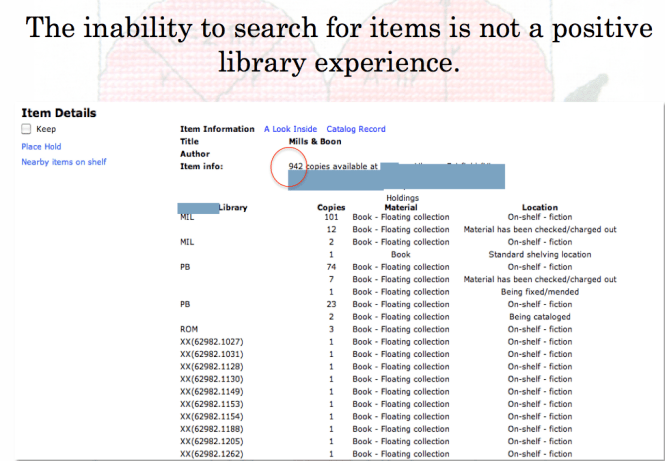
This single catalogue record/many accessioned items impacts the reader experience of the library. The inability to search for items is not a positive library experience. I attended the Australian Romance Readers Convention in 2009. I was discussing public lending rights with an Australian Mills and Boon author. Her comment was “My books don’t get catalogued. As they are rarely searchable I don’t recieve PLN payments”. This writer has 16 books published in Australia and translated in over 10 languages worldwide. This decision to not catalogue does not only impact readers – it impacts authors and their impression of libraries.

Let’s look at the language librarians use:

Here are 2 large print Mills and Boon Christmas trees. Both libraries posted these on their social networks.
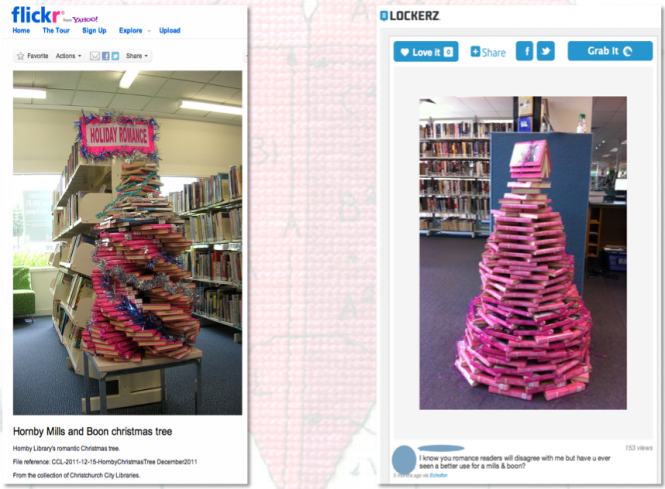
The first one is a romantic tree. Straightforward. Objective.

The second tree – “I know you romance readers will disagree with me but have u ever seen a better use for a mills and boon”. This statement that these books purpose as an aesthetic, decorative object is preferable to their content may be tongue in cheek and having a bit of fun but what message does it send to the recipient of that social media?

To the romance reader, it sends the message that their reading choices are inferior. To the non-romance reader it sends the message of librarian (authority figure) is disdainful of romance therefore romance must be inferior if said authority figure says so. As librarians, do not underestimate the authority that you command.

Another example, I was approached by a librarian who wanted romance recommendations for a display he was preparing. I suggested Jennifer Crusie was a good start and his comment was “Oh. But Crusie transcends the romance genre. Her writing is highly commendable”.

To transcend a genre is what happens when a reader discovers that the book they have just read and enjoyed is genre fiction but they don’t want to identify themselves as having read genre.

Romance is not alone in this. Margaret Atwood has transcended fantasy. Peter Temple has transcended crime. I dislike transcends. I prefer to use the phrase “these authors benchmark their genre”. Jennifer Crusie is a benchmark of romance. As librarians the language we use when discussing reading with our patrons and our colleagues needs to be objective. Patronising only results in less patronage.

On Legal Deposit in Australia and NSW:

The National Library of Australia has the most comprehensive romance collection in Australia as they catalogue all the titles they receive through legal deposit. The State Library of NSW fully catalogues all romances written by Australian authors which then become part of the Mitchell Library collection. Other titles by non-Australian authors are not catalogued thoughthey are stored in offsite storage and accessible if you know the publisher, the month and year that they were published. Fisher Library at Sydney University however has retained few of the romances deposited with them. They’ve retained authors such as Stephanie Laurens, Bronwyn Parry, Helene Young and Anna Campbell. However, Anna Jacobs or Anne Gracie, Sarah Mayberry and Kelly Hunter all of whom are celebrated and awarded both nationally and internationally as benchmark authors in the romance genre do not have a single title of theirs held at Fisher Library along with a number of other Australian women authors published in NSW that I could list let alone looking at bodies of work by specific international romance authors that a scholar may be interested in studying. But I was placated by the librarian I spoke to with“we have a great crime collection if you want to study genre”.

How does the romance reader perceive the library?

The Australian Romance Readers Association conducts an annual readers survey.

There are 2 library specific questions in this survey.

“Have you borrowed romance books from your local library this year”. 50% of respondents answered “Never”.

“Are new romance releases usually available from your local library” Only one quarter of the respondents said yes. The other quarter said no, and let’s not forget that half of the respondents never use the library.

I find this data concerning. This is a survey of engaged, committed readers. Readers who are part of a reading association, readers who follow book review sites, author websites, subscribe to newsletters, magazines and blogs so as to decide upon their next read. These are readers that engage with social media. If we are looking at the lower end of the scale these readers read 60 romances a year and this does not include their other reading interests. Yet, they don’t recognise the library playing a large, positive role in their reading experience. Half of them never use the library.

“To Sup with the devil you need a long spoon”

Libraries have treated romance readers as “the devil” for they maintain a distance from them. We see this in librarians trying to improve the readers choice, cataloguers not valuing the books the readers choose. All this is reflected in the romance readers survey responses that the library is not a provider for their reading needs.

It will be interesting to see what trends will emerge with ebook lending.  When I searched the libraries in Sydney that subscribed to Overdrive there were a substantial selection of romance titles available. That spoon is getting shorter. It is not all dire. There are libraries that know the value of the romance reader. They have strong romance collections, romance authors are on their standing author lists, speak at library events and run writing workshops. These libraries know that the big readers impact positively on their KPIs so they court the reader and romance readers love a courtship.

Towards the end of Sup with the Devil, Courtney is torn. She suspects her husband embezzled from her family but she likes him. She makes the decision that she was no longer going to hold him at bay for “to sup with the devil might hold an element of excitement”.

to sup with the devil might hold an element of excitement

This metaphor invites you to be a risk taker. Life is about using the short spoon when you are supping with the devil. And this is what libraries should be doing.

Look for the marginalised reader, look for the marginalised patron and support them and court them.  Discover those ideas that to others are distasteful, that are met with derision and make room for them in your libraries. Find your gamers, hobbyists, hackers and makers. Your homeless, your reenactors, geeks, crafsters and subversives. Look at your emerging communities and do not dismiss your established users. For Raymond Williams tells us that Culture is Ordinary. That “every human society has its own shape and its own purpose, its own meanings. Every human society expresses these, in institutions and in arts and learning”. These institutions are our libraries and libraries are our secular cathedrals and these secular cathedrals should be representing our ordinary culture. As this conference is about Discovery, I ask you to go out, discover the ordinary in our society and use the short spoon to sup with them.

© Vassiliki Veros and Shallowreader, 2012.

Reflections on Sydney Writers’ Festival 2012

Over a week ago I attended a handful of sessions at the Sydney Writers’ Festival. The last time I had attended the festival was in 2009, as I was overseas in 2010 and moving out of my house in 2011. The Sydney Writers’ Festival is always an exploration of ideas and unknown writers for me. The festival rarely represents my personal reading interests but on a professional level, as a readers’ advisory librarian, every session is important, every session has relevance. Writing festivals reflect a segment of the reading publics’ interest and in the months that follow there will be a raised awareness of the authors that were in attendance and with it a higher demand for their books both in bookshops and libraries. With that in mind, it was lovely to bump into several librarian friends and colleagues over the 3 days I attended and I would love to think that there were many more librarians in attendance.

Audience

I find the writers’ festival appeals to a conservative audience. That is, tertiary educated and women. Please don’t misunderstand me here, I feel this is a wonderful group – I AM this group! It is imperative that this audience base is retained but I would like to have seen a little more experimentation with the events so as to appeal to, not only a broader readership, but a broader cross section of the greater Sydney community. Surely risk taking with writer events is not only the charge of emerging writer’s festivals and fringe festivals. The organisers might point to the hiphop poets but hiphop has been around for many decades so I don’t count that as experimental. Perhaps I would have noticed a broader audience if I had attended some of the Western Sydney events but I was only able to attend the city events this time.

The other thing I felt was the distinct difference between attending a readers’ convention and a writers’ festival. Here, I am comparing SWF to the Australian Romance Readers’ Convention. The differences may be more due to the volume of the individual events where there are about 200 people at ARRC compared to the thousands that attend SWF. However, I don’t really think this is the difference. At the SWF the writer is coveted. Most don’t walk and talk amongst the other attendees whereas the readers’ convention is about connecting reader to writer both at scheduled events and at social events where you get to meet each other. Perhaps it is Writers’ Festivals focus on the writer experience whereas readers’ conventions focus on developing the readers as fans. I think that this is a grey area which I am interested in exploring futher.

National Year of Reading

I found it very peculiar that in the National Year of Reading there was no mention or presence of the National Year of Reading campaign. I am happy to stand corrected on this point but from my own observations (and I cannot be omnipresent so I can only comment on the sessions I attended and the tweet stream I read) this didn’t cross the radar of the organisers nor the presenters of the sessions I attended. Richard Glover’s blurb makes mention of NYR, as do the CBCA events as they are NYR partners. I’m not completely naïve and I realise that it is a complex case of sponsorship, advertising, grants approval etc but to have a zero connect is like having a forestry convention during the National Year of the Tree with no crossover. SWF is on the National Year of Reading’s events calendar but I’d love to hear from others on this. Maybe I missed something. Is this unique to the Sydney Writer’s Festival or has the National Year of Reading been missing from all the other Writers’ Festivals around Australia.

Kids at the Festival

I think that kids programs at the festival is one area that is excellent. Every year seems to have the same consistent good programming. There is a broad representation of literary authors and mass market authors. I love this. It shows that you can have the benchmark literary authors alongside benchmark mass market and genre authors. Ranging from picture book authors to young adult authors reflecting the different age groups. Hopefully, the adult programming will start to shift and be more like the kids programming.

I took my son to hear Jeff Kinney speak. I was fortunate enough to have won tickets from @BookdOut on Twitter (thank you! once again).

Jeff Kinney is fab! Jeff Kinney writes books that appeal to children because he “gets” kids. He remembers details from being a kid. I found it quite interesting that he said that he kept being told that he “appeals to reluctant readers” and that he didn’t know what a reluctant reader was until it was explained to him that it was boys. Yet boys are not reluctant to read Diary of a Wimpy Kid because the writing appeals. My funny son, did say that Jeff Kinney was up there as a favourite but not his absolute favourite (this from a boy who sleeps with Diary of a Wimpy Kid books framing his bed).

What I did find peculiar in the kids program was the omission of Eoin Colfer from a standalone presentation or talk. Eoin Colfer has a huge readership in Australia. Many adults, along with kids, love his Artemis Fowl books as well as his Worst Boy books yet the only way you could get to hear him speak is if your school chose to take you to a Schools Day event that he presented to. I was very disappointed by this.

Beating the genre drum – Writers don’t get it but the critics did

There were several thought provoking comments during different sessions which were made during the writers’ festival that I will outline. The panels that I’m talking about had a varying degree of my presence from reading a tweetstream, to sitting outside a theatre and listening to a panel to actually attending two sessions.

I was following the tweetstream from Kathy Lette & Toni Jordan’s Girl Trouble session seemed to be more anti-chick lit than for chick lit. Lette showed her lack of understanding of the genre with comments about clitlit and Mills and Boon. There is a Storify of the tweets and the ensuing wider audience comments about these comments. I love that a tweeted comment could get so many people not in attendance discussing the talk. Such is the power of social media. I also understand that comments can be taken out of context and that this is the negative side of social media. I spoke with some friends who had attended this session and said that she was very funny and the comments were just flippant. But isn’t that always the case when someone is being derogatory about something that they feel is inferior to them? The flip comment is not necessarily the ignored comment. Perhaps authors should allow their work to stand on their own merits rather than trying to elevate their work through the discrediting of authors and publishers whose work I doubt they have read.

This was not a comment isolated to that session. As you do at the SWF, there are times you walk around and listen to panels being piped out into the forecourt. One session I listened to the closing 20 minutes of was Old Scrags and Other Sheilas.I have no idea which of the speakers was saying the following but when their book was described as “chick lit” the author – very respectfully and in no way flippant or denigrating – stated that her book was not chicklit which was a subgenre of romance as chick lit had plot points and specific requirements for the order of events that need to happen. She emphasised that her book was not chicklit because she played with these ideas and changed them around. She then proceeded to discuss how she loves the conventions of crime fiction and how different authors played with these conventions.

I respect that an author may not identify their work as a certain “type” and have no issue with the author rejecting the “Chicklit” label but to describe romance/chicklit genre negatively due to the rules that they follow yet in the same breath celebrate “crime conventions” seems obtuse to me. What is derided in one genre is celebrated in another? How could that author not have seen that formula=conventions. A bit of a “Duh” moment really.

Another session that I attended was “But is it a good read”. Stella Rimington’s controversial comment that the Booker prize judges panel were going to choose “a readable” book was the basis of this talk. Stella Rimington brought up that she possibly should have used the word more “accessible” rather than ‘readable’. Other panellists were Stephen Romei, Chip Rolley and Neil James from the Plain English Foundation. There were a wealth of statements such as

“We are all different readers”

“what is difficult for you will be a zip along for someone else”

“I love being challenged but not challenged and bored”

“A good read will always be noticed by the public whereas a difficult read needs the prize to be noticed by the public”.

The idea of privileging difficult reads was brought up. Somehow, society consider the difficult read to be the better read. This did bring me to think that perhaps this was a Christian ideal, harking back to the narrow, less travelled road. It also is reflective of St Augustine discussing the guilt he felt for his enjoyable, leisurely reading.

There was a lot of discussion around the readability of Ulysses. Many people in the audience admitted to owning it but not reading it. One of the questions/statements from an audience member was on having rejected reading Ulysseys but having loved the audiobook as it is a book of rhythms and quite dependent on the auditory experience. Stella Rimington immediately dismissed this idea “That is acting. That is not reading”. (As an aside – this seemed quite startling for me as I have always thought of audiobooks to be a reading experience. But upon further thought, audiobooks do not require any decoding. They are a natural experience.) So telling may not be reading but certainly a story, such as Joyce’s Ulysses, can be much more enjoyable in an auditory capacity.

I want to write that Stephen Romei’s positive comments on genre writing were pleasing to hear. Romei pointed out (in relation to the Booker Prize) that genre novels do not get chosen not because of the judges but because of the publishers. The judges already receive a vetted list before they decide on a longlist as each publisher can only enter two books. So it is the publishers who are the ones who are setting the agenda against genre here.

Another mention of genre was at Criticism and Witticism and the Pascall Foundation’s Critic of the Year award which was awarded to James Bradley who was described as a “polymath of genre” and that “Bradley argues for a wider sense of what literature can be”.

Wrap-up

I had an invigorating 3 days spent browsing the different sessions at the festival. Sydney had brought out its best weather for the event. There were a few other sessions I attended on memoirs, the environment, politics and war that I have not discussed here. In the end, I chose not to attend any Sunday events because I felt recharged and I spent a day at home reading with my family. My 3 year absence highlighted to me that organisers, moderators and critics are aware that there is a broader readership with which to engage but this is not yet evident in the programming. Perhaps, this will come around next year (she whispers optimistically).

The Passionate Winter – with free 5 years later epilogue by Moi channelling Jackie

The Passionate WinterThe Passionate Winter by Carole Mortimer

This book is full of WTF situations yet it is trainwreck readable. It was published in 1978 and the book has not stood the test of time.

The hero, 37 year old Piers, is the father of the 18 year old heroine, Leigh’s boyfriend (also 18). They meet when the son, Gavin, is trying to trick her into bed with him and the dad diffuses the situation. She continues going out with the son as a “special friend” despite hot pashing sessions with the stalker dad who is freaked out by their age gap of a comfortable 19 years. Her parents are relaxed about him (go figure!) and have no issue with the age gap. Yet she continues to politely refer to him as ‘Mr Sinclair’ even 20 pages from the ending. He keeps refering to her as an adolescent, kid, young lady etc. The age gap was irksome but I kept reminding myself of pairings such as Celine Dion and Rene Angelil (26 years) and Catherine Zeta Jones with Michael Douglas (25 years) and that it isn’t unknown for such a large age difference. Also, it was the major issue for the two protagonists in this book and it was not lightly dismissed. The heroine keeps being told that she deserves a beating from both the hero and her father and she keeps slapping people. Horridness abounds and love is only realised by sexual attraction.

I did love the description of clothes throughout this book. Her dresses were superb (except her nurse’s smock), her velvet trousers and cream smocks, purple slacks and black turtle necks. Hero Piers alternates between formal dress clothes, black trousers with a white dress jacket,  to brilliant outfits

“He was dressed in close fitting black trousers and a black silk shirt unbuttoned almost to the low waistband of his trousers….Over these he wore a thick sheepskin jacket…”

Hawtness! There’s even a frilled neck shirt in one scene!

There is the usual Mills and Boon HEA but I kept imagining what life would be like for these two in 5 years time. Not pretty. So ‘not pretty’ that I couldn’t help myself and I wrote my own response to how I think life treated Piers and Leigh ….and Gavin (cue wobbly dream sequence waves)….

MOI

Leigh is 23 years old and feeling very much like her youthful age. However, she grimaced when she thought about her 42 year old husband who still wore his shirts open to the waist, he still tried to keep up with trends – he’d even started sporting Michael Jackson styled jackets. When it came down to it their age difference was abysmal. Lately, he had been hinting that they should have a child but all that she can think of is that he grated on her nerves.

She had finished studying two years earlier and she looked back at her decision to marry a man nearly as old as her father who was temperamental, a bully and occasionally still thought it was fine to threaten her with a beating. Her own friends had partied through their studying years and even though they tried to include her and pops-hubby neither of them really had fit in with each others group. Looking back at her decision to marry him she realised that she had only done so because she had been too scared to just go to bed with him. The lust would have been over and then she could have moved on. But innocent that she was at the time, life had been rose-coloured glasses.

And now she had to deal with the fact that last night she and Gavin had more than made out. Her stepson! Her stepson who had been the guy that she had been going out with when she had been blindsided by hunkahunka burning love. Uggh! What could he have been thinking. She was dumb and 18 but if at 23 she realised his pursuit of her was creepy weird why couldn’t he who had been 37 at the time just backed off. Whereas Gavin now was gorgeous, so much more mature that he had been 5 years ago and their interests were much the same. If anything, Piers, washed up racing car driver that he was, spent his nights tinkering with his car, had been fine for his young wife to go to discos with his son and her friends. “I trust you darling! You chose me over him.”

So much for trust, Leigh thought. Going the full way with Gavin had been stupid and risky but the two of them had been burning for each other for years. She would have to divorce Piers, she thought. But this time she was not going to marry his son. She knew the desire would go away and she would be left with an awful, awkward mess on her hands. She’ll have her affair and move on to someone else, eventually. She just hoped that she had not fallen pregnant last night with Gavin….or the night before when she had been with Piers….

Yep, I think I’m channeling Jackie Collins 😀

R*BY Award Finalists and the availability of the shortlist in Australian Libraries


The Romance Writers of Australia Awards were announced today. These awards are voted on by readers and I was pleased to see so many of my favourite Australian Women Writers listed. As I am saving all my pennies to get my bookshelves built, I thought I’d borrow some of the titles through interlibrary loan so I searched through Trove (the National Australian Library’s database for the uninitiated) and I thought I would share the results with readers of this blog.

Short Sweet
Molly Cooper’s Dream Date – Barbara Hannay (18 public libraries/4 State or National)
How To Save a Marriage In a Million – Leonie Knight (1 public library/2 State/National)
Abby and The Bachelor Cop – Marion Lennox (19 public libraries)
Single Dad’s Triple Trouble – Fiona Lowe (16 public libraries/1 State/National/1 University)

Short Sexy
The Fearless Maverick – Robyn Grady (1 State/National/1 University)
The Man She Loves to Hate – Kelly Hunter (12 public libraries/1 State/National)
The Wedding Charade – Melanie Milburne (19 public libraries/1 State/National/1 University)
Her Not-So-Secret-Diary – Anne Oliver (7 public libraries/1 State/National/1 University)

Long Romance
Midnight’s Wild Passion – Anna Campbell (39 public libraries/2 Universities/3 State/National)
Boomerang Bride – Fiona Lowe (0 holdings – this seems very odd to me)
The Best Laid Plans – Sarah Mayberry (11 public libraries/1 university/National)
The Voyagers – Mardi McConnochie (53 public libraries/4 Sate/5 universities/National)

Romantic Elements
The Trader’s Wife – Anna Jacobs (52 public libraries/2 State/National/2 University)
The Shelly Beach Writers’ Group – June Loves (63 public libraries/3 State/3 Universities/National)
Busted In Bollywood – Nicola Marsh (0 – this seems very odd to me)
Shattered Sky – Helene Young (54 public libraries/4 universities/3 States/National)

I’m not sure how anyone else feels about this list but, with the exception of 5 of the titles, it doesn’t feel as though there are many loan choices. At first glance 15 might seem a lot but break that down by State and it doesn’t represent many holdings. I’m not sure how the authors themselves would feel about this. Is it a case of “Good – they’ll go out and buy my book instead” or “For heaven’s sake! Will librarians start buying up in romance! I want my books to be read by library borrowers who ultimately become buyers”.  Hopefully, now that libraries have a shortlist to select from, this list will look quite different by August when the awards are announced.

NOTE: I know that, in terms of ILL’s libraries do have other avenues to search for titles, but as a reader searching from home, I rarely explore these other options. If it isn’t listed by Trove I either don’t read it or I buy it. I also understand that Australian Librarians can’t all buy every single title that comes out – and perhaps this is where I sometimes get all nostalgic and bemoan that libraries no longer have schemes such as the wonderful Sydney Subject Specialisation Scheme – Fiction Reserve program in place. This scheme gave each library in the Sydney region a Dewey span and a Fiction letter span to specialise in – for example, one library I worked at had the span of authors with surnames Koc – Let (cheeky librarians). The loss of this program has resulted in everyone catering to the middle ground and some less well known, less read but still interesting books are not being purchased.