Reading Note 86: I first heard of Koraly Dimitriadis in the early-2010s when I came across her Twitter discussions. I looked up her books and saw them described as “portraits of life”, “ghosts of the old country”, “emotional self-examination” and at that time, I just couldn’t engage, purely based on my own personal situation where I was overwhelmed with life demands that I couldn’t bear reading someone else’s take filled with gritty reality.
However, it is more than a decade later, the Greek-Australian Writers’ Festival is hosting Koraly Dimitriadis, and though I can’t really say that I am not busy, I am certainly not as overwhelmed by life’s demands as I used to be (the amazing liberation of no longer tending to the physical and emotional needs of teenagers while also working and studying)! So during the semester break, I sat down with Dimitriadis’s collection of short-stories The Mother Must Die and it had this deep, clawing impact upon me.
The opening story “They Put Me in my Grave” was an amalgam of so many Greek mothers’ voices I have encountered in my life, including my own mum. The mother in the story grieving the shame that is brought upon her life by her daughter divorcing her husband, refusing to acknowledge her daughter’s pain. The mother looking back at the betrothal remembering the couple’s “Promise” to her to stay together echoed my own mother telling my Anglo boyfriend (and now husband of nearly 30 years) that “it is better you kill me than shame my family with divorce”. In that first page, I felt ill at reading further but also damned if I didn’t as the writing was compelling.
Every short story is a telling of modern-day Australia where there is a negotiation of cultural expectations, personal grief and lost dreams. Of the 15 stories, the ones that stood out to me were “They Put Me in my Grave”, “Theo and Haroula”, the devastating “Smelly Francesco”, and “The Bridal Wars” where Tasha belligerently casts her vote following her father’s preferences, on the eve of finally becoming self-aware through her viewing a documentary on Fast Fashion, regretting her vote and seeing life and wedding processions through an ethical fashion lens – a lazy Saturday night watching TV changing Tasha’s life trajectory.
I absolutely loved this book which was felt so close to so many people I knew, including myself, but also so distanced from my own life. It was like a sliding door to a life I somehow avoided. Dimitriadis’s writing style mirrors so many Greek-Australian writers like Peter Polites and Will Kostakis who occasionally inject a local Greeklish (or is it Greenglish???) vernacular which makes each story accessible and personal.
The fashion industry is killing the planet but I really need that new designer handbag… Her daughter is divorcing and she’s going to die because of it… The mother must be medicated… I’m in Australia but I just want to be in Cyprus… She’s never had an orgasm and still lives with her parents…Anything my boys want they get… He’s got a whole bank of chicks on his phone… Ever since I came to this country I been in bed… Until her children can get her the new drug for the MND, she will dream of her village in Greece…Conquests are about scoring the chicks, but he’s never going to turn out like his nonno… They never talked about what her uncle did again… The money made him go mad… My mummy is sad, she keeps talking about ‘court and custody’, but I’m going to take the potion and make everything better…
Broken people trying to make their way back to hope. Stories of identity, divorce, sexuality, parenting, domestic violence, and the working-class migrant experience. Bestselling poet Koraly Dimitriadis’s debut collection will transport you into the minds of disenfranchised characters, troubled men, children who live in two homes, andwomen trying to break free.
With the Greek-Australian Writers’ Festival https://greekfestivalofsydney.com.au/…/greek-australian… being held this Sunday, I thought I would post about some of the sessions that we are running this year. I have read many of the books which are being presented this year.
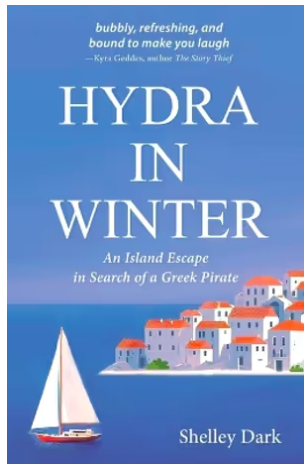
Reading Note 85: We will be launching Shelley Dark’s Hydra in Winter on Sunday. This is such a wonderful and delightful read. Part genealogical study, part history, another part memoir and writing guide. I loved how Shelley Dark expresses her every day, researching her family’s first ancestor in Australia, Ghikas Voulgaris. Voulgaris was a Greek-Hydriot sailor turned pirate captured off the coast of Malta, and sent to 7 years in the colony of New South Wales in the early 19th century. Voulgaris leaves Hydra as a young man during the Greek War of Independence (1821-1829), yet he never returns to Greece, staying in the colony of New South Wales for the rest of his life despite receiving a pardon and free repatriation after he had served his time.
I love the Argo-Saronic islands of Greece and have visited Hydra many times while visiting my aunt on the nearby island of Poros. Poros itself gets a brief visit from Dark on her way to Hyrda which in winter transforms back to a tourist-free haven with a long-time literary tradition.
In Hydra in Winter, Dark sets off for her husband’s ancestral island in search of the story of Ghikas Voulgaris, one of seven Hydriot pirates captured and sent to Australia as convicts in the early 1800s. What begins as a historical quest also becomes a lesson in slow travel—walking Hydra’s hills, delighting in Greek seafood and wine, and meeting the relaxed and ever-hospitable locals. Her sojourn on Hydra later sparked a much longer research journey, taking her to Malta, Portsmouth, the Kew Archives in London, and Ireland to further investigate the pirate for her historical novel about the pirate, Son of Hydra, due for publication in 2025. In conversation with Festival Director Dr Helen Vatsikopoulos.
In my continuing tale of pretending that I am not taking part in SuperWendy’s TBR challenge, I continue to (quasi) take part by riffing off her monthly themes, and this month is Location Location Location.
Observation 102: Foreshadowing the reading note 42. There is a long history in Australia of migrant Greeks opening milkbars in suburbs and country towns from the mid-twentieth century. Most of these have either closed down or morphed into cafes run by the original migrant owners’ children and grandchildren. Australian photographer and historian couple Effy Alexakis and Leonard Janiszewski have captured much of the history of this Greek migrant phenomenon in their non-fiction books.
For example, I remember in 1982 my family going for a holiday to Port Macquarie. My mother mentioned to my dad that she believed her cousin ran a milkbar in the small city but didn’t think it was possible to find her. My dad pulled his car over and called out to a pedestrian “excuse me – where is the best milk bar in town”. The man leant over and said “that would be the Greeks” and proceeded to give my father directions. Dad drove a few blocks. We all got out and it was my mum’s cousin behind the counter.
With stories like these, and experiences in Greek milkbars in Marrickville, Dulwich Hill and Summer Hill in the Inner West where I have spent my whole life, the milkbar is synonymous with family and friends and my experiences. There is even a small bar in Summer Hill called The Rio Bar which draws on its previous history as a Milk Bar which stood there for over 60 years and closed only when its elderly owner George Poulos passed away. The external signage being left intact.
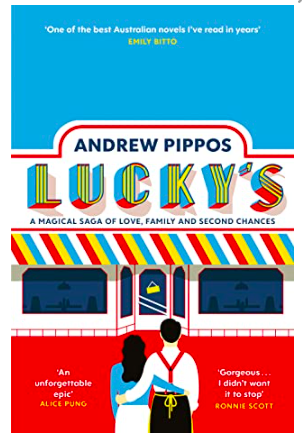
Reading Note 43:Familiarity with a location in novels. Other than romance fiction, I have two other absolute go-to fiction reads – books set in the Inner West of Sydney, (Melina Marchetta, Marele Day) and books written by Greek Australians (Christos Tsiolkas, Peter Polites). So upon discovering that Greek-Australian author Andrew Pippos wrote a book about Greek milkbars in the Inner West of Sydney, it was an auto-read (though it sat on my TBR for over a year). So for my only leisure reading adventure in April, I read Andrew Pippos’s Lucky’s. The Goodreads blurb is as follows:
Lucky’sis a story of family. A story about migration. It is also about a man called Lucky. His restaurant chain. A fire that changed everything. A New Yorker article which might save a career. The mystery of a missing father. An impostor who got the girl. An unthinkable tragedy. A roll of the dice. And a story of love – lost, sought and won again (at last).
Following a trail of cause and effect that spans decades, this unforgettable epic tells a story about lives bound together by the pursuit of love, family, and new beginnings.
I am not really sure where to start with this book. I was intrigued and excited to read it. The promise of a novel about Greek-Australian milkbars and coffee shops had high expectations for me. Sadly. Because high expectations just makes the disappointment that little bit more palpable.
The book is premised on recently made redundant editor Emily who travels from London to Sydney on a search for her (dead) biological father’s connection to a painting he had given to her of a restaurant called Lucky’s. Emily discovers the story behind Lucky (nicknamed as such because “Vasilios” was too hard) who with his wife Valia, built a franchise of restaurants across New South Wales, having first purchased the restaurant from Valia’s mean-assed father, Achilleas (I can’t remember if it is Achilleas or Achilleon. I have returned my library copy so I can’t check). But like many people who build fortunes, Lucky lost his, due to lives that were lost, his wife divorcing him, and his life opportunities being reversed.
As part of her own search for her father, Emily meets Lucky to interview him for a story she was writing in The New Yorker, an opportunity provided to her from a friend and old lover, a man who gave her the chance to rediscover herself after the revelation of her husband’s infidelity. Pippos’s characters are richly written and the one thing that did shine strongly was his ability to write well-defined female characters, something that his male Greek-Australian contemporaries Peter Polites and Christos Tsiolkas fail, their female characters often being reduced to stereotyped caricatures. Pippos is successful where they are not. I like Emily, Valia and the other women in this book. They are full characters, they are believable and complex throughout the story.
The novel moves back and forth through time, from 2002 to the 1940s, 1960s right through to the 1990s. I do enjoy a book that time jumps in its aim to unravel a story but it didn’t really work for me in Lucky’s. I found that there was too much of a disconnect between Lucky’s tragic story and Emily from England’s story, and the time jumping did it no favours. Unfortunately, this was not my only gripe.
I was annoyed by the idea that Lucky’s was a franchise. I get it. This book is fiction. You can write anything you want in fiction, it is poetic licence and writers can do whatever they like to embellish their stories but I was unconvinced and it annoyed me when it could have easily just carried me with the story.
This is not unusual for me. I’m all over the place with my opinion on anachronisms in fiction. In one book, I may be totally fine with an EJ Holden being driven during a Jazz era scene, and in another book I will be annoyed with go-go dancers in a WWII scene. I am totally at ease with wallpaper historical romances, yet easily annoyed by historical inaccuracies in the series The Tudors. And yet the mention of a 1990s trip to Tempe Tip annoyed me. Tempe Tip closed in the 1970s dammit!
There was too much suspension of disbelief required for my reading of this novel. Lucky’s being a food franchise from the 40s and 50s annoyed me. Food franchises didn’t enter Australian until much later in the 1970s mostly through the American experience of McDonalds and Kentucky Fried Chicken. It certainly was not true to the Australian experience of Greek milk bars and cafes. These were single family business and it really bothered me that the set up for the whole novel challenged this knowledge. It even got me wondering if there was even a kernel of truth to it, making me question what I considered an absolute certainty, one validated by the Alexakis and Janiszewski photographic histories. That said, I am more than happy to be corrected on this point.
I also felt that the sense of place was lacking. Even though Pippos makes mention of all the suburbs that I live around, and towns that I have visited, there is a lack of description. I hate to draw comparisons (but I will still do it), but Peter Polites’s description of Sydney (both East and West) is visceral and truthful, as is Melina Marchetta whose description of the Inner West is like the places I frequent every day – though in Marchetta’s The Piper’s Son, there is a scene where the main characters drive to a Newtown pub from Maroubra Beach via the Anzac bridge which is the most ridiculous double distanced route possibly imaginable. Despite this, Marchetta’s Inner West is as strongly characterised as her protagonists. However, the issue with Lucky’s is that the roads and suburbs, the light, the air, the sounds, the sense of standing in the places that his book described to me was a feeling that I didn’t experience. Pippos doesn’t really describe the cafes in the story beyond names. The cafe itself is not a main character, and neither is the city a character. They remained names and any name, any location could have been used.
Another annoyance which is personal and just for me, was Valia’s name which is fine and good. However, it was revealed partway into the book that it was short for Vassiliki and though I can kind of imagine how this is a possible shortening of my name, it is one I have never come across. Name shortening isn’t letter potluck, right? There are naming rules like chopping out syllables, mostly about finding Anglo equivalents. The name “Valia” doesn’t do this and I remain unconvinced.
That being said, I was pleased to be able to add another book to my “Vassiliki/Vasiliki” Goodreads tag which is pathetically sitting on five books having a character with my name.
LOL.
Just a quick heads up that you may want to stop reading here because there are some spoilers ahead.
Movie Note 1:I masked up and went and saw a movie. So not even an hour ago, I walked out of the darkness of the movie house, and I had two things on my mind. Sandra Bullock and my ride home (cheeky wink for The Outsiders fans). I just watched The Lost City and I was so amused, so delighted, so so so happy that a light-hearted romance comedy had been made and it just slayed. It had everything – an adventure romp with witty repartee, love and snark and everything in-between. It had an enemies to lovers trope. It had cover model jokes. It had the sassy best friend trope (wellll….kinda with a twist – she was author Loretta Sage’s literary agent). It had the nasty (short) villain trope, it had purple sparkly prose metaphors (oh that onesie that Bullock wears for most of the film sublimely channels all the romance expectations), it had allusions and intertextuality, it had lush location location location Atlantic island setting,, it had folklore singing sages, it the dark moments, it had swoon, oh and it had….it had spark!
I have always loved Sandra Bullock romcoms (Miss Congeniality, While You Were Sleeping, The Proposal, Two Weeks Notice) and she just excelled in her role of a tad recalcitrant romance author Loretta who has given up on her dream of being an archaeologist due to her true love husband having died. I have never seen a Channing Tatum movie (that is correct – not even Magic Mike) so I was pleasantly surprised at how cheeky and cool and fantastic he was in this movie as the gormlessly sweet cover model Alan who like Fabio seems to have no surname.
For lots of fun convoluted reasons Loretta gets kidnapped from the launch of her book tour by evil (Murdoch-like) mogul Abigail Fairfax (like realllllly??? The scriptwriters must be keenly in tune with the former Australian mass media family moguls) played by Daniel Radcliffe. Fairfax needs Loretta to translate a dead language for him that only she knows so he can find lost archaelogical treasure. Alan along with Loretta’s literary agent, Beth Hatten (played by Da’Vine Joy Randolph) hire former Navy SEAL (lol – romantic suspense trope much) Jack Trainer to find Loretta. Jack Trainer is handsome, tough, a deft fighter, and all things OTT amazing including adding complete and utter validation as tough man Navy Seal, he is a hatchback hero who drives a tiny Bajaj Qute. To the scriptwriters – I feel heard! Trainer (Pitt) is a total hero who makes Alan look soft. But that is why Alan is so cool. I won’t go into what happens other than were being twists, turns, fights, blow-ups, burials, a swoon-worthy dance scene, and just a whole lot of fun.
The Lost City reminded me so much of Romancing the Stone (I do believe this is deliberate) yet it felt fresh and original. And isn’t that the thing about truly magical, truly fabulous movies. The storyline was similar, the locations were similar, as were the stars. But I suspect that The Lost City undoes the 1980s sexism, and instead injects a 21st century sensibility. I loved it.



 Shallowreader