Last week I was part of a reader’s panel at the ALIA Biennial Discovery Conference. Neither the author or reader’s panels were official conference papers. Due to many requests from conference attendees I am posting my paper here on my blog. Please note that this is a heavily edited version of the original paper I had written in response to the Call for Papers and the topics of “The book that changed your life” and “Connecting with your communities”:

I read romances for the love, the escape, for the catch of breath below my diaphragm at the anticipation of that knowing glance and the sexual tension, I read romances for the beautifully retold love cliché, I read them for they are predominately women writing for women about women. I read romances for the sheer science fiction of improbability that is possible, for its absurdist nature and absolutely for the joyful resolution, the Happily Ever After.
Choosing the romance book that changed my life for this talk today was a difficult task as I have so many that I consider seminal. I chose Sara Craven’s Sup With the Devil.
Sup With the Devil was Craven’s 23rd novel. The protagonist, Courtney, was of a privileged background but had been living on the breadline for the last 3 years due to her family going bankrupt. Courtney is being coerced to marry the nephew of the man who bankrupted her family. She remembers her grandmother’s warning that:
when you sup with the devil you should only do so with a long spoon
The story has slow revelations, hidden passions, many misunderstandings And it has love. Not only a passionate love but also a love of friendship and trust that comes from an emergent courtship.
As a teen, I quickly read out the small romance collection at my local library. When I would ask for more the librarian would kindly guide me to “better” reading choices. This was in the 1980s which were focused on reader development/education rather than the current paradigm of reader advisory which is about matching a reader to a similar experience. I was given Mary Wesley and Maeve Binchy. Lovely reads but they were nothing like the darkness of Charlotte Lamb, Anne Mather’s torridness and Carole Mortimer’s alphabrutes.
At university, when reading was being discussed, it was literary. I read across all fiction but discussing romances was considered only one step away from being illiterate. Fine if you weren’t smart enough to read anything else. I also started to explore academic papers on the romance reader which I did not agree with. What these papers did was anger me because everyone seemed to think that there must be a psychololgical reason to read romance. Romances meant I was subjugated. Romances meant I expected a male to rescue me. Romances meant that I was not a feminist. You read to learn and develop and the attitude was that you couldn’t possibly do that with romances.
As a reader, I gave up on accessing my books from my library early on. I bought all my romances from newsagencies, supermarkets, second hand bookstores, bookshops, markets, online and swapping books with friends. As a romance reader I am not unique in this behaviour.
There are impediments to borrowing from the library such as the cataloguing of paperbacks. Records are basic. The practice for many public libraries used to be a “Romance Fiction” title with barcodes attached for individual items. Basically, the romance is not searchable. The argument always goes along the lines of “we have budget constraints”, “these books are junk”, “the readers don’t remember them”.
Cataloguing of literary fiction, which sells less than a third of that of romance, is comprehensive yet romance is not catalogued to the same level.
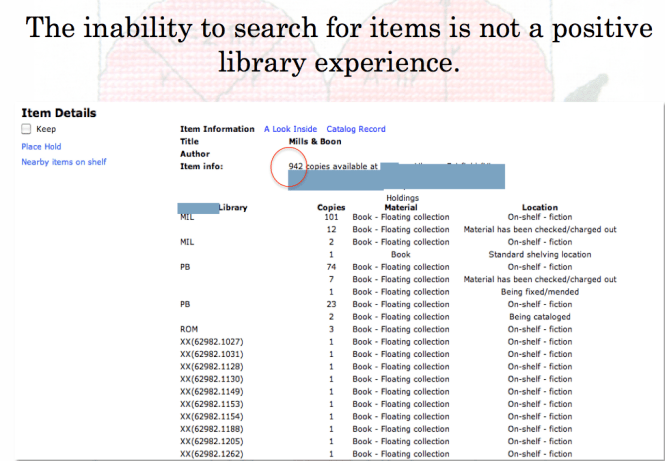
This single catalogue record/many accessioned items impacts the reader experience of the library. The inability to search for items is not a positive library experience. I attended the Australian Romance Readers Convention in 2009. I was discussing public lending rights with an Australian Mills and Boon author. Her comment was “My books don’t get catalogued. As they are rarely searchable I don’t recieve PLN payments”. This writer has 16 books published in Australia and translated in over 10 languages worldwide. This decision to not catalogue does not only impact readers – it impacts authors and their impression of libraries.
Let’s look at the language librarians use:
Here are 2 large print Mills and Boon Christmas trees. Both libraries posted these on their social networks.
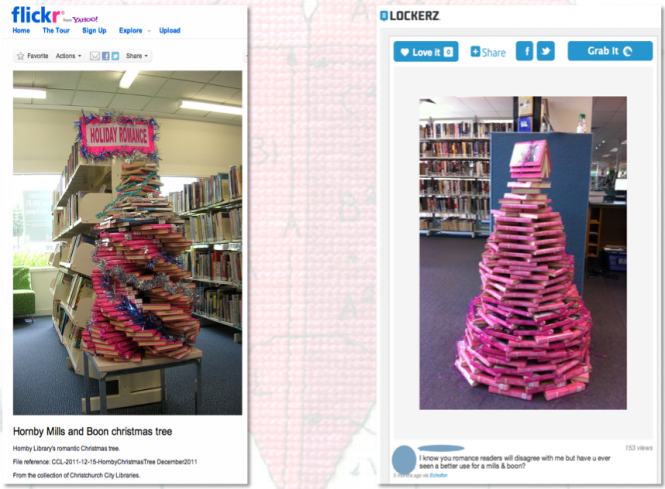
The first one is a romantic tree. Straightforward. Objective.
The second tree – “I know you romance readers will disagree with me but have u ever seen a better use for a mills and boon”. This statement that these books purpose as an aesthetic, decorative object is preferable to their content may be tongue in cheek and having a bit of fun but what message does it send to the recipient of that social media?
To the romance reader, it sends the message that their reading choices are inferior. To the non-romance reader it sends the message of librarian (authority figure) is disdainful of romance therefore romance must be inferior if said authority figure says so. As librarians, do not underestimate the authority that you command.
Another example, I was approached by a librarian who wanted romance recommendations for a display he was preparing. I suggested Jennifer Crusie was a good start and his comment was “Oh. But Crusie transcends the romance genre. Her writing is highly commendable”.
To transcend a genre is what happens when a reader discovers that the book they have just read and enjoyed is genre fiction but they don’t want to identify themselves as having read genre.
Romance is not alone in this. Margaret Atwood has transcended fantasy. Peter Temple has transcended crime. I dislike transcends. I prefer to use the phrase “these authors benchmark their genre”. Jennifer Crusie is a benchmark of romance. As librarians the language we use when discussing reading with our patrons and our colleagues needs to be objective. Patronising only results in less patronage.
On Legal Deposit in Australia and NSW:
The National Library of Australia has the most comprehensive romance collection in Australia as they catalogue all the titles they receive through legal deposit. The State Library of NSW fully catalogues all romances written by Australian authors which then become part of the Mitchell Library collection. Other titles by non-Australian authors are not catalogued thoughthey are stored in offsite storage and accessible if you know the publisher, the month and year that they were published. Fisher Library at Sydney University however has retained few of the romances deposited with them. They’ve retained authors such as Stephanie Laurens, Bronwyn Parry, Helene Young and Anna Campbell. However, Anna Jacobs or Anne Gracie, Sarah Mayberry and Kelly Hunter all of whom are celebrated and awarded both nationally and internationally as benchmark authors in the romance genre do not have a single title of theirs held at Fisher Library along with a number of other Australian women authors published in NSW that I could list let alone looking at bodies of work by specific international romance authors that a scholar may be interested in studying. But I was placated by the librarian I spoke to with“we have a great crime collection if you want to study genre”.
How does the romance reader perceive the library?
The Australian Romance Readers Association conducts an annual readers survey.
There are 2 library specific questions in this survey.
“Have you borrowed romance books from your local library this year”. 50% of respondents answered “Never”.
“Are new romance releases usually available from your local library” Only one quarter of the respondents said yes. The other quarter said no, and let’s not forget that half of the respondents never use the library.

I find this data concerning. This is a survey of engaged, committed readers. Readers who are part of a reading association, readers who follow book review sites, author websites, subscribe to newsletters, magazines and blogs so as to decide upon their next read. These are readers that engage with social media. If we are looking at the lower end of the scale these readers read 60 romances a year and this does not include their other reading interests. Yet, they don’t recognise the library playing a large, positive role in their reading experience. Half of them never use the library.
“To Sup with the devil you need a long spoon”
Libraries have treated romance readers as “the devil” for they maintain a distance from them. We see this in librarians trying to improve the readers choice, cataloguers not valuing the books the readers choose. All this is reflected in the romance readers survey responses that the library is not a provider for their reading needs.
It will be interesting to see what trends will emerge with ebook lending. When I searched the libraries in Sydney that subscribed to Overdrive there were a substantial selection of romance titles available. That spoon is getting shorter. It is not all dire. There are libraries that know the value of the romance reader. They have strong romance collections, romance authors are on their standing author lists, speak at library events and run writing workshops. These libraries know that the big readers impact positively on their KPIs so they court the reader and romance readers love a courtship.
Towards the end of Sup with the Devil, Courtney is torn. She suspects her husband embezzled from her family but she likes him. She makes the decision that she was no longer going to hold him at bay for “to sup with the devil might hold an element of excitement”.
to sup with the devil might hold an element of excitement
This metaphor invites you to be a risk taker. Life is about using the short spoon when you are supping with the devil. And this is what libraries should be doing.
Look for the marginalised reader, look for the marginalised patron and support them and court them. Discover those ideas that to others are distasteful, that are met with derision and make room for them in your libraries. Find your gamers, hobbyists, hackers and makers. Your homeless, your reenactors, geeks, crafsters and subversives. Look at your emerging communities and do not dismiss your established users. For Raymond Williams tells us that Culture is Ordinary. That “every human society has its own shape and its own purpose, its own meanings. Every human society expresses these, in institutions and in arts and learning”. These institutions are our libraries and libraries are our secular cathedrals and these secular cathedrals should be representing our ordinary culture. As this conference is about Discovery, I ask you to go out, discover the ordinary in our society and use the short spoon to sup with them.
© Vassiliki Veros and Shallowreader, 2012.


 Shallowreader