Growing Up: Reading 7 Up style

It is a 7 Up year. The premise of Michael Apted’s 7 Up of “Give me a child until he is seven and I will give you the man.” sparked an interest in me. I decided to explore my favourite books at the 7 Up points and see if the child reader I was at 7 shows you the adult reader I have become.

7 years

My absolutely favorite book was Bennett Cerf’s Book of Riddles that I thought were hilarious and Edward Lear’s Book of Nonsense. I read out the jokes section of the library (793.7). I also read fairy tales and Aesop’s Fables. Humour, happiness and absurd writing appeals to my sense of ridiculous.

14 years

My reading obsession was well and truly established. I loved MAD Magazine and stole as many as I could from my cousin John (who tells me he was aware of what I was doing and felt that every MAD reader should steal their first copies). I loved reading Elizabeth Enright, Edward Eager, Eleanor Estes and the beautiful fairytales of Eleanor Farjeon. I loved Archie comics (love triangle though I like Betty best). By 14 I had outgrown my love of Sweet Dreams and had only just embarked on reading Mills and Boon, Candlelight Supremes and Silhouettes. I loved teen fiction – Judy Blume, SE Hinton and Paul Zindel. I had also just discovered scaring myself with Horror reading. Stephen King, James Herbert and Virginia Andrews. Though I liked ghosts and magic I liked them firmly based on reality and I was never interested in alternate fantasy worlds.

21 years

At 21 my reading was deep and meaningful. I read Euripides and Aristophanes, I turned my nose up to Roman writers (how stupid was that). I read Milan Kundera, Gabriel Garcia Marquez, Isabelle Allende, John Irving, Tama Janowitz and Spalding Gray. I would spend hours talking about the meaning of life and the art of writing. I was a tad hipster. I had ceased reading any crime and could not bear gruesome murder description in my books. Meanwhile my category romance reading remained healthy though I never read larger romances. My opinion at the time was that if you couldn’t write a romance in 180 pages you were a waffler. Also, I didn’t consider the longer stories to be romances. They were novels along with all other books on the Fiction shelves. Marketing, genre identification and stereotyping books had not occured to me as the libraries I worked in shelved books in a democratic, non-judgemental rollcall of authors.

28 years

By the time I was 28 my interest in literature had started to wane. I found the soul searching frustrating, the deep insights snort-worthy and the storytelling stilted and uninspiring. I was searching for joyful reads and the sense of a silver lining was not delivering what I needed. I had found Janet Evanovich by this time and I loved her hilarious books. I also had discovered Jennifer Crusie whose books were completely different to my previous Category romance reading. I also had lots of people recommending Chicklit to me but I never managed to engage with chicklit. Helen Fielding and Marian Keyes were both OK but they lacked the relationship intensity of category romances. My opinion of waffling longer romances still remained but I continued reading literary fiction.

35 years

These 7 years I refer to as my black hole reading years. I had 2 babies and had no time to immerse myself in novels – for the first five years that included the shorter category romances. I read a number of history books, particularly the Penguin Atlas of history series. I enjoyed dipping in an out of non-fiction and I didn’t have to invest time in emotional connections with fictional characters. My reading was centred on picture books and board books. I loved searching for books that would bring chortles of laughter from my toddlers. This is quite a hard task. To date, our favourite funny reads have to be Sandra Boynton’s Red Hat, Blue Hat and But Not the Hippopotamus and Peter Catalonotto’s Matthew A.B.C. In the last couple of years I started reading novels again and discovered Suzanne Brockmann’s category romances. My love for her books led me to reading *shock horror* longer romances.

42 years

It is the eve before I turn 43. My last 7 years of reading have involved me becoming a readers’ advisory librarian and my whole reading life has been turned on its head. I won’t go into my non-book reading here but let it be said that I read non-book items much more than books. My fiction reading has shifted to almost exclusively romance reading. Unlike previous years, I now read longer romances and adore them. I no longer consider them waffle but they are also less intense than category romances which I still read but lately I have become disinterested in them. It took me many years to develop but I now love historical romances. Perhaps because they still allow for tension and courtship which I find is less common in contemporary romance. What I love most is the euphoric joy I feel at the end of a well-written heart rending romance.

7 Up Sum up

“Give me a child until he is seven and I will give you the man.”

Upon first glance, one could say that my reading at the age of 7 is wildly different to my reading today. However, for me, it is comedy and happiness that is my reading gateway. Pamela Regis expanded definition of the romance novel in “A Natural History of the Romance Novel” places romance within the broader genre of comedy. Which takes me right back to being 7 years old and reading out the 793.7 jokes and riddles section of the library. So for me, my reading at 7 is a reflection of me as a reader at 42.

Supping With the Devil that is Romance Fiction

Last week I was part of a reader’s panel at the ALIA Biennial Discovery Conference. Neither the author or reader’s panels were official conference papers. Due to many requests from conference attendees I am posting my paper here on my blog. Please note that this is a heavily edited version of the original paper I had written in response to the Call for Papers and the topics of “The book that changed your life” and “Connecting with your communities”:

I read romances for the love, the escape, for the catch of breath below my diaphragm at the anticipation of that knowing glance and the sexual tension, I read romances for the beautifully retold love cliché, I read them for they are predominately women writing for women about women. I read romances for the sheer science fiction of improbability that is possible, for its absurdist nature and absolutely for the joyful resolution, the Happily Ever After.

Choosing the romance book that changed my life for this talk today was a difficult task as I have so many that I consider seminal. I chose Sara Craven’s Sup With the Devil.

Sup With the Devil was Craven’s 23rd novel. The protagonist, Courtney, was of a privileged background but had been living on the breadline for the last 3 years due to her family going bankrupt. Courtney is being coerced to marry the nephew of the man who bankrupted her family. She remembers her grandmother’s warning that:

when you sup with the devil you should only do so with a long spoon

The story has slow revelations, hidden passions, many misunderstandings And it has love. Not only a passionate love but also a love of friendship and trust that comes from an emergent courtship.

As a teen, I quickly read out the small romance collection at my local library. When I would ask for more the librarian would kindly guide me to “better” reading choices. This was in the 1980s which were focused on reader development/education rather than the current paradigm of reader advisory which is about matching a reader to a similar experience.  I was given Mary Wesley and Maeve Binchy. Lovely reads but they were nothing like the darkness of Charlotte Lamb, Anne Mather’s torridness and Carole Mortimer’s alphabrutes.

At university, when reading was being discussed, it was literary. I read across all fiction but discussing romances was considered only one step away from being illiterate. Fine if you weren’t smart enough to read anything else. I also started to explore academic papers on the romance reader which I did not agree with. What these papers did was anger me because everyone seemed to think that there must be a psychololgical reason to read romance. Romances meant I was subjugated. Romances meant I expected a male to rescue me. Romances meant that I was not a feminist. You read to learn and develop and the attitude was that you couldn’t possibly do that with romances.

As a reader, I gave up on accessing my books from my library early on. I bought all my romances from newsagencies, supermarkets, second hand bookstores, bookshops, markets, online and swapping books with friends. As a romance reader I am not unique in this behaviour.

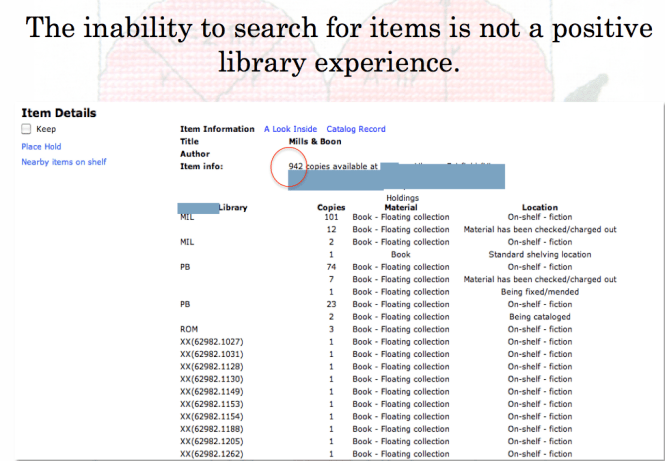
There are impediments to borrowing from the library such as the cataloguing of paperbacks. Records are basic. The practice for many public libraries used to be a “Romance Fiction” title with barcodes attached for individual items. Basically, the romance is not searchable. The argument always goes along the lines of “we have budget constraints”, “these books are junk”, “the readers don’t remember them”.

Cataloguing of literary fiction, which sells less than a third of that of romance, is comprehensive yet romance is not catalogued to the same level.

This single catalogue record/many accessioned items impacts the reader experience of the library. The inability to search for items is not a positive library experience. I attended the Australian Romance Readers Convention in 2009. I was discussing public lending rights with an Australian Mills and Boon author. Her comment was “My books don’t get catalogued. As they are rarely searchable I don’t recieve PLN payments”. This writer has 16 books published in Australia and translated in over 10 languages worldwide. This decision to not catalogue does not only impact readers – it impacts authors and their impression of libraries.

Let’s look at the language librarians use:

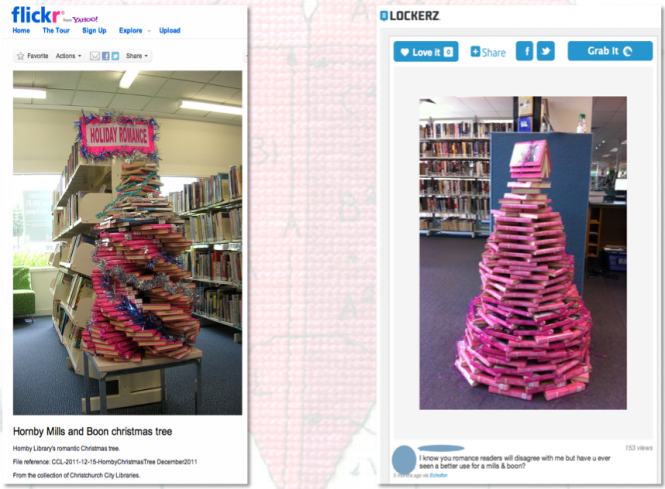
Here are 2 large print Mills and Boon Christmas trees. Both libraries posted these on their social networks.

The first one is a romantic tree. Straightforward. Objective.

The second tree – “I know you romance readers will disagree with me but have u ever seen a better use for a mills and boon”. This statement that these books purpose as an aesthetic, decorative object is preferable to their content may be tongue in cheek and having a bit of fun but what message does it send to the recipient of that social media?

To the romance reader, it sends the message that their reading choices are inferior. To the non-romance reader it sends the message of librarian (authority figure) is disdainful of romance therefore romance must be inferior if said authority figure says so. As librarians, do not underestimate the authority that you command.

Another example, I was approached by a librarian who wanted romance recommendations for a display he was preparing. I suggested Jennifer Crusie was a good start and his comment was “Oh. But Crusie transcends the romance genre. Her writing is highly commendable”.

To transcend a genre is what happens when a reader discovers that the book they have just read and enjoyed is genre fiction but they don’t want to identify themselves as having read genre.

Romance is not alone in this. Margaret Atwood has transcended fantasy. Peter Temple has transcended crime. I dislike transcends. I prefer to use the phrase “these authors benchmark their genre”. Jennifer Crusie is a benchmark of romance. As librarians the language we use when discussing reading with our patrons and our colleagues needs to be objective. Patronising only results in less patronage.

On Legal Deposit in Australia and NSW:

The National Library of Australia has the most comprehensive romance collection in Australia as they catalogue all the titles they receive through legal deposit. The State Library of NSW fully catalogues all romances written by Australian authors which then become part of the Mitchell Library collection. Other titles by non-Australian authors are not catalogued thoughthey are stored in offsite storage and accessible if you know the publisher, the month and year that they were published. Fisher Library at Sydney University however has retained few of the romances deposited with them. They’ve retained authors such as Stephanie Laurens, Bronwyn Parry, Helene Young and Anna Campbell. However, Anna Jacobs or Anne Gracie, Sarah Mayberry and Kelly Hunter all of whom are celebrated and awarded both nationally and internationally as benchmark authors in the romance genre do not have a single title of theirs held at Fisher Library along with a number of other Australian women authors published in NSW that I could list let alone looking at bodies of work by specific international romance authors that a scholar may be interested in studying. But I was placated by the librarian I spoke to with“we have a great crime collection if you want to study genre”.

How does the romance reader perceive the library?

The Australian Romance Readers Association conducts an annual readers survey.

There are 2 library specific questions in this survey.

“Have you borrowed romance books from your local library this year”. 50% of respondents answered “Never”.

“Are new romance releases usually available from your local library” Only one quarter of the respondents said yes. The other quarter said no, and let’s not forget that half of the respondents never use the library.

I find this data concerning. This is a survey of engaged, committed readers. Readers who are part of a reading association, readers who follow book review sites, author websites, subscribe to newsletters, magazines and blogs so as to decide upon their next read. These are readers that engage with social media. If we are looking at the lower end of the scale these readers read 60 romances a year and this does not include their other reading interests. Yet, they don’t recognise the library playing a large, positive role in their reading experience. Half of them never use the library.

“To Sup with the devil you need a long spoon”

Libraries have treated romance readers as “the devil” for they maintain a distance from them. We see this in librarians trying to improve the readers choice, cataloguers not valuing the books the readers choose. All this is reflected in the romance readers survey responses that the library is not a provider for their reading needs.

It will be interesting to see what trends will emerge with ebook lending.  When I searched the libraries in Sydney that subscribed to Overdrive there were a substantial selection of romance titles available. That spoon is getting shorter. It is not all dire. There are libraries that know the value of the romance reader. They have strong romance collections, romance authors are on their standing author lists, speak at library events and run writing workshops. These libraries know that the big readers impact positively on their KPIs so they court the reader and romance readers love a courtship.

Towards the end of Sup with the Devil, Courtney is torn. She suspects her husband embezzled from her family but she likes him. She makes the decision that she was no longer going to hold him at bay for “to sup with the devil might hold an element of excitement”.

to sup with the devil might hold an element of excitement

This metaphor invites you to be a risk taker. Life is about using the short spoon when you are supping with the devil. And this is what libraries should be doing.

Look for the marginalised reader, look for the marginalised patron and support them and court them.  Discover those ideas that to others are distasteful, that are met with derision and make room for them in your libraries. Find your gamers, hobbyists, hackers and makers. Your homeless, your reenactors, geeks, crafsters and subversives. Look at your emerging communities and do not dismiss your established users. For Raymond Williams tells us that Culture is Ordinary. That “every human society has its own shape and its own purpose, its own meanings. Every human society expresses these, in institutions and in arts and learning”. These institutions are our libraries and libraries are our secular cathedrals and these secular cathedrals should be representing our ordinary culture. As this conference is about Discovery, I ask you to go out, discover the ordinary in our society and use the short spoon to sup with them.

© Vassiliki Veros and Shallowreader, 2012.

Reflections on Sydney Writers’ Festival 2012

Over a week ago I attended a handful of sessions at the Sydney Writers’ Festival. The last time I had attended the festival was in 2009, as I was overseas in 2010 and moving out of my house in 2011. The Sydney Writers’ Festival is always an exploration of ideas and unknown writers for me. The festival rarely represents my personal reading interests but on a professional level, as a readers’ advisory librarian, every session is important, every session has relevance. Writing festivals reflect a segment of the reading publics’ interest and in the months that follow there will be a raised awareness of the authors that were in attendance and with it a higher demand for their books both in bookshops and libraries. With that in mind, it was lovely to bump into several librarian friends and colleagues over the 3 days I attended and I would love to think that there were many more librarians in attendance.

Audience

I find the writers’ festival appeals to a conservative audience. That is, tertiary educated and women. Please don’t misunderstand me here, I feel this is a wonderful group – I AM this group! It is imperative that this audience base is retained but I would like to have seen a little more experimentation with the events so as to appeal to, not only a broader readership, but a broader cross section of the greater Sydney community. Surely risk taking with writer events is not only the charge of emerging writer’s festivals and fringe festivals. The organisers might point to the hiphop poets but hiphop has been around for many decades so I don’t count that as experimental. Perhaps I would have noticed a broader audience if I had attended some of the Western Sydney events but I was only able to attend the city events this time.

The other thing I felt was the distinct difference between attending a readers’ convention and a writers’ festival. Here, I am comparing SWF to the Australian Romance Readers’ Convention. The differences may be more due to the volume of the individual events where there are about 200 people at ARRC compared to the thousands that attend SWF. However, I don’t really think this is the difference. At the SWF the writer is coveted. Most don’t walk and talk amongst the other attendees whereas the readers’ convention is about connecting reader to writer both at scheduled events and at social events where you get to meet each other. Perhaps it is Writers’ Festivals focus on the writer experience whereas readers’ conventions focus on developing the readers as fans. I think that this is a grey area which I am interested in exploring futher.

National Year of Reading

I found it very peculiar that in the National Year of Reading there was no mention or presence of the National Year of Reading campaign. I am happy to stand corrected on this point but from my own observations (and I cannot be omnipresent so I can only comment on the sessions I attended and the tweet stream I read) this didn’t cross the radar of the organisers nor the presenters of the sessions I attended. Richard Glover’s blurb makes mention of NYR, as do the CBCA events as they are NYR partners. I’m not completely naïve and I realise that it is a complex case of sponsorship, advertising, grants approval etc but to have a zero connect is like having a forestry convention during the National Year of the Tree with no crossover. SWF is on the National Year of Reading’s events calendar but I’d love to hear from others on this. Maybe I missed something. Is this unique to the Sydney Writer’s Festival or has the National Year of Reading been missing from all the other Writers’ Festivals around Australia.

Kids at the Festival

I think that kids programs at the festival is one area that is excellent. Every year seems to have the same consistent good programming. There is a broad representation of literary authors and mass market authors. I love this. It shows that you can have the benchmark literary authors alongside benchmark mass market and genre authors. Ranging from picture book authors to young adult authors reflecting the different age groups. Hopefully, the adult programming will start to shift and be more like the kids programming.

I took my son to hear Jeff Kinney speak. I was fortunate enough to have won tickets from @BookdOut on Twitter (thank you! once again).

Jeff Kinney is fab! Jeff Kinney writes books that appeal to children because he “gets” kids. He remembers details from being a kid. I found it quite interesting that he said that he kept being told that he “appeals to reluctant readers” and that he didn’t know what a reluctant reader was until it was explained to him that it was boys. Yet boys are not reluctant to read Diary of a Wimpy Kid because the writing appeals. My funny son, did say that Jeff Kinney was up there as a favourite but not his absolute favourite (this from a boy who sleeps with Diary of a Wimpy Kid books framing his bed).

What I did find peculiar in the kids program was the omission of Eoin Colfer from a standalone presentation or talk. Eoin Colfer has a huge readership in Australia. Many adults, along with kids, love his Artemis Fowl books as well as his Worst Boy books yet the only way you could get to hear him speak is if your school chose to take you to a Schools Day event that he presented to. I was very disappointed by this.

Beating the genre drum – Writers don’t get it but the critics did

There were several thought provoking comments during different sessions which were made during the writers’ festival that I will outline. The panels that I’m talking about had a varying degree of my presence from reading a tweetstream, to sitting outside a theatre and listening to a panel to actually attending two sessions.

I was following the tweetstream from Kathy Lette & Toni Jordan’s Girl Trouble session seemed to be more anti-chick lit than for chick lit. Lette showed her lack of understanding of the genre with comments about clitlit and Mills and Boon. There is a Storify of the tweets and the ensuing wider audience comments about these comments. I love that a tweeted comment could get so many people not in attendance discussing the talk. Such is the power of social media. I also understand that comments can be taken out of context and that this is the negative side of social media. I spoke with some friends who had attended this session and said that she was very funny and the comments were just flippant. But isn’t that always the case when someone is being derogatory about something that they feel is inferior to them? The flip comment is not necessarily the ignored comment. Perhaps authors should allow their work to stand on their own merits rather than trying to elevate their work through the discrediting of authors and publishers whose work I doubt they have read.

This was not a comment isolated to that session. As you do at the SWF, there are times you walk around and listen to panels being piped out into the forecourt. One session I listened to the closing 20 minutes of was Old Scrags and Other Sheilas.I have no idea which of the speakers was saying the following but when their book was described as “chick lit” the author – very respectfully and in no way flippant or denigrating – stated that her book was not chicklit which was a subgenre of romance as chick lit had plot points and specific requirements for the order of events that need to happen. She emphasised that her book was not chicklit because she played with these ideas and changed them around. She then proceeded to discuss how she loves the conventions of crime fiction and how different authors played with these conventions.

I respect that an author may not identify their work as a certain “type” and have no issue with the author rejecting the “Chicklit” label but to describe romance/chicklit genre negatively due to the rules that they follow yet in the same breath celebrate “crime conventions” seems obtuse to me. What is derided in one genre is celebrated in another? How could that author not have seen that formula=conventions. A bit of a “Duh” moment really.

Another session that I attended was “But is it a good read”. Stella Rimington’s controversial comment that the Booker prize judges panel were going to choose “a readable” book was the basis of this talk. Stella Rimington brought up that she possibly should have used the word more “accessible” rather than ‘readable’. Other panellists were Stephen Romei, Chip Rolley and Neil James from the Plain English Foundation. There were a wealth of statements such as

“We are all different readers”

“what is difficult for you will be a zip along for someone else”

“I love being challenged but not challenged and bored”

“A good read will always be noticed by the public whereas a difficult read needs the prize to be noticed by the public”.

The idea of privileging difficult reads was brought up. Somehow, society consider the difficult read to be the better read. This did bring me to think that perhaps this was a Christian ideal, harking back to the narrow, less travelled road. It also is reflective of St Augustine discussing the guilt he felt for his enjoyable, leisurely reading.

There was a lot of discussion around the readability of Ulysses. Many people in the audience admitted to owning it but not reading it. One of the questions/statements from an audience member was on having rejected reading Ulysseys but having loved the audiobook as it is a book of rhythms and quite dependent on the auditory experience. Stella Rimington immediately dismissed this idea “That is acting. That is not reading”. (As an aside – this seemed quite startling for me as I have always thought of audiobooks to be a reading experience. But upon further thought, audiobooks do not require any decoding. They are a natural experience.) So telling may not be reading but certainly a story, such as Joyce’s Ulysses, can be much more enjoyable in an auditory capacity.

I want to write that Stephen Romei’s positive comments on genre writing were pleasing to hear. Romei pointed out (in relation to the Booker Prize) that genre novels do not get chosen not because of the judges but because of the publishers. The judges already receive a vetted list before they decide on a longlist as each publisher can only enter two books. So it is the publishers who are the ones who are setting the agenda against genre here.

Another mention of genre was at Criticism and Witticism and the Pascall Foundation’s Critic of the Year award which was awarded to James Bradley who was described as a “polymath of genre” and that “Bradley argues for a wider sense of what literature can be”.

Wrap-up

I had an invigorating 3 days spent browsing the different sessions at the festival. Sydney had brought out its best weather for the event. There were a few other sessions I attended on memoirs, the environment, politics and war that I have not discussed here. In the end, I chose not to attend any Sunday events because I felt recharged and I spent a day at home reading with my family. My 3 year absence highlighted to me that organisers, moderators and critics are aware that there is a broader readership with which to engage but this is not yet evident in the programming. Perhaps, this will come around next year (she whispers optimistically).

Bookish Meme: Reading Habits

The following meme is modified from the original by Booking Through Thursday.

.

What’s your favorite time of day to read?

Late afternoon but any time will do.

Do you read during breakfast? 

Sort of. I get coffee in bed every morning while I read. But during breakfast I’m busy getting kids ready for school and I rarely read (though they do).

How many hours a day would you say you read?

3 hours a day at the least. This includes reading for work, newspapers, journals, my twitter feed as well as my novel on the go.

Do you read more or less now than you did, say, 10 years ago?

I read a lot more now than I any other time in my life.

Do you consider yourself a speed reader?

No. I’m not particularly fast though I don’t deliberate over my reading unless it is a peice, a book that has impressed me enough to require re-reading. I always read slower during a reread.

If you could have any superpower, what would it be?

Astral projection.

Do you carry a book with you everywhere you go? What KIND of book?

Yes and it is always a paperback as I don’t like carrying heavy items. And it is almost always a romance.

How old were you when you got your first library card?

4 years old.

What’s the oldest book you have in your collection? (Oldest physical copy? Longest in the collection? Oldest copyright?)

Wilson’s Border Tales c1836

Do you read in bed?

In bed, on the couch, in the backyard, at the beach, on the train but never on a bus.

Do you write in your books?

Rarely. I occasionally put an ownership signature on the first page.

If you had one piece of advice to a new reader, what would it be?

Enjoy and don’t over-analyse.

366 books for 2012

It is the National Year of Reading here in Australia and I have decided to read a book a day for the whole year. It’s already not boding well as it is the 3rd of January and I still haven’t posted anything. In my defense, I only thought of doing this today. I have already read 2 books so I only have to play catch up on one.

To add to this, I have also decided to join the Australian Womens Writers Reading and Reviewing Challenge so it will be an interesting year!