Libraries, Greece and the Earth’s Balcony

National Library of Greece

National Library of Greece

A huge thank you to my wonderful aunt Maria Liakou who arranged for me to visit with Mrs Antonia Arohova at the National Library of Greece, Mrs Antonia Arohova for her warm welcome and talking with us about the library and to my fabulous cousin Vaia Rodi-Theologitou who loves walking to the new site every day and for sharing her walk and her enthusiasm for the new library with me.

As one belonging to the Readerly Tribe, there is a certain awe that I feel every time that I set foot in Greece. My skin tingles at the thought that I am walking on the streets where Homer was first committed to the written word. A time where writing and alphabets were a new fangled technology and Old Skoolers tsked tsked at early adapters, bemoaning the loss of memory skills. I love walking past theatres where Euripides and Aristophanes were new releases, where publishing formed its roots, storytelling found its scribes and Western literary canon was born. I love that librarianship was born in Greece, with texts copied and stored and libraries being a reflection of the culture and the products of thought that a great city bore. Despite these feelings I had connecting me to the birth of Western literary tradition, I had never visited the National Library of Greece. Continue reading

Radio and library links

A few weeks ago I was approached by 702Sydney to discuss books and libraries on The Blurb alongside host Linda Mottram and Pages and Pages bookseller Jon Page and in my ever so librarianlicious way I can’t help but share links to all that I mentioned.

I was only a tad nervous before we began having managed to get only a few hours sleep in anticipation for the show but both Linda and Jon put me at ease right from the start. I had a great time, I sprouted Dewey numbers and I even got to crack a corny Shhh! librarian joke – putting dad jokes to shame 🙂

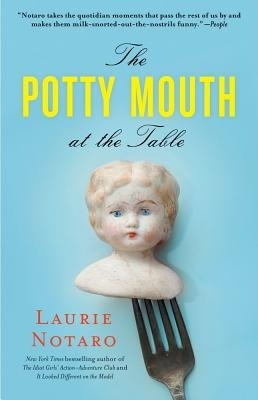
We discussed Paul Ham’s 1914 and 1914 Centenary projects and scanathons run by public libraries. I have included below some links provided to me by lovely @B3rn. I reviewed Laurie Notaro’s The Potty Mouth at the Table and then we got chatting about libraries. I must say that one of my favourite part of the discussion was James Valentine playing library roulette (in libraryland we call this serendipitous searching).

I do blame Laurie Notaro for creeping into my brain and frying it and making me think that mentioning her writing in polite company (read – radio broadcast) is quite okay. So I grabbed my shovel and dug a hole and mentioned her Hogwarts’ porn story on my first (and hopefully, Ms. Notaro, not my last, thanks to your insidious story) ABC radio show. Just no-one tell my mum. Thanks.

Here is my review that I meant to read out:

Laurie NotaroI was excited to see that Laurie Notaro released a new memoir this year. I adored her essays in Autobiography of a Fat Bride and The Idiot Girl and the Flaming Tantrum of Death, at times laughing so hard that I could not continue reading. Her first person, narrative humour is perceptive, self-deprecating and wildly funny. She is like a cross between David Sedaris and Judith Lucy.

The Potty Mouth at the Table is Notaro’s tenth book and she continues her sharp observance of events in her life. She recounts having food poisoning on an 8 hour (vomit) train ride, meeting up with a horny ex-boyfriend, maybe finding a dead hobo in her backyard, as well as her not so diplomatic reaction to her friend’s heinous cupcake tattoo and her pinterest foodie hate. Notaro’s sense of the bizarre shines through her writing and I find myself laughing out loud at her tales and reading aloud excerpts from this book to anyone who will listen.

Here are the rest of the links:

ReadWatchPlay

Read Watch Play – the NSW Readers’ Advisory Group blog and twitterchat #rwpchat held on the last Tuesday night of every month. This month – #egoread, Biographies etc!

http://readwatchplay.wordpress.com/

Centenary Links

Doing our bit: Mosman 1914-1918 – coordinated by Mosman Library

Blog, database, photos, collecting days ‘Scan-a-thon’
http://mosman1914-1918.net/project/ – blog, events

Illawarra Remembers – coordinated by Wollongong City Libraries
http://illawarraremembers.com/
Scan and share days at local libraries: http://illawarraremembers.com/events/

There is also a project at Orange – council project, but library involvement –http://www.centenaryww1orange.com.au/

See this post: http://mosman1914-1918.net/project/blog/coo-ee-from-nsw-public-libraries

City of Ryde and Kiama also have programs.

Pronouncing Library
It really doesn’t matter how you pronounce it – just use them!

http://tumblr.libraryjournal.com/post/60656742787/amen

Make-up artists in libraries

Zombies at the Tullamore (Australia) Public Libraries

http://www.libraryasincubatorproject.org/?p=8939

Bookmobiles

There is lots of stuff on mobile libraries around so I recommend people google the term. However the Shoalhaven libraries bookmobile does tweet from the road @BookTARDIS.

Deselection process of libraries

Here is an example guideline that libraries use for deselection/weeding of library collections. Different libraries use different criteria

http://www.ala.org/Template.cfm?Section=libraryfactsheet&Template=/ContentManagement/ContentDisplay.cfm&ContentID=75744

I’m in a library (or am I?)

I had an interesting exchange with my son the other day. He was doing a school assignment on life in Ancient Egypt and having the boffin information maven mother that he has been blessed with, he knew he needed to log on to “authoritative information”. I had spent some time with him earlier in the week showing him how to log into library databases rather than using free to the web resources.

My son called out to me to say that he couldn’t find the Ancient and Medieval History database on the website so I went over to him and saw that he had clicked on the “In Library Databases”. Now, by late Thursday afternoon I was already fed up with Ancient Egypt and my son’s assignment so I was a tad cantankerous when I snarkily said to him “Why did you choose the In Library Databases. You need the At Home ones. Are you “in” the library?” Bless my gorgeous son who ignored my sarcasm and said “But Mum – I am “in” the library. Look” and he pointed to the library URL. It is at this point I cringed at my Old Skool 20th Century concept of place, apologised and led him through to the resource he needed.

This did lead me to think about when I am physically “in” a place or virtually “in” a place. For me being “in” a library still means being physically “in” a bricks and mortar building. Yet, for most people, it is the library website that is their first port of call. For many users, once they have received their library card, it is their only port of call. So calling library resources “In-library” and “Home access” – I did a quick (oh so scientific) survey of 6 library services and they all used these terms – is catering towards an older user demographic and not towards younger users whose concept of being “in” a place differs substantially. To add to that, often those valuable In Library/Home resources are secondary to the library catalogue – a tool which necessitates a physical visit to the library to use the resource found. This seems a tad ass-end backwards to me.

From that thought, I moved to my sense of having my nose buried “in” a book. When I visualise this, I have in my mind myself as a reader with book open, nose seemingly pressed against the crease of the open book mind completely focused on the words on the page. Somehow, my nose buried “in” an ebook lacks the same sense of hiding amongst the pages for me. Have I been lost “in” an ebook? Absolutely. I am lost “in” digital reading for hours every day. There are days I need to be reminded that it is time to feed myself and any other dependents that may be around me. But I don’t physically feel as though the ebook provides a shelter for my mind. It is not a space I hide “in”. I could not hide my face in an ebook should it make me cry in public (because we have all been there, damn you Barbra Conklin’s PS I Love You). But in neither experience – traditional print or ebook – am I physically “in” the place that I am reading about. As much as I may escape, or be lost in the story, unless I am reading in situ I am not really there.

I spend hours travelling the world on Google Maps. I discover small towns, I follow roads, I enter places that I doubt I will ever physically visit. Do I consider myself to be “in” those places? My answer is No. I am “in” Google Maps but not the place I am exploring. I need to physically experience that place to be there. Just as I am not really in my books.

However, online gaming allows you to be “in” that space. Whether you are playing Fifa 13 or World of Warcraft or Assassin’s Creed the only place to have this experience is online. As a sideline you can have cosplay, you can attend fan conventions however the virtual space is the primary space.

With these other examples in mind, I am thinking again of the public library as a physical place or as a virtual space*.  The reality is that, unlike the chicken and the egg, the physical place did come first so it is natural that our terminology is still couched with a bricks and mortar mindset. Though the industry has shifted, public library websites need to become the creative library branch where users add value to the site rather than purely being recipients and searchers of information. Some libraries already have some user led content creation particularly in the area of local studies and oral histories but this is mainly engaging with older generations (which is great in itself but needs to now be expanded upon). It won’t be until user led content creation for libraries is driven by youth, who are already engaged in creative screen based and digital culture and already think of the library website as being the main entrance, that the local public library will be a a primarily virtual place for the community to get lost “in”.

*I want to take a moment to highlight that I do not feel the same way about  State and National Libraries which are also public libraries. For many people in Australia, their only experience of the National and state libraries as a place is the website.

Emerging from January

All month I have had a number of posts stewing in my brain yet I managed to not write any of them until now – so this is a super long blog post.

January was a culmination of several events for me. I have finally finished my Certificate IV in Training and Assessment allowing me to teach in the TAFE system. I used to teach at TAFE 10 years ago when I was not required to have a qualification beyond Train the Trainer. I found the teaching rather harrowing as there were times I was being handed the lesson plan 10 minutes before the class itself. With this certificate I feel much more prepared – now to pick up some casual hours!

I completed a 10 thousand word assessment for university. Even as I sit here all I can think is that there is so much more I wanted to write. I could have easily added another 5 K. I’ve since met with my supervisors who are trying to convince me to move from a Masters program to a Doctorate program. They keep saying “doctorate” as though it is a forgone conclusion but for me it is a much harder decision. I’m loving the study but I am finding the whole parenting/studying/working balance difficult.  As much as I would love to be a Doctor of Rrrrrromance in libraries I may just settle to be a Mistress of Rrrrromance in libraries instead.

I managed to get slammed by an anonymous blogger called Annoyed Librarian over at Library Journal. There seems to be a badge of honour amongst a few librarian bloggers such as @ScrewyDecimal and @Catagator who have also been slammed. I felt spesh. Am I the only antipodean to merit this treatment *preen*?  The slamming came while I was in the midst of my 10K assessment and TAFE resubmissions. As much as I wanted to get in there and comment again I was a very good student and focused on my assessments. In brief, the blogger made a number of derogatory comments about housebound romance readers to which I questioned her professionalism. In the slamming, she questioned public librarians and readers’ advisors professionalism and how she was “happy to have a little fun goading romance readers and writers”. And here is the irony. My aforementioned 10K assessment is about the marginalisation of ordinary culture by cultural institutions – namely libraries/librarians marginalising romance fiction: Romance fiction and its authors and readers. I came across the first post in searching for more current examples of librarians showing derision towards the readers of the most highly read fiction genre. Not only had I found more evidence for my paper but by her responding in the form of another blog rather than a simple reply she gave me even more material. Just as I was thinking that perhaps the library situation wasn’t all that bad she gave me plenty of fodder that was instantly added to my research.

By the time I had a moment to make my own comment a number of people had already made enough comments rejecting her blog stance against public librarians so I happily did not leave my own. But here’s the thing: when her blog was first pubished I had a number of people contact me – some through public tweets and others through email and Twitter DMs in support of my comments, which I appreciated. But the comments and discussion outside of the official website will not remain part of a digital record. The comments dismissing the blogger for not having the courage to write under her own name, the comments dismissing Library Journal as a credible opinion source in the industry due to their validating a”library troll”, and the incredulity that there were still readers of the blog, are not part of an official record. Researchers in 100 years will be going to the industry stalwart, Library Journal, but how they will connect to the conversation that is happening in other online forums about their articles, particularly discussions held elsewhere as most librarians are hesitant to post comments on LJ as they know they will be the next librarian to be ridiculed? What sort of legacy of information will allow for these informal (yet illuminating) conversation to be found. I’ve been told that there is research into this question but I have become the lazy researcher at this stage of January and I haven’t searched for more information. If I find some links I will post them on a later blog.

Since I finished writing my papers 10 days ago I have chilled out with my kids, I’ve watched lots of TV – reruns of Coupling, Scrubs, Friends, Big Bang Theory and Ben Stiller movies. I love Hank Azaria in Along came Polly saying “Rueben, look me in the eyeball” and the extreme sports corporate Bryan Brown. After 366 books in 2012, I have begun 2013 in fine form and I have read only 2 books The Amorous Education of Celia Seaton by Miranda Neville which was lovely and A Basic Renovation by Sandra Antonelli which was fab fab fab and I will be writing a separate blog post for next week. My family and I spent a lovely week in Wollombi in the Hunter Valley at my sister-in-law’s farm. We swam in the dam daily, we watched kangaroos grazing, we played lots of Wii and generally did the holiday pleaser of nothing much.

Coming up, I am going to be on a romance panel on Valentine’s Day with Isolde Martyn and Jane Austen Society journal editor Joanna Penglase to discuss 200 years and the romance focus of Pride and Prejudice. I’m really excited to be involved in such an event seeing the pretty much universal appeal of the book. I’m pretty sure I have been asked along to bring in the contemporary romance tie-in. Though I liked Pride and Prejudice when I first read it I have not been part of the fandom. I have not reread it (but plan to before the event) and I don’t think much of Colin Firth. My husband really wanted to give our oldest son the middle name of D’Arcy, after his great-g-g-g-g-g-g-grandfather D’Arcy Wentworth, to which I objected as I wasn’t all that chuffed at naming my son after a highwayman despite the fact that he came good upon coming to the colony of New South Wales as the second fleet’s doctor and as a free settler (oh – the irony as my son tells me he would have loved to have D’Arcy as his name). In my research for this panel  I discovered the Lizzie Bennet Diaries just to discover my favouritest ever Darcy. I have become obsessed with this vlog and transmedia fiction. I follow the characters on twitter, I read Jane’s Tumblr and Lydia is totally understood. And the whole “Socially Awkward Darcy” meme is fun. And most importantly, The Lizzie Bennet Diaries have given me that jolt in my stomach. That feeling that romance readers get when they come across a couple that you know should be together, and despite the fact that I know there is a happy ever after, the anticipation that only a good adaptation and dramatisation can affect, that feeling that perhaps these two will not get past Regis’s point of ritual death. I do love the well retold romance.

Schmoozing with a Smart Bitch and a vulgar amount of name-dropping

Up until last week, I had not attended a high tea since 2000. 12 years ago I had the good fortune to attend a high tea in the Queen’s Ballroom whilst journeying through the Whitsunday Islands along the North East coast of Australia on a leg of the millenium world cruise of the QE2, as one does. There were marvellous sandwiches, petit fours and loose leaf tea served in fine bone china teacups. It was all very very proper. A string quartet played while well-dressed couples danced to music from the early twentieth century when I was asked if I would like to dance and I found myself doing the cha-cha with a gentleman host beside the Queen’s bust.

This is a travelling highlight for me and I had not felt the need to go to another high tea as it would be a hard act to follow. But last week I finally attended one as Sarah Wendell from Smart Bitches Trashy Books was attending along with a number of romance readers, writers and bloggers. It was a loud and raucous afternoon spent with some fabulous women and a lot of fun was had by all. Sarah Wendell was in Sydney as an international guest for the inaugural Genre Convention and I was fortunate enough to be asked to be on a panel discussion with Sarah. The panel was called Not Just a Narrator where, along with Sarah, speculative fiction author Kirstyn McDermott and Harlequin Escape managing editor Kate Cuthbert, we spoke about the many people who promote books and reading, on and offline, from authors, bloggers and librarians *cough* yours truly *cough*. I spoke about the collaborative work NSW librarians and the NSW Readers’ Advisory group are doing to promote readership in developing their monthly themes, facilitating a monthly twitterchat group and blogs Love2Read2012 for the National Year of Reading and next year’s readwatchplay. As the sole librarian speaking at the convention, and only my second non-library talk, I was eager to see how libraries fit into the broader reader, author and book industry discourse. In my opinion, the library aspect was well received and it intersected well with the blogger and author experiences being relayed by the rest of the panel. I think that we need more librarians being part of readers conventions, literary festivals and book fairs as there is a natural overlap for these industries.

The convention itself was fantastic. With a swathe of amazing Australian authors discussing their readership and their craft, the atmosphere was exciting. I heard several of the speakers discussing that we are in an era of writing abundance and it was evident with the number of aspiring, emergent and established authors present and the fabulous editors and publishers that enable their work to be distributed broadly. There were so many fabulous people I spoke with such as Anna Campbell, Shannon Curtis, Christina Brooke, Kat @bookthingo, Rosie @fangbooks, @Rudi_Bee, Kate Eltham, Peter Ball, Denise Rosetti, Bronwyn Parry, Nicky Strickland, Kylie Mason, Haylee and Lilia from Harlequin, Caitlyn Nicholas and many more (and my apologies if I didn’t mention you).

However, I cannot be blasĂ© about Sarah Wendell. Sure, I’d be much cooler if I didn’t gush all over her on my blog. But I have never been a cool kid and I think Sarah was lovely and funny and so generous with her time despite her concerns for her family and friends in the wake of hurricane Sandy. Back in 2008, I gave a Romance 101 presentation at the NSW Readers’ Advisory annual seminar where I introduced the Smart Bitches blog (and a number of other romance literature resources) to over 140 librarians. So to find myself four years later, onstage speaking with Sarah has been a career highlight.

There was no Queen’s ballroom or Queen’s bust, there weren’t any views of the South Pacific or tropical islands and there were no gentlemen hosts or string quartets. But we did have Tim Tams and lamingtons, and there was snark and there was awesomesauce. And it ranks up there with my high seas high tea cha-cha.

Supping With the Devil that is Romance Fiction

Last week I was part of a reader’s panel at the ALIA Biennial Discovery Conference. Neither the author or reader’s panels were official conference papers. Due to many requests from conference attendees I am posting my paper here on my blog. Please note that this is a heavily edited version of the original paper I had written in response to the Call for Papers and the topics of “The book that changed your life” and “Connecting with your communities”:

I read romances for the love, the escape, for the catch of breath below my diaphragm at the anticipation of that knowing glance and the sexual tension, I read romances for the beautifully retold love clichĂ©, I read them for they are predominately women writing for women about women. I read romances for the sheer science fiction of improbability that is possible, for its absurdist nature and absolutely for the joyful resolution, the Happily Ever After.

Choosing the romance book that changed my life for this talk today was a difficult task as I have so many that I consider seminal. I chose Sara Craven’s Sup With the Devil.

Sup With the Devil was Craven’s 23rd novel. The protagonist, Courtney, was of a privileged background but had been living on the breadline for the last 3 years due to her family going bankrupt. Courtney is being coerced to marry the nephew of the man who bankrupted her family. She remembers her grandmother’s warning that:

when you sup with the devil you should only do so with a long spoon

The story has slow revelations, hidden passions, many misunderstandings And it has love. Not only a passionate love but also a love of friendship and trust that comes from an emergent courtship.

As a teen, I quickly read out the small romance collection at my local library. When I would ask for more the librarian would kindly guide me to “better” reading choices. This was in the 1980s which were focused on reader development/education rather than the current paradigm of reader advisory which is about matching a reader to a similar experience.  I was given Mary Wesley and Maeve Binchy. Lovely reads but they were nothing like the darkness of Charlotte Lamb, Anne Mather’s torridness and Carole Mortimer’s alphabrutes.

At university, when reading was being discussed, it was literary. I read across all fiction but discussing romances was considered only one step away from being illiterate. Fine if you weren’t smart enough to read anything else. I also started to explore academic papers on the romance reader which I did not agree with. What these papers did was anger me because everyone seemed to think that there must be a psychololgical reason to read romance. Romances meant I was subjugated. Romances meant I expected a male to rescue me. Romances meant that I was not a feminist. You read to learn and develop and the attitude was that you couldn’t possibly do that with romances.

As a reader, I gave up on accessing my books from my library early on. I bought all my romances from newsagencies, supermarkets, second hand bookstores, bookshops, markets, online and swapping books with friends. As a romance reader I am not unique in this behaviour.

There are impediments to borrowing from the library such as the cataloguing of paperbacks. Records are basic. The practice for many public libraries used to be a “Romance Fiction” title with barcodes attached for individual items. Basically, the romance is not searchable. The argument always goes along the lines of “we have budget constraints”, â€śthese books are junk”, â€śthe readers don’t remember them”.

Cataloguing of literary fiction, which sells less than a third of that of romance, is comprehensive yet romance is not catalogued to the same level.
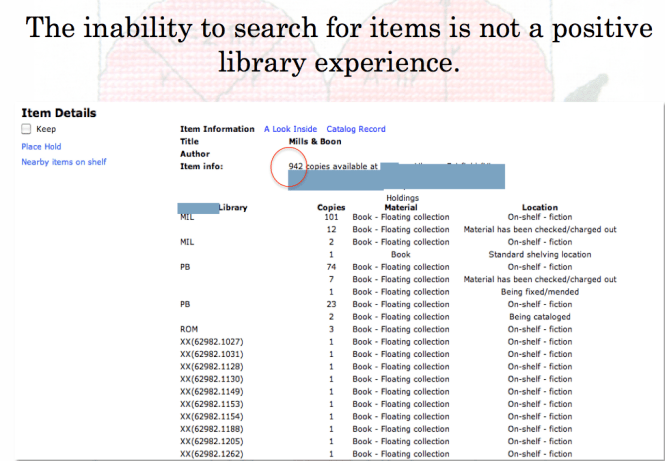
This single catalogue record/many accessioned items impacts the reader experience of the library. The inability to search for items is not a positive library experience. I attended the Australian Romance Readers Convention in 2009. I was discussing public lending rights with an Australian Mills and Boon author. Her comment was “My books don’t get catalogued. As they are rarely searchable I don’t recieve PLN payments”. This writer has 16 books published in Australia and translated in over 10 languages worldwide. This decision to not catalogue does not only impact readers – it impacts authors and their impression of libraries.

Let’s look at the language librarians use:

Here are 2 large print Mills and Boon Christmas trees. Both libraries posted these on their social networks.
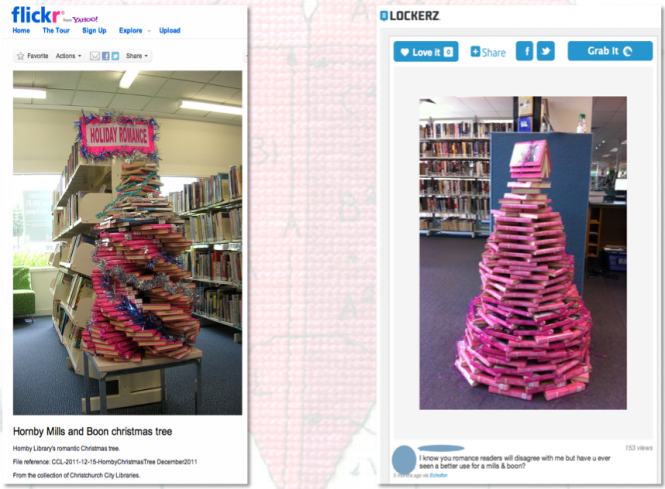
The first one is a romantic tree. Straightforward. Objective.

The second tree – “I know you romance readers will disagree with me but have u ever seen a better use for a mills and boon”. This statement that these books purpose as an aesthetic, decorative object is preferable to their content may be tongue in cheek and having a bit of fun but what message does it send to the recipient of that social media?

To the romance reader, it sends the message that their reading choices are inferior. To the non-romance reader it sends the message of librarian (authority figure) is disdainful of romance therefore romance must be inferior if said authority figure says so. As librarians, do not underestimate the authority that you command.

Another example, I was approached by a librarian who wanted romance recommendations for a display he was preparing. I suggested Jennifer Crusie was a good start and his comment was “Oh. But Crusie transcends the romance genre. Her writing is highly commendable”.

To transcend a genre is what happens when a reader discovers that the book they have just read and enjoyed is genre fiction but they don’t want to identify themselves as having read genre.

Romance is not alone in this. Margaret Atwood has transcended fantasy. Peter Temple has transcended crime. I dislike transcends. I prefer to use the phrase “these authors benchmark their genre”. Jennifer Crusie is a benchmark of romance. As librarians the language we use when discussing reading with our patrons and our colleagues needs to be objective. Patronising only results in less patronage.

On Legal Deposit in Australia and NSW:

The National Library of Australia has the most comprehensive romance collection in Australia as they catalogue all the titles they receive through legal deposit. The State Library of NSW fully catalogues all romances written by Australian authors which then become part of the Mitchell Library collection. Other titles by non-Australian authors are not catalogued thoughthey are stored in offsite storage and accessible if you know the publisher, the month and year that they were published. Fisher Library at Sydney University however has retained few of the romances deposited with them. They’ve retained authors such as Stephanie Laurens, Bronwyn Parry, Helene Young and Anna Campbell. However, Anna Jacobs or Anne Gracie, Sarah Mayberry and Kelly Hunter all of whom are celebrated and awarded both nationally and internationally as benchmark authors in the romance genre do not have a single title of theirs held at Fisher Library along with a number of other Australian women authors published in NSW that I could list let alone looking at bodies of work by specific international romance authors that a scholar may be interested in studying. But I was placated by the librarian I spoke to with“we have a great crime collection if you want to study genre”.

How does the romance reader perceive the library?

The Australian Romance Readers Association conducts an annual readers survey.

There are 2 library specific questions in this survey.

“Have you borrowed romance books from your local library this year”. 50% of respondents answered “Never”.

“Are new romance releases usually available from your local library” Only one quarter of the respondents said yes. The other quarter said no, and let’s not forget that half of the respondents never use the library.

I find this data concerning. This is a survey of engaged, committed readers. Readers who are part of a reading association, readers who follow book review sites, author websites, subscribe to newsletters, magazines and blogs so as to decide upon their next read. These are readers that engage with social media. If we are looking at the lower end of the scale these readers read 60 romances a year and this does not include their other reading interests. Yet, they don’t recognise the library playing a large, positive role in their reading experience. Half of them never use the library.

“To Sup with the devil you need a long spoon”

Libraries have treated romance readers as “the devil” for they maintain a distance from them. We see this in librarians trying to improve the readers choice, cataloguers not valuing the books the readers choose. All this is reflected in the romance readers survey responses that the library is not a provider for their reading needs.

It will be interesting to see what trends will emerge with ebook lending.  When I searched the libraries in Sydney that subscribed to Overdrive there were a substantial selection of romance titles available. That spoon is getting shorter. It is not all dire. There are libraries that know the value of the romance reader. They have strong romance collections, romance authors are on their standing author lists, speak at library events and run writing workshops. These libraries know that the big readers impact positively on their KPIs so they court the reader and romance readers love a courtship.

Towards the end of Sup with the Devil, Courtney is torn. She suspects her husband embezzled from her family but she likes him. She makes the decision that she was no longer going to hold him at bay for “to sup with the devil might hold an element of excitement”.

to sup with the devil might hold an element of excitement

This metaphor invites you to be a risk taker. Life is about using the short spoon when you are supping with the devil. And this is what libraries should be doing.

Look for the marginalised reader, look for the marginalised patron and support them and court them.  Discover those ideas that to others are distasteful, that are met with derision and make room for them in your libraries. Find your gamers, hobbyists, hackers and makers. Your homeless, your reenactors, geeks, crafsters and subversives. Look at your emerging communities and do not dismiss your established users. For Raymond Williams tells us that Culture is Ordinary. That “every human society has its own shape and its own purpose, its own meanings. Every human society expresses these, in institutions and in arts and learning”. These institutions are our libraries and libraries are our secular cathedrals and these secular cathedrals should be representing our ordinary culture. As this conference is about Discovery, I ask you to go out, discover the ordinary in our society and use the short spoon to sup with them.

© Vassiliki Veros and Shallowreader, 2012.

R*BY Award Finalists and the availability of the shortlist in Australian Libraries


The Romance Writers of Australia Awards were announced today. These awards are voted on by readers and I was pleased to see so many of my favourite Australian Women Writers listed. As I am saving all my pennies to get my bookshelves built, I thought I’d borrow some of the titles through interlibrary loan so I searched through Trove (the National Australian Library’s database for the uninitiated) and I thought I would share the results with readers of this blog.

Short Sweet
Molly Cooper’s Dream Date – Barbara Hannay (18 public libraries/4 State or National)
How To Save a Marriage In a Million – Leonie Knight (1 public library/2 State/National)
Abby and The Bachelor Cop – Marion Lennox (19 public libraries)
Single Dad’s Triple Trouble – Fiona Lowe (16 public libraries/1 State/National/1 University)

Short Sexy
The Fearless Maverick – Robyn Grady (1 State/National/1 University)
The Man She Loves to Hate – Kelly Hunter (12 public libraries/1 State/National)
The Wedding Charade – Melanie Milburne (19 public libraries/1 State/National/1 University)
Her Not-So-Secret-Diary – Anne Oliver (7 public libraries/1 State/National/1 University)

Long Romance
Midnight’s Wild Passion – Anna Campbell (39 public libraries/2 Universities/3 State/National)
Boomerang Bride – Fiona Lowe (0 holdings – this seems very odd to me)
The Best Laid Plans – Sarah Mayberry (11 public libraries/1 university/National)
The Voyagers – Mardi McConnochie (53 public libraries/4 Sate/5 universities/National)

Romantic Elements
The Trader’s Wife – Anna Jacobs (52 public libraries/2 State/National/2 University)
The Shelly Beach Writers’ Group – June Loves (63 public libraries/3 State/3 Universities/National)
Busted In Bollywood – Nicola Marsh (0 – this seems very odd to me)
Shattered Sky – Helene Young (54 public libraries/4 universities/3 States/National)

I’m not sure how anyone else feels about this list but, with the exception of 5 of the titles, it doesn’t feel as though there are many loan choices. At first glance 15 might seem a lot but break that down by State and it doesn’t represent many holdings. I’m not sure how the authors themselves would feel about this. Is it a case of “Good – they’ll go out and buy my book instead” or “For heaven’s sake! Will librarians start buying up in romance! I want my books to be read by library borrowers who ultimately become buyers”.  Hopefully, now that libraries have a shortlist to select from, this list will look quite different by August when the awards are announced.

NOTE: I know that, in terms of ILL’s libraries do have other avenues to search for titles, but as a reader searching from home, I rarely explore these other options. If it isn’t listed by Trove I either don’t read it or I buy it. I also understand that Australian Librarians can’t all buy every single title that comes out – and perhaps this is where I sometimes get all nostalgic and bemoan that libraries no longer have schemes such as the wonderful Sydney Subject Specialisation Scheme – Fiction Reserve program in place. This scheme gave each library in the Sydney region a Dewey span and a Fiction letter span to specialise in – for example, one library I worked at had the span of authors with surnames Koc – Let (cheeky librarians). The loss of this program has resulted in everyone catering to the middle ground and some less well known, less read but still interesting books are not being purchased.

Cacophony in the library

I’m going to start this post recounting a personal experience of mine from 2000. At the time I was 3 months pregnant with my second child and I was expecting a phone call from my obstetrician with some urgent blood results. I was in a meeting which was being held in a library (I was not working as a librarian at the time). My phone rang, I excused myself and went into an empty corner and answered it. Despite giving very quiet, monosyllabic responses to my obstetrician, the librarian approached me and quite loudly told me to turn my phone off and to leave the building to make phone calls. The officious librarian talked over me and was getting more and more agitated that I was not listening to her. Upon hanging up, I ignored her and made a mental note to NEVER be a librarian like that. So I want to point out from the outset that this is not about keeping a library in absolute silence. However, it is a post about libraries being quieter places and to recognise this as a positive attribute of our library spaces rather than a negative that turns libraryland into apologists. This positive attribute allows for reflective, calmer spaces that are conducive to thinking, creativity and innovation.

I like a quiet library. I like a library where you know there is a buzzed conversation but you cannot hear its detail. I like a library where the sound of fingers hitting keyboards and photocopiers printing is the norm. I like to hear the tutor leading the child through their maths homework using hushed tones, I like the parents quietly reading picture books to their pre-schoolers. And I like that occassionally this hushed space is converted to sounds electric but for an hour, for storytime, an author talk, a science presentation or a bookgroup meeting. I like running paper-plane flying competitions down the aisles of books during Open Days, I like craft-time for kids and adults (as long as I don’t have to lead it) and I like people feeling comfortable enough in the library that they use it for creativity, learning and for escape. This buzz, this muted white noise in a library is welcoming and expected.

But what I do not like is the library as a playground or a cafe. I cannot stand children playing chasings amongst the aisles of books both in childrens’ and adult sections. Aside from the grating noise, it is also compromising the safety of other library patrons. I do not want to see teens throwing a basketball over bays of books in a game of blind baskets and nor do I want to hear music being piped into the library in some weird super mall sense and I especially don’t want to have to stick my fingers in my ears to drown out the group sitting over 15 metres away. I know that this is not a popular stance to make, and that many libraries have cafes in them (I’m all for that as the cafe is then a designated talking space) and that kids should be made to feel welcome but I think libraries can do this without giving up what, for a large part of library patronage, is a place that they can come to that has relative quiet. For many people, going to the library is to escape from their already loud, busy, cluttered, over-stimulated spaces.

Now let me start, as Miss Piggy would say, with “Moi”. Up until I was 13 years old my parents ran our house as a boarding house. Until I was 8 we could have up to 20 people living in our house at a time. Predominately, these boarders were migrants, refugees and at one stage a bunch of illegal immigrants – sailors who had jumped ship in Sydney one night. We had Germans, Dutch, Italians, Indians, Greeks and Egyptians. Families, bachelors and even a Vietnam vet. As you could imagine, life was one big party. The shared living areas either had a television on or a radio or my dad’s trusty reel-to-reel (this was the 70s!) and there was always dancing. There were always kids living with us so we would all be playing games or making up plays and stories. Even when the majority of boarders left and we only had one other family living with us, we continued being visited by all our (ex-boarder) family friends. The one thing that we didn’t have was quiet in our home. Even 10 years after the last boarders moved out and my then boyfriend (now husband) would come over to visit his comment was “My God! Your house is like a sitcom. The doorbell is always ringing and you always have visitors”. Now as fun as a home like that may be, I relished quiet from a young age. And the only place to get it was the local library. I could spend my afternoons sitting in a corner not talking to anyone or talking quietly with the other kids and not having to compete for airspace. Even now, when I sit in my own home, I never turn on the TV or radio, I drive in silence and it is only me, my tinitis and the white noise of the urban world.

I am not alone in this need. Let me give you some examples of people I know though I have changed their names:

Nena

A Masters student living in a 2 bedroom flat with her host family. She shares her bedroom with 2 other girls. Her bed is her only private space. She studies at the library until closing time every day as her host family has an open door policy with many visitors. She arrives home one night when her host family advise her that they have taken on another boarder. When she points out the lack of space she is advised that they have rented out the other side of her bed and she was to top and tail with a stranger (but not to worry – it was another female). This student’s distress the next day was noticed by the staff and they helped her find emergency accommodation. The student found solace in the library, eventually worked in the industry and 20 years later is a highly effective information professional. The quiet of a library, she told me, was the quiet that she desperately need for study.

Dr John

Dr John’s parents ran a fish and chip shop. There a 6 children living in a 3 bedroom house above their shop. One room for the boys and another for the girls. They all have to work in the shop after school and if there was a busy moment you would be pulled from your room where you were doing homework to help out. For Dr John going to the library to study was his escape from a loving but busy, noisy house.

Sally

I met Sally earlier this year when I went to pick my son up from a friend’s place. She was discussing how she could no longer bear to take her kids to her council’s newly refurbished library because the books were tucked into nooks and crannies and the children’s area was designed for rough and tumble play. “I know where the playgrounds are, I know where playgroups in community centres meet. Not everything needs to be hyped yet my kids get hyped in the library. I just want to sit and read to them”.

Ben

Ben and his family had moved to his mother’s home during a renovation. He worked from home but found it impossible to concentrate as his mother cared for his 3 nieces during the day. Going to the library was a better (and cheaper) option than a noisy cafe. However, it took visiting 5 library branches before he found one that was not overwhelmingly noisy.

I believe that these library patrons are not a tiny minority. I believe that most people in the community expect a library to not be so loud that they need to use noise cancelling headphones when they use it. Nor do they expect the absolute silence required in cinemas and theatres. Certainly, many larger libraries are able to provide designated quiet areas and floors but smaller libraries will find this harder to manage particularly if they are open-plan.

However, I think it is imperative that library staff do no scoff, do not ignore and do not dismiss as unimportant the library patron who comes and asks if there are quiet spaces or for a staff member to intervene and ask someone making unreasonable noise to tone it down. The library patron with a need for a quiet is no less important than the needs of other library patrons that as librarians we are able to meet.

Repeat after me “I am the stereotype librarian and I am proud”

In which I go on a rant which has been building up within me for 25 years. Some librarians may get their noses out of joint. But I don’t care. For mine has been out of joint for far too long……

People who discuss librarian stereotypes and overcoming them annoy me. It is a tired, bleating sound that has turned into a stereotype itself. There is nothing new about this move to “reject the stereotype”. When I started my LIS course in 1988 some fellow students were discussing that they <insert disdainful tone> “weren’t the typical librarian”  and the need to <disdainful tone again> “challenge stereotypes”. This attitude surprised me in 1988 and completely spins me out that it still exists a quarter of a century later. I worked hard throughout high school to ensure I got into a library information course and my aim was always to be a librarian for the ones that I had come into contact from a young age were all brilliant people. My list below shows a broad mix of personalities that were the librarians I cam into contact with prior to going to uni:

1. My first children’s librarian – tall, skinny, long hippy hair and hippy fashions. Always wore wedged clogs, allowed kids behind the desk to help and always chatted about books.

2. My second children’s librarian – Curly black hair, male, always smiling but didn’t know how to rec books like our first one. This was dissapointing to us kids (but he was still cool and let us hang out).

3. My high school librarian had gnarled arthritic hands and was the antithesis of my local librarians. She was dour but always knew how to help us with school asignments.

4. My first foray into the adult library librarian was a cool chick. She wore funky clothes, had a funky haircut and loved Mills and Boon.

5. The librarian that cool chick librarian worked alongside with was male and only spoke to people who had literary tastes in reading. As a teen, this did not rule me out as I read lots of literature both in English and in Greek. He relished this and was always very nice to me (but was standoffish to others).

6. Desk Set. Katharine Hepburn, Spencer Tracy and a bunch of bright fabulous librarians being threatened with being closed down as computers can do a librarians’ work (sound familiar? This movie is circa 1957 – Knowledge trumps data in this one).

What I’m trying to demonstrate above is that I came in contact with a broad variety of librarians and I am sure that if you were to make a list of those you came in contact with, you too will have a similarly broad list. So, to still be discussing librarian stereotypes nearly 25 years later shows a lack of understanding of the profession and that there are some people who may have their own personal image problem with their choice of career. (I did say I was going to get ranty). It is like begging for acceptance. Hand up in the air, waving to the cool kids and saying “Hey I’m hip even though those before me weren’t”.

In my opinion, the only librarian stereotype is a person who is always able to help you locate the information you need and can usually be trusted to be objective. That is it.

For I don’t care if someone wears their hair in a bun, wears glasses or asks people to keep keep the noise down (actually I lurrrrve these librarians but here is not the place to write about my opinions on libraries and cacophony). I won’t pass judgement if a librarian is toting a book or e-device of their choice, is in a suit, is in jeans and a polo top or in a flippy skirt or a pair of cinos. I don’t care if librarians choose to wear sensible shoes or stilettos (well – in a workplace where you are expected to climb step ladders I do care but that is an OH&S issue not a librarian issue). I don’t care if the librarian wears converse, a cardigan, sports a beard, a mohawk, ponytail, support hose or has ink and piercings. That’s right, for the tattooed librarian is a stereotype too. Not because they have a tat but because they have delivered an information service.

What I do care about is the disdain with which librarians of the years gone by are being subjected to by proclamations of rejecting the stereotype. These are professionals who went through amazing technological changes in their libraries during the twentieth century, some of them as drivers of change and others who were implementers and, of course there were those who didn’t like the changes too. These “stereotypes” that image conscious information professionals are trying to not emulate were responsible for the transition of the profession from the 19th century industrial era library through the modernist 20th century into the digital information era of the early 21st century. These book peddling, knowledge sorting, program delivering librarians have inspired and changed people. They have delivered them from a tradition of taking on your family’s work to inspiring them to look beyond their personal experiences and to dream of the places that they have read about in books and magazines and movies that would not have been available in the home. The whole thing about librarians is that they are an agile profession providing information and experiences to an agile community.

So those of you who want to be hip and reject YOUR perception (not everyone’s) of librarians of a past era to show how alternative and edgy you are. Well here’s my challenge to you. How about being the alternative to the alternative. Rather than join the herd and rally against the stereotype – just be yourselves, work hard, deliver the information service, give a nod to those that went before you and a leg up to those that will follow.

Tipping one’s hat to Britannica’s bookbinders

Encyclopaedia Britannica’s decision to cease printing their leather bound knowledge tomes hit the news today. People became nostalgic, call back radio was busy with people regaling tales of their parents, teachers, neighbours as sales people, spruikers and customers. Telling the tale of the need to have a set on their shelves as a sign that they cared for their children’s education. My family was no different. We would tease my dad for reading through the Macropedia and Micropedia. Britannica was ace! I don’t mind that it is now out of print. I use the online access my library subscribes to and I treasure the 197o’s edition I do own.

What I haven’t heard anyone mention, though, is the superb craftsmanship of the Britannica (and for that part the majority of well produced reference books). The paper quality, though thin, is strong enough to suspend a volume from a single page.

20120314-234543.jpg

I hope that Britannica preserves their binding knowledge.