Book 7: Let’s Do It by Cole Porter with illustrations by Ward Schumker.
Porter’s Let’s Do It is a favourite, so when I saw this picture book version, I felt the need to own it. With delightful illustrations, joyous couplings and bright primary colours this book lends itself well for storytime with young kids. For “Let’s Do It, let’s fall in love!”
Book 8: The Roaring Twenties: A Spicy Pop-Up Book for Adults Only illustrated by Pete Seymour, Borje Svensson and paper engineering by Rodger Smith & Dick Dudley.
I love pop-up books. They are clever and cool. This is the first Adults Only pop-up book I have read. And, unlike the misleading title, its cheeky and suggestive text and pop-ups are tame. Tabs allow peek-a-boo situations to be illustrated in a typical 20’s fashion.
Book 9: Wonder Book of Sex by Glen Baxter.
This book is filled with odd, peculiar illustrations of absurd (and mostly non-sexual) situations. I always have a laugh at the inanities illustrated in this book. Perhaps one of my favourite wedding presents from a librarian friend.
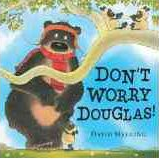
David Melling is amongst my favourite picture book authors. Quirky, heartfelt stories with wry humour and lots of love. His Hugless Douglas series are about the adventures of a young bear called Douglas. In this lovely book, Douglas’s woollen hat unravels and he worries about telling his father. Filled with gorgeous illustrations throughout the book, this would make a good storytime book for libraries.
I read this book with my 13 year old. The illustrations are cool and retro and the story starts with a giggle which I didn’t feel was sustained to the end of the book. It was an OK read and it’s repetitive nature would engage a younger child.
Any person who has met me and asked for a picture book recommendation will know that my first suggestion is Mo Willems’ Knuffle Bunny. I adore all of Willems’ books but my deepest love is for Knuffle Bunny and Don’t Let the Pigeon Drive the Bus. So I surprised even myself when I took so long to finally read the third Knuffle Bunny book. And it is fabulous! Knuffle Bunny, Knuffle Bunny, Too and Knuffle Bunny Free all manage to capture expressions and feeling of not only the child in the story but of the bemused, frustrated and perplexed adults in the stories too. By the end of Knuffle Bunny Free I had sweet tears come to my eyes. Such a heartfelt story.
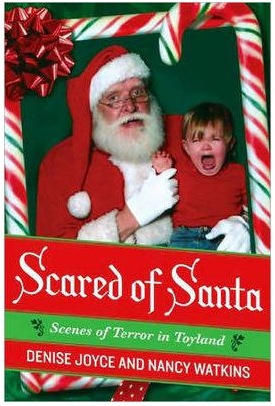
I chortled reading this book. Photos of horrified children with creepy Santas and witty captions. Compiled by The Chicago Tribune this book is a Christmas keeper. Pack it in with your Christmas decorations and revisit it once a year.
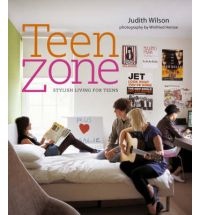
As mentioned in the previous post, I am currently going through a home renovation (an experience which I am hating). This means that I am spending quite some time reading interior design books. One that has been a favourite for many years is Judith Wilson’s Teen Zone. I find the spaces interesting and inspiring.
However, neither of my sons like anything in the book. I’m not sure if this is indicative of adults writing for teens but missing the point or that my boys just want to play cricket and won’t humour me.
I have an unhealthy love for Barry Manilow’s music. It is toe-tapping, happy and brings on a belt-it-out sing-a-long which disturbs not only my sons but my husband too. I saw Barry Manilow perform live at the Sydney Entertainment Centre back in 1994 and I still count it amongst the best concerts I have ever attended. It was full of laughter and joy with great audience participation. Barry is a funny man.
I have many favourite Bazza songs but I particularly love “I Can’t Smile Without You”. This song can give you such a happiness high when you are with the person you love, whether you are singing it with your partner, child, parent or friend. Yet, it is the sadness it invokes when it comes on the radio and I am not with the people I love, with my sons, my husband and sadly my long departed father, that touches me most. This song makes me cry.
In this clip, Barry is accompanied by the accordian and BBC Orchestra.
Oh! And I still own the T-shirt!
You know I can’t smile without you
I can’t smile without you
I can’t laugh and I can’t sing
I’m finding it hard to do anything
You see I feel sad when you’re sad
I feel glad when you’re glad
If you only knew what I’m going through
I just can’t smile without you
You came along just like a song
And brighten my day
Who would of believed that you where part of a dream
Now it all seems light years away
And now you know I can’t smile without you
I can’t smile without you
I can’t laugh and I can’t sing
I’m finding it hard to do anything
You see I feel sad when your sad
I feel glad when you’re glad
If you only knew what I’m going through
I just can’t smile
Now some people say happiness takes so very long to find
Well, I’m finding it hard leaving your love behind me
And you see I can’t smile without you
I can’t smile without you
I can’t laugh and I can’t sing
I’m finding it hard to do anything
You see I feel glad when you’re glad
I feel sad when you’re sad
If you only knew what I’m going through
I just can’t smile without you
In library circles and the greater book reading industry there is a strong anti-censorship understanding that sees readers, authors, publishers, librarians and many others defending the right to read books that push boundaries with which different members of society may find issue.
Lobby groups, mostly in the US, highlight the books that teachers, librarians and other educators are called upon to defend due to parental and community concern. I think this is a great practice but what I haven’t seen is a banned words lobby.
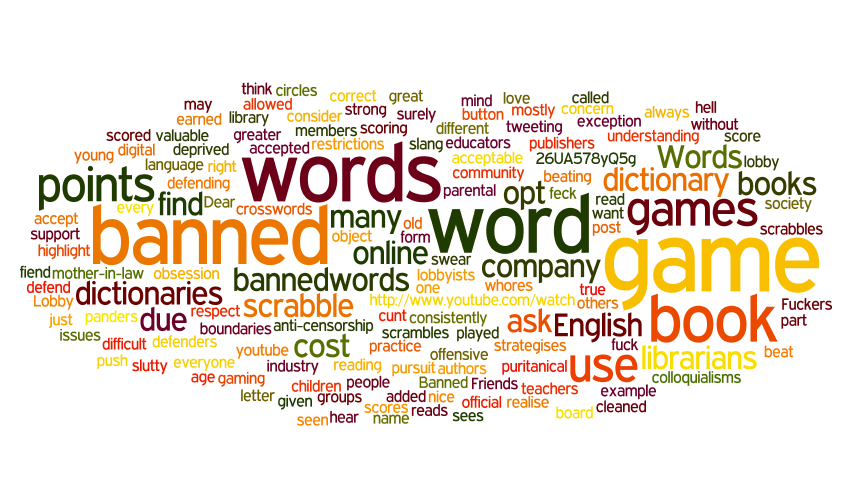
That’s correct. Banned Words. For I am a word game fiend from a young age.
I love my crosswords, Scrabbles, Scrambles, find-a-words. I’ll do them in print, digital, and board game form. It is such an obsession that my 10 year old strategises Scrabble games and consistently scores over 250 in pursuit of beating me. My mother-in-law was always very nice to me but it wasn’t until I beat her in a game of Scrabble that I felt I had earned her respect.
So it is with that in mind that I object to the online puritanical, cleaned up dictionaries that have cost me valuable points in word games.
I could have scored 45 for whores, slutty would have given me 17 and cunt would have been 26 (and the letter C is difficult enough to use without added restrictions), and why the hell (acceptable) is feck allowed but not fuck??
So all you banned book ralliers, lobbyists, defenders, I ask you to add your support to help instigate a true online dictionary that does not pander to just those individuals who don’t want to acknowledge that these are accepted words in English dictionaries. They are not slang, they are not colloquialisms. They are a part of the richness and versatility of the English language.
I am not advocating walking around and throwing about these words liberally and, although some might consider these words offensive, surely as adults we should be able to partake in word games and games companies should be able to provide us with the choice of opt in/opt out buttons to facilitate their use (or non-use).
So, from here on I will be tweeting every missed opportunity due to a banned word with the score it deprived me of, the game that I played, and the name of the gaming company. For example, Dear @Zynga, According to the Oxford English Dictionary fuck is an official word. I missed out on 22 points in Words With Friends #bannedwords
I ask everyone who reads this post to consider doing the same. Say “No!” to #bannedwords
Occasionally, I blog over at Read It 2011. This is part of my work as a member of the NSW Readers Advisory Steering Committee. My blog posts over at Read it 2011 are a swathe of reading recommendations on a specific topic.
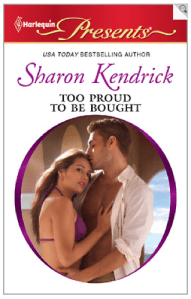
I love my category romance fiction books and, along with my love for the stories, I also love the schmaltzy cover art. For what can be more soothing at the end of a tiring day, than an easy-on-the-eyes image of a handsome man on the cover of your current read.
Mills and Boon Covers
But for many years, I would get annoyed at the waxed, glistening pecs on a torso on so many covers. Now, unless the book is about a male model/exotic dancer/personal trainer, I prefer the cover to reflect the character. You know, white coats for the medics, suits for the business man, kanduras for the sheiks, western shirts for the cowboys and a black T-shirt for the firies. And though I know that some readers like to see the muscle bound man on the cover, I find it very hard to reconcile myself to the hardened Montana cowboy or Australian outback station owner driving/flying to Helena or Barcaldine for their monthly manscaping appointment as it is contradictory to the character I am reading about. And the reality is, most men have chest hair. And it is lovely and it is normal.
I often wonder about historians in 3011. The apocalypse had been and gone with a second dark age where everything had been burnt and annihilated. However, there is a rare discovery of boxes of discarded category romances found during an archaeological dig. These boxes are the only insight into the early second millenium. After a long investigation, these learned historians come to the summation that thousands of years ago melodrama was the stance of the normal couple, women only wore flowing, backless dresses and men had no chest hair yet had really well-developed pecs and abs.
When I suggested on Twitter that cover artists were briefed to not make men hirsute, fellow romance reader and tweeter, McVane, reasoned:
This makes a lot of sense to me and I have to agree though, if you can be bothered searching, there are some fab cover illustrations from the 70s and 80s that are exceptions such as Anne Weale’s Passage to Paxos.
So, after a long hiatus from browsing the eharlequin website, I thought I’d have a quick look at the upcoming releases. And what a pleasant surprise it was to see a hairy chested man on the occasional cover. No longer did the men have prepubescent hairless physiques but they represented a (kinda) norm. The buffed, oiled (squick me out) hero can still be seen in all his flexed (eww) glory over at the Blaze line. But the other lines are that tad bit more realistic (bwahahaha), and in my opinion, sexier. Though I wish HMB had used a hot hot hot Westmoreland rather than a boring old stetson on a chair on this book. For the most part, cover heroes are all in suits (yum) and regular clothes (yay) with the occasional half-dressed-in-the-bedroom or sunset-on-the-beach-in-slightly-rolled-up-trousers scenes (hmmm).
I recall that sometime last year Harlequin/Mills and Boon ran a Twitter survey asking reader preferences for hair or no hair and I would like to think that the current changes are a reflection of the responses that they received.
And, for what it’s worth, I’d love to see more black haired, blue eyed heroes wearing a suit with their shirt opened only slightly at the neck.

 Book 7: Let’s Do It by Cole Porter with illustrations by Ward Schumker.
 Book 8: The Roaring Twenties: A Spicy Pop-Up Book for Adults Only illustrated by Pete Seymour, Borje Svensson and paper engineering by Rodger Smith & Dick Dudley.
 Book 9: Wonder Book of Sex by Glen Baxter.