Procrastireading

Procrastiread / prô’kræstairid/ verb (procrastiread, procrastireading) – 1. to delay finishing a book: I procrastiread my last book for three days. 2. purposely reading slowly so as to not reach the end of a book: the reader was procrastireading because of an emotional connection with the characters of a book in such a deep-felt way that to end the book would result in severing the relationship. [Latin]  – procrastireader, n.

Have you ever found yourself reading a book whose characters endear you, become your friends, become your soulmates and envelop you into their lives to the point that soon you realise that you are half way through your book? And with every page you are getting closer to the end of your relationship with these people. Sure, you are the passive person in this relationship where all others are walking, talking and interacting with each other yet ignoring you. But you are the one who is setting the pace, you are the one that decides when the next words in their story will be read. You are the one that can evoke a procrastiread.

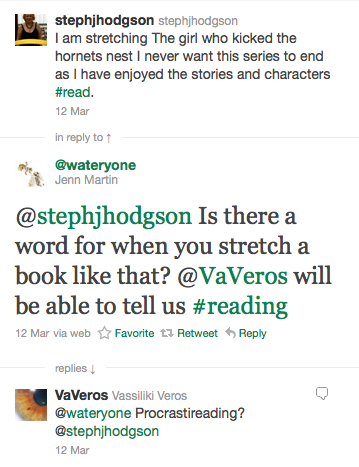
The other day, on Twitter, I took part in a short exchange where @stephjhodgson tweeted that she was stretching the ending of the Stieg Larsson series, @Wateryone asked me if there was a word for that.

I couldn’t find an Oxford Dictionary word or definition for this behaviour . But now, there is a word that we can all use – procrastireading/procrastiread

Over the years there have been few books that I have procrastiread. For the most part, if I am enjoying a book, I need to finish it quickly. I fly through it. I stay up until 3 or 4 in the morning with my obsessive need to know how it finishes despite the fact that I read the ending before I started the book and despite the fact that I will be a mess at work that day. But once in a while I am captured. I am enchanted by every word and phrase. I am lost within the book and I just don’t want it to finish. So I stretch out my reading experience over a number of days.

My most memorable procrastiread has been Bet Me by Jennifer Crusie. Not only are the main characters Cal and Min perfectly matched with their sharp banter from the beginning of the story but their friends also became my friends. I felt captured by them. I was engaged and amused by the narrative and the dialogue. I was invested in these people and as I felt the thickness of the book’s pages in my right hand lessen, I realised that I no longer would have these wonderful friends with me. They would cease to exist. But not if I read only sections at a time. Slowly, savouring each exchange and every nuance. And once I came to the end of the story, I was thankful to Jennifer Crusie who gave me a snapshot epilogue of “Where are they now” for each wonderful character.

I really do miss them.

Have you ever found yourself procrastireading?


No Touching Rule in a Touchy-Feely-Needy Library World

I love being a librarian. And as a librarian I will take up most causes, promotions, events. I will willing give you whatever information you want and don’t want (but hey! maybe one day you’ll realise I was right and you did need it and you’re welcome). I (humbly big noting myself here) am a dedicated librarian.

When the powers that be asked me to celebrate National Simultaneous Storytime. Great, I did it! When I was asked to take part in National Science Week – I was there with safety glasses on! Four years in a row now (but who is counting). When I was asked to take part in Public Lending Rights counting (in pre Online Catalogue days) I volunteered. And so the story goes from ALIA week, to Library Lovers’ Day to Heritage Week even threatening to make “Avast! ye’ll walk the plank, ye landlubbing, fine dodging curmudgeon” on Talk Like a Pirate Day. I am hands on!

Even when twibrarians get in the swing and start library #hashtags trending – I get involved. Yup. I’m there, in the midst of the #savelibraries, #followalibrary, #followalibrarian, #readit2011, #AliaIoc, #reading, #nswra, #hcod, #followreader, #spbkchat….you get my drift. I’m there with bells on. And I’m there with bells on because I want to be there.

But today, my lovely leaders in the ether whoever you are. Today, you declared the day to be the International Hug a Librarian Day. I’m sorry but I cannot support this program. I cannot open up myself to strangers throwing their arms around me, I cannot endorse this touchy feely program. With Hug a Librarian I feel that you have entered my personal bubble, that cone of silence that I hold sacred – my body.

I am quite happily a “No touching” type of person.

When I am with my family, I am affectionate. I hug my children, I kiss them and adore them. I hold my husband’s hand in public (really – I do!), I kiss him and adore him. But that is my “Out of work” personal life and even there I am not overly touchy, feely.

But in the workplace, I am a professional and a “No Touching” rule prevails. Affection does not come into it. As it stands, I really don’t appreciate having to approach the occassional amorous, horizontal teenage couple in the corner of the library to tell them to keep it vertical and frankly, I don’t want any of the 1000’s of borrowers that cross the library threshold to feel that I am in need of affection of any kind. I am happy in my answering questions objectively, contributing to someone-else’s information needs. And damn it, no one is walking around proclaiming it’s “Hug an Actuary” day or “Hug a Surveyor” day. Is this another stupid way of perpetuating the grim, spinster librarian stereotype?

So, please, leave me alone to do my job. Do not encourage strangers to give me unsolicited affection. I don’t want dead-pigeons-down-her-top lady hugging me, or the guy-who-exposes-himself hugging me nor do I want that over-perfumed-botox woman giving me “Mwah!”. I just want to do my job. And needy affection is not in my job description. Hell, I don’t know where members of the public have been and frankly they don’t know where I have been either. And we’re all covered with germy germs.

P.S I think that I would have accepted “High 5 a Librarian” Day. Though that too would have entailed touching.


Why can’t a man, sound more like a man…

OK I have another soapbox moment, yes another one, (an aside – I love how Twitter has become my soapbox of choice, so many people get to hear about my idiosyncrasies and likes and dislikes – bliss!!) – female authors who write male characters that “think” and talk like “chicks”.

I don’t want to read about male characters who only belch, put their hands down their pants or just grunt monosyllabically but what I would like is a guy to sound like a guy.

It is jarring and completely annoying when a male (of all sexual persuasions) character spouts out something so incongruous that it makes me scratch my head and say “Huh”

What guy would:

  • Check out a girl and think about how her accessories really compliment her overall theme: “Her pencil skirt looks really wonderful with chartruese pintucked sheer blouse and finished off beautifully by the stiletto slingbacks”; or “Her violet eyes glimmered and cornsilk hair blew softly in the wind”
  • Utter the following lines: “It stirred my loins into fire” or even better “This is all such sweet sweet torment” or  “Goody’ or my fav “What you needed was someone to meet you where you are emotionally”
  • Sit around a pub/bar/club talking about their requited and unrequited feelings in the romance stake. This point has caused some dissent (well amongst 3 of us) Vaveros & her Huzbah disagree with me and believe that guys do this, I on the other hand must only know troglodytes who would prefer to chew off an arm than ‘talk’. So let’s leave it up to you all to decide.

Really? Really , truly? I am not saying that guys are emotional pygmies or don’t have style or don’t love, they just don’t talk or think like females.

To me a sign of a good author is one that can write internal and spoken dialogue of both the male and female characters so well that you can’t tell if the author is male or female – they are just a writer.

Not so successful authors are the ones who wrote the lines or concepts that I pointed above – no I am not naming, not only am I a shallow reader I am a scaredy cat and don’t want to be flamed or hated on by fans.

Successful writers in this: PD James; Elizabeth George; Minette Walters; Linda Howard; Jaci Burton; Robin Hobb; Victoria Dahl;  Anne Stuart; Laura Kinsale; Loretta Chase and so many others.

The sign of a not so good author is one that can’t make their characters ‘believable’, we know they are fictional but to be remembered and to be talked about, characters have to somehow come to life for the reader.

Mea Culpa Mea Culpa Mea Bloody Culpa (but then again maybe the bookstores will have to shoulder this one)

Last week, RedGroup went into administration and along with it a number of Australian and New Zealand book chains – Borders, Angus and Robertson and Whitcoulls. Of course, the media have gone crazy blaming the darn internet again (my god – prior to 1994 you could only blame society). With the gradual decline of the print newspaper (hell, they’re giving them away at 8am these days) the media are bitter, enraged and ready to snarl at any hint of online business having healthier sales than a bricks and mortar company.

Now I am being implored by the media to “put my money where my heart is” and support my bricks and mortar independent bookseller and stop buying from those horrid online bookshops.

Well, let me say this to the book chains and indies.  You lost me, and a large chunk of the book buying market (romance readers), by being disdainful of our reading choices. I have spent decades struggling to source romance titles and finally have found places that will not only stock them but will sell them to me at a lower price than venerated bookstores can supply them. Why should I change my buying habits. As it stands, I would still have to source my titles through the online bookstore to give to my indie who has actively chosen not to supply them.

Yes, I do love my indie. Their loyalty program is splendid, their staff are friendly and knowledgeable (and all greet me by name) and for years they would order in books for me (back when I really didn’t feel comfortable with online purchasing). These books were, inevitably, romances.  But did this impact at all upon their book stocks? Well – they always stock Jennifer Crusie. But that is it. Despite the fact that they had staff that enjoyed the genre and and that they had customers that enjoyed the genre and that they had genre sections throughout the shop (Sci-fi, Fantasy, Graphic Novels, Crime) my “beloved” indie chooses to not sell Romance. Somehow, I suspect that independent bookshops would prefer to declare bankruptcy than to dedicate any space to the romance genre.

When you have a mortgage or family  or other responsibilities to look after, your book buying priorities change. Thankfully, I work in a public library so access to millions of books is at my fingertips. These same millions of books are accessible to any Australians who visit their public library. To find these books Trove is the best source for titles held throughout the country. That said, I love my keepers and I am all for the adage of “Buy the best, borrow the rest”. So when I find that I have borrowed and renewed a book multiple times and I am deeply in love with it I will go out and purchase a copy for my home.

I find that I buy approximately 20 books a year for my whole family and I buy these books from various sources. Now, the difference between paying $20 per item by going through my indie/chain or paying $8 for the same book through Book Depository/Amazon – it’s a no brainer. And it is insulting to my intelligence to beseech me to stop buying online. Franky, that “leftover” $12 supplies my home with 10 litres of milk (which lasts 3 days) or 1.5 other book titles. A win/win situation for my family.

And if the issue is “Buy Australian” there are a number of generalist Australian online bookstores who do supply romance titles and promote them, discuss them and enjoy them too. They provide a wonderful service and operate in a similar way to indies (except they know what their customers want to read). And their prices are reasonable, too. A shout out to Booktopia and The Nile.

The question is: do I still buy from my indie? That would be a resounding yes though not as much as I used to. I buy all my Australian and New Zealand authors and publications from them. It is the same price (and in many instances, cheaper) than buying those titles online. Will this save the store? I don’t know. Would I return to my local indie if it set up a romance section? Perhaps. I love reading the last pages of a book before I buy it and I also love skimming through a book to get a sense of the language that is being used. Once again, I can’t do that online. So it would really depend on the price and the quality of the titles being sold.

The important point to observe is that readers who choose to buy their books online do so for a number of reasons, be they cost driven, being too busy to be bothered going into a bookstore or quite importantly, inaccessibility of titles readers want to read.

I am putting my money where my heart is – and my heart is with the suppliers of books that I like to read. So if this means that bricks and mortar bookstores will close down I will be amongst the many who will be saying “Mea Culpa”.

Sex, love and passion: the appeal of romance novels: the moderator responds

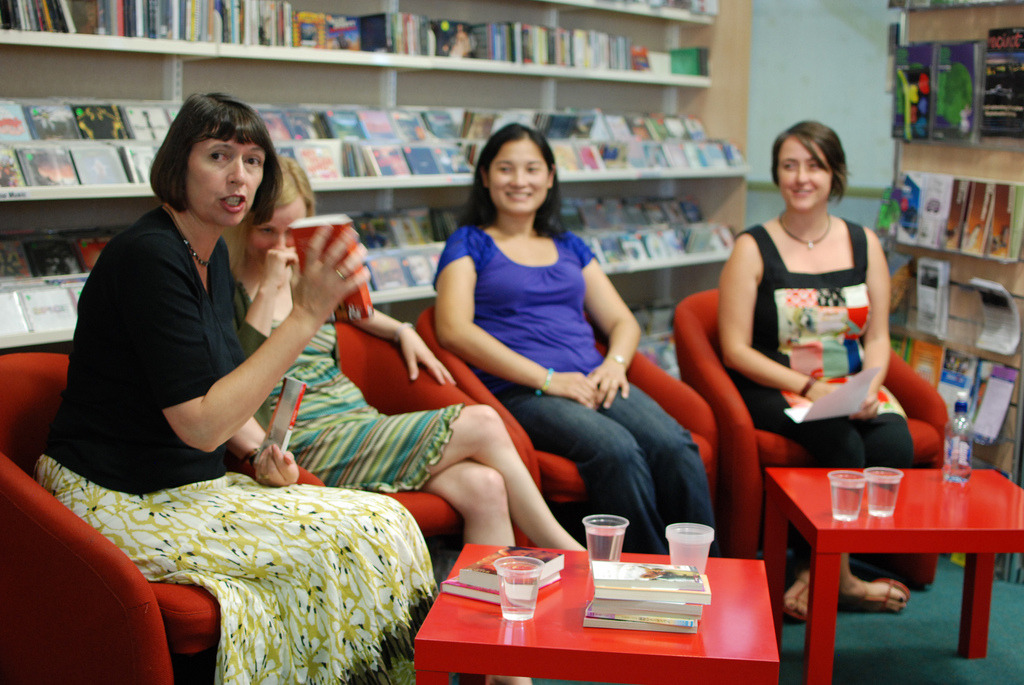
On Friday the 11th of February, I moderated a Romance Panel for the City of Sydney at Ultimo Library.

Kick off your Friday night talking about Sex, Passion and Love with our romance panel discussion. Join Mills and Boon author Annie West, romance scholar Sandra Barletta and book blogger, Kat Mayo along with Ultimo’s romance reading librarians in discussing romance fiction in the 21st century…

It was a fabulous night with an engaged audience, a wonderful panel and fantastic discussion that ensued. So fantastic that Ultimo Community Centre staff had to push us out of the building as we went beyond their closing time.

As the moderator for the panel I had my questions prepped and I knew that I wouldn’t have to prepare meaningful answers (ever the shallowreader).

From the left: Annie West, Sandra Barletta, Kat Mayo and Vassiliki Veros Photograph courtesy from BookThingo http://www.flickr.com/photos/bookthingo/

However, as the panel discussion progressed I found that I really wanted to give my point of view, too. I behaved and, with the exception of the last question and some library promotion, I left the answers to the panel. A transcript of the panel’s answers is available on BookThingo’s blog. I now would like to share my answers to the questions on the night:

Why do you do what you do in romance, of all genres (I’ll answer this in the vein of why do I promote romance reading as a librarian)

Public libraries are charged with providing equity and access of information to all.  My feeling had been that libraries and librarians were not treating genre fiction and it’s readers with equity. Throughout all my years as a librarian, romances not only were not purchased for library collections but there was also a certain attitude amongst staff and some borrowers that romance reading was secondary and that library budget money would not be devoted towards the genre. This annoyed me so I decided to support the underdog, climb onto my soap box and declare romance King until the shelves were populated and the staff accepting  of readers choices.

What have you observed as differences between romance in the past decade as opposed to romance in the 80s?

For me there are 2 standout differences:

1. Like Annie, the 80’s and prior were predominately written from the female point of view. During the 90’s and now in the 21st century there was a gradual shift to both the female and male point’s of view being written into a novel. In my opinion, this shift has been so strong that the way I personally categorise the books I read is that if it has both the protagonists’ points of view then it is a romance. If it is only a female or male point of view it is categorised as Chicklit or Ladlit.

2. The sex is much more explicit and, thankfully, turgid shafts and manhoods have made way for erections and dicks. A much more realistic reflection of contemporary language.

Some people think that reading the last page first is sacrilege. Do you?

I always read the last page. I  feel that “fairies must die” and have previously blogged about this.

Now about male leads. Why do we love rakes, rogues, cowboys, tycoons, sheikhs?

My favourite leads are Montana cowboys and the best friend/sibling’s best friend hook up. Journeys into someone else’s life, journey’s into a world quite foreign and the complete escape from the reality of our own lives. I tend to avoid romances set in Sydney and in Australia as I keep finding myself distracted by the setting of the book.

Kat, you said people get bored with just a kiss, but the obvious exception is Twilight. Can you discuss why it was successful?

As I haven’t read Twilight nor have I watched the movies I cannot answer this question. Though on a purely aesthetic basis – Team Edward.

Do you think romance has lost its stigma?

I think that some of the stigma associated with reading romance has dissipated for the following reasons.

1. Romance readers and romance publishers are leading the ebook revolution. This is acknowledged further by traditional book review magazines taking on romance reviewers.

2. The establishment of the International Association for the Study of Popular Romance and the Journal for Popular Romance have made inroads in bringing academic merit to the study of popular romance literature. Having been established for under 3 years it will be interesting the changes that will come forth over the next decade.

That said, there is still  a large amount of bias towards romance literature and a lot more work is needed from not only the reading and reviewing public but the publishers of romance, also.

What books would you suggest to a new romance reader?

My 1st question to the person venturing into reading romance would be: What do you normally enjoy and then I would select titles from there. I’m a strong believer in merging someone into a genre by using cross-over fiction titles though there are some definite titles that I never hesitate to recommend:

Agnes and the Hitman by Jennifer Crusie

A Matter of Class by Mary Balogh

How come book stores don’t have a romance section? Where can we buy romance?

Unfortunately, romance isn’t stocked in most bookstores because it relates back to the stigma question and bookstores don’t value their readers. I get my romance books from 2 sources Kmart/Target and from overseas. Either the Book depository or Amazon. I also get most of my books from the library but, it too, has it’s biases.

Fave authors? (the only one I answered on the night)

Vassiliki: Anne McAllisterJennifer CrusieVictoria DahlSusan Elizabeth PhillipsSuzanne BrockmannAnne Stuart, Rachel Gibson, Julie James and Melanie La’Brooy)

It was a very successful event and I feel it is apt that my moderator’s cherry was painlessly popped at a romance literature panel.

On why more fairies will die

It is a well known fact that every time someone reads the ending of a book before they start – a fairy dies.  I am not making this up. It is true. If you want to know more about the origins of fairies dying you must read BookThingo’s Spoiling a Happy Ending where the whole idea is explained, in depth.

Readers, in general, fall into two categories – those that can’t bear to know the ending of a book, who enjoy a story unravelling around them and read in anticipation of the final moments, and then there are readere who like knowing how a book ends so that they can enjoy the journey without the page turning anxiety of needing to know if the hero and heroine will make it in the end. I am of the latter proclivity. I will read the ending, assure myself that ends in a way that satisfies me and then I will start the journey. It is particularly good for me to read reviews with *spoilers* so I don’t have to read the endings.

In the case of spoilers, a fairy is only maimed. Perhaps a missing limb.

But let me tell you why I am this way:

I started reading the end of books at about 12 years of age. Up until then, for the most part, I had grown up reading children’s fiction which was funny, positively conclusive, life affirming and, in general, a happy read. Then I started entering the world of tear jerkers. Books where you are torn apart with grief.

I remember sitting in Marrickville Children’s Library reading Lois Lowry’s A Summer To Die horrified that Meg’s sister Molly dies. Horrified! Firstly, I was reading and sobbing in a public space that I was not comfortable in. (That may sound odd but, in actual fact, my local library branch The Warren Library in South Marrickville had been closed down a year earlier. I no longer visited the library daily but could go only once a fortnight)…..so anyway….I’m sitting in the corner sobbing with red blotchy eyes but yet unable to stop reading a compelling, touching story.

I learnt my lesson that day. I never again read a book in the library. All books were to be consumed at home. Reading was no longer public.

By the time I read Katherine Paterson’s Jacob Have I Loved I became used to the idea that crying was just part of the story, as were dying people, manipulative relationships and finding your own way in life. To counter-balance these sadness filled novels I discovered the wonderful world of romance novels. And in particular, Mills and Boon.

Short and contemporary, they were easy to hide in your foolscap folder so that your father couldn’t see them when he was checking that you were doing your homework. And best of all they ended happily.

That is, until Anne Weale’s A Portrait for Bethany. In A Portrait for Bethany, Bethany ends up with the WRONG man. WRONG MAN! YES I AM SHOUTING! IT’S IS NEARLY 25 YEARS LATER AND I STILL HAVEN’T RECOVERED. After traumatic Bethany, I never trusted a book again.

So it would have been about…ummm…let say…..25 years ago that I started reading the back page of every novel I read. I read about 100 books a year so that comes to approximately 2500 dead fairies. Now, I did slip into complacency at one stage and stopped reading the last pages of any Harlequin Mills and Boon that I purchased. They were a given Happily Ever After. Guaranteed. The “formula” said so. I was safe! (let’s quickly re-calculate that number. Perhaps drop it to 1800 dead fairies).

Then disaster struck. Late last year, I purchased an auto-buy Harlequin Mills and Boon author, Lynne Graham. Now I adore Lynne Graham’s books. They have incredulous plots with engaging, emotional narratives leading the reader to be enthralled at how she manages to pull it all together. I was on the edge with The Pregnancy Shock but when it ended without closure I was horrified. I would have loved to have thrown the book at my wall but my wall has some lovely prints hanging off it so the floor had to do.

How could the author, editor, publisher, marketing group, janitor and building supervisor do this to Harlequin Mills and Boon readers. How could they do this to fairies? How could they misunderstand the reasons that any woman will tolerate those awful titles and mostly stupid covers is because the HEA is king. Forget Content is King. HEA is the absolute rule here. As romance readers, we will tolerate awful plots, shocking phrases (I’m looking at you Miss Paullina “she looked up at his face but it was as closed as a bank on a public holiday” Simons), ludicrous premises and sometimes Alpha-Brutes that you wouldn’t let approach you with a ten-foot barge pole. We readers will put up with all that for an HEA.

(Please Note: most romances are beautiful, brilliant, well constructed , wonderfully researched, emotionally charged and full of snappy dialogue that would make Al Jaffee proud).

The thing is that since The Pregnancy Shock I now distrust Harlequin Mills and Boon again. I now read their back pages just as I read the back pages of all novels. And sadly, I have come across several that end in an “…there’s more to come” way. And even more sadly, more fairies are dying than needs to be the case.

PS. Should you be a fairy killer and use twitter, remember to use #afairydies.

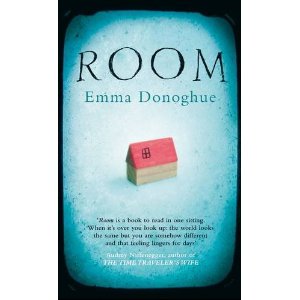
Room by Emma Donoghue (you will need to wear sunnies if reading in public)

1

Room

by Emma Donoghue

a shallow reader review

4

5

6

Please avert your eyes and ears if you can’t bear to see a grown woman sob…

I just finished this book after a number of starts (picked it up, put it down, picked it up, put it down) because I knew it would be a devastating read.

Emma Donoghue, wow wow wow!!

I read through the story with a constant dread, aware of the pain and horror both in the concept of Room and the freedom from Room.

She has created an exceptional  book with the construct of the story emotive and concise. The characters of Room are very real to me in the pacing and the voices of each. There is a liveliness and happiness despite the horror scenario.

Ms Donoghue’s characters inhabit a world where her characters  react and speak in a manner they have developed for themselves – their constructs of language; imagination; reality.

I am simply in awe of everyone inhabiting the novel:

Jack – a boy who knows nothing other than Ma, Room, television and Old Nick (shudder) but who is loving, joyful , smart and inquisitive, Jack is simply a delight

Ma – her depiction was delicate and respectful. The author didn’t make her a superhero, just someone who found strength to cope in a unbelievable nightmare scenario. For her to survive her ordeal but still have the capacity to love and nurture is beyond incredible, for real for real.

Extras – the rest of the characters seem to react in an honest way, unsure, awkward, ultimately normal.

I don’t want to reveal too much, for despite it’s emotional depth and complexity the story is written simply but I will say that the “ending” was very impressive – 3/4 of the way through the book I worried how she would finish (as we have all read books where the story seems to overwhelm the author) – and was really anxious but nope she kept it consistent and honest.

I simply loved this book and think it’s one of those stories that will resonate with me for a very long time.

So, you’re going to have a baby picture book review

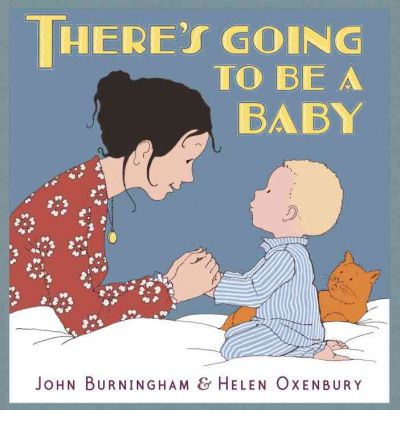
There’s Going to be a Baby

by John Burningham

illustrated by Helen Oxenbury

a shallow reader review

This is one of the best picture books I have read on preparing a child for the arrival of a sibling. Helen Oxenbury uses two different illustrating styles to deliver a delightful story that follows a mum with her young child throughout a 9 month gestation. The mum and child’s interactions are straight illustrations whereas the younger child imaging how life with a new sibling will be is illustrated in a comic book style. An enjoyable and highly recommended read, particularly if you have a 2nd baby on the way.

The Ick Guide on when to discard books

I love reading books. I love reading new books, old books, used books and borrowed books. I love reading well thumbed books and spine unbroken books, big books, tiny books, paperback and hardback books, red books, blue books and dammit! I will even read green books!

However, there comes a time that you need to recognise that a book should be discarded. Yep, that’s right. Sent into that big paper recycling plant in the sky. Because, Dear reader, we all know that we have “ick” boundaries. I have met many people who refuse to use libraries because of “germs” or “but who knows what the previous person was doing with that book” and as a seasoned librarian I can understand that sentiment. Now, some of these ick boundaries will vary from person to person. I personally don’t mind a little bit of sand in my beach novel but it may cross your boundary of ick acceptance. So, here is a list that all book owners, lenders (yep – that’s you too Dear Libraries) and booksellers should pay heed.

Discard if your book has any of the following properties:

1. Odour Ick: You know that sand in my beach read that I don’t mind. 2 years later that sand will give off an eau de pisce…..which is not good at all. Any smell strong enough to make you reel your head back upon opening that first page is an indicator that the book must go – and I don’t care if the smell is your fave L’eau D’Issey.

2. Hair Ick: Hair of any sort should never be in or on a book. Unless  it’s a Princess touch and feel board book and even then – it will have cooties.

3. Tactile Ick: Unfortunately this comes in several forms.

3.1  Cover Ick. You pull a book off the shelf and immediately your fingers touch something other than paper or covering plastic. They touch a film…a film of something unidentifiable. It may be brown and grimy (very common amongst libraries whose staff persist on using sticky tape on the covers of books rather than securing notes/reservation notices with paper and elastic bands – not that it’s a bugbear of mine or anything like that – gee I was trained well by those Randwick librarians in the early 90’s), or it is wet. Wet when it is water isn’t particularly good but it is better than when wet that is not water.

3.2 Internal Ick: That’s right. This book is perfectly fine. You’re reading it and you’re totally engaged. Then, upon turning to page 230 just as it’s a cliff hanger, sex scene, gun at the temple, alien abduction showdown with a unicorn, you turn the page and there is something…something gracing the pages. It could be grimy (soil, sand), edible (banana, honey), movable (lice, cockroach) or it could just be pages that are stuck together. Now, you the reader, depending on where in the story these pages became stuck, will be able to ascertain as to the nature of what has stuck them together. But more on that in Point 4.

When you are faced with tactile ick – it’s time to discard the book.

4. Bodily fluid ick: From the less inocuous snot, ear wax or baby saliva to the gross levels of urine, faeces or semen, if you suspect that bodily fluid irk is present on the covers or between the pages of the book you are reading follow these instructions: drop the book; holler “ick”; don some industrial strength gloves. If the book is yours throw it away. If it is not your book place it in a plastic bag, seal it and report it to whoever you borrowed it from. And yes – that may mean your lovely librarians who will gag as they record the barcode, take it off your record and discard of the offending book ASAP.

5. Wet Ick: So you were reading in the bathtub again. Only this time the book fell in. Or you’re at the beach and you haven’t noticed the tide come in. You now own a sopping wet book. Of course, there are methods to salvage a wet book but unless it is an out of print, rare book (and if it is what the hell were you thinking reading it in the bath/at the beach you bloody idiot) don’t bother. The cost of replacing the book will be much less bother. Though, if you insist, here is a guide on how to dry wet books.

6. Mould Ick: This is directly related to 5. Wet Ick. If you have tried to salvage wet ick and left moisture mould ick ensues. And this is, let’s say, icky. Worst part is that mould spreads so even if the rest of your books weren’t wet – the mould will still get to them. Get rid of it!

7. Eaten Ick: I don’t like tomato sauce, mustard, jam, banana, coffee or steak with my books. I like my books without any condiments to be honest. And frankly, I do not like my books to have been eaten by rodents either. Another surefire discarding moment.

So when if comes down to it, when you are choosing a book to read, or if you work in a library and you are reshelving items, look at the tattered book in your hand and think to yourself; Would I read this in bed? Would I read this over a coffee (which may in fact be the reason that no-one will want to read it as the previous coffee drinker got a bit bloody excited while reading, slushed coffee and hid the evidence)? Would I give this book to my immuno-suppressed, living in a bubble neighbour? If the answer is No! Get rid of it. And if you are wailing “but it’s my favourite”, “it’s a first edition”, “the author personally signed it for me” or “but my granny gave me that book” I have several things to say:

1. Take better care of your things (of course, the exception to this rule is if the damage is due to fire, flood, plague and all other cataclysmic disasters).

2. Buy a new book. Booko.com.au will help you with a price comparison and suggested retailers.

3. Buy a second hand one abebooks.com

3. Cope. Live life without it.

I haven’t been exhaustive as I thought that I would avoid the whole age and use aspect of icks because it is done so well at Awful Library Books. I recommend you turn to them for guidance in this area.

So for the salvation of all readers, for the salvation of your own personal bookshelves and your own sanity (dammit! where is that fishy smell coming from!) use this Ick Guide, discard offending books and buy yourself some brand-spanking new copies.

Now some of you may ask about the falling apart from having been read so many times ick. This is not ick. This is love. This is deep, abiding love. And even the crooked book can be read.


PS Note to collection development librarians reading this – feel free to use this as part of your weeding guide. You’re welcome!

The BookGroup you’re having when you’re not having a bookgroup

or Why pubs make great venues for bookgroups

On the 2nd Wednesday of every month I walk down to my local pub to talk with other readers about thingys we have read. And yes, these get togethers are as vague as that first sentence. But let me start at the beginning.

Nearly 10 years ago, my local barista/friend/reading pal asked if I was interested in starting a bookgroup with her at the coffee shop she owned. She found that she was constantly chatting with her customers about books and this was affecting queues for coffee. The inaugural meeting was held with many of her customers, both male and female, turning up.

On that day there were several things that everyone agreed upon:

1. No-one wanted to feel like they were in a classroom. They did not want book notes, study notes, analysis or anything that might remind them of their school years. [My kind of people!]

2. The idea of 1 book that everyone had to read was distasteful. Choosing a single title that would appeal to the broad group would be too hard. Everyone agreed that a themed bookgroup was best. [Internal cheers]

3. Everyone had an equal voice. There was to be no scoffing, no derision, all reading and all choices were valid. [Yay! I could take romances with the knowledge that I didn’t have to roll my eyes and sneer at literary snobbery]

We eventually came to have a Number 4:

4. Cheers for most tenuous link between the subject and the reading choice. [This has become a highlight in our monthly meetings with the best ever tenuous link being someone who read a biography on Fidel Castro for the topic Infidelity and my own win with Susan Elizabeth Phillips’ Heaven, Texas for the topic of Church and State]

At first, we met up at Muse Cafe in Summer Hill. Once our friend, who owned the cafe,  sold up we chose to also move and after various unsuccessful venue choices we decided upon Summer Hill pub. I must point out that the then owners of Cafe Decolata (another of Summer Hill’s many cafes) were fabulously accommodating! Despite the fact they closed at 5pm they gave the group the keys to the cafe and we met there after hours for as long as we liked which we did for several sessions. But the eating & drinking options weren’t available to us so we had to move on.  The Pub provided us with a relaxed environment where no-one felt obliged to purchase a meal or a drink yet we had the ability to stay for as long as we liked. We have had the occasional clash with a rowdy football game but shouting across a table as to why you loved the latest romance or murder mystery you have read can be surprisingly cathartic.

Over the years, our themes have ranged from the sea, 3, music, blue, elections, feminism, blokes, beer, Russia, design and the list goes on. We also have had a variety of formats. Our reading extends beyond fiction and includes non-fiction, poetry, song lyrics (which on one occassion were sung and accompanied by guitar), plays, picture books, Hansard, essays, films and television scripts. Our members are a varied lot of people. With a good mix of males and females, we’ve had some very interesting people come and go. From teachers, baristas, ministers (well only 1 really but he was with us for a long time & we wish he hadn’t been transferred to Newcastle), librarians [moi!], academics, illustrators, marketers, teens, parents and even the occasional appearance from some of our kids presenting the book that they have read. Some of us have formed friendships over the years yet, for the most part, our strongest connection is meeting at the local to talk about our topic once a month.

In 2006, I saw the first write up of this type of book group in Library Journal as to the value [and in my opinion, a much more welcome model] of thematic book clubs. I was impressed. This article articulated the organic way our group operated. It also highlighted that by opening up to a theme based approach reading choices allowed diverse choices, less structure and suited to people who are not similar in their reading habits but just want an opportunity to share their reading experiences with others.

FAQs:

Do I think a library would be a better venue? No! Libraries close too early and they don’t serve beer.

How can you too have a group like the one I belong too? I don’t know. How does one meet an open-minded, reading friendly publican/coffee shop owner willing to provide the space and spread the word to their customers?

Does this type of bookgroup suit everyone? Not at all. We have had many people turn up for one meeting only to leave exasperated at our lack of focusing on one book and our tangential conversations.

And how does a laissez-faire group of people with no leader manage to keep meeting for 10 years? I’d say common courtesy and a desperation to share their reading experiences with anyone other than their immediate families who may or may not be readers.

Now, I must clarify, that the rest of the group are not Shallow Readers. They have depth……. and they will all happily acknowledged that I am the shallow one.