Doing justice to Desire

The other week I guest posted a Five Word Review on Charlotte Lamb’s Desire. The review reads “Drunk Fuck Pregnancy Equals Luurve”. I stand by this review. It relays the exact premise of the book. But what it doesn’t relay is the love I have for this book.

The heroine, Natasha, gets drunk after breaking up with her fiance. She goes out with friends and becomes uninhibited after drinking champagne and takes off with a hottie called Lee Farrell with whom she has a one-night stand. When she wakes up the next morning she is mortified and he drives her home upset that it was the alcohol and not her desire for him. She falls pregnant and doesn’t keep the baby secret. Inevitably they marry for convenience but are stand offish and suspect of each other until the grand grovel and love reveal at the end. It is a fab read that very much reflects the mores of the early eighties.

I have reread Desire at least once a year for the past 25 years and I still love it. Published in 1981, the year that Charles and Diana married (why is this relevant), the protaganists have a 16 year age gap (Charles and Diana had a 13 year gap so it is relevant to set it in context) which I find irksome when the heroine is 17 but seeing that 20 is my tipping point into acceptability these two characters are fine by my measure as she is 21 to his 37.

The standout for me is that Natasha has been brought up conservatively and to believe that love is soft and gentle. After breaking up with her fiance “Natasha had always played the submissive, female role…” it is through alcohol that she feel uninhibited. She feels desire and she matches Lee’s desire as an equal.

She had been conditioned to see herself in that yielding female role, to accept the qualities which society expected in a woman, to be soft and gentle and pliant, to submit and give what was demanded. She had not been taught to demand in her turn, to be strong and self-sufficient, to claim her right as a woman, to match the male on her own terms

It is paragraphs like these that I feel are lacking from many romances today. As a 12 year old the sex flew over my head. However the concept of not being subservient, not being shy and reticent, stating my terms and refusing to compromise those values is what stays with me. It is finding a partner who matches you, not a partner who subsumes you that clicked in my reading.

They start conditioning you when you [are] in your cradle

                                                                                        Natasha

My belief is that many romances (particularly from the 70s and 80s) may write what at face value is an unbalanced relationship but it is the reading between the lines that I am interested in. The relationship may fade but the knowledge that with this man, Lee Farrell, Natasha feels strong and self-sufficient yet with others she was submissive. Natasha recognises society’s expectations of her and chooses to not adhere to them but it takes courage to do so.

The book is pretty much angsty from beginning to end. Angsty in that good, melodramatic way with fainting, fisticuffs, jealous fits over beaux and belles, alphabrute chest beating and other ridiculous misunderstandings that drive the story.

You have some crazy notion that love and sex are separate issues

                                                                                                           Lee

This book is about sexual love. Not a love of companionship which no doubt will eventuate in years to come but a love of physical desires firing the soul and Charlotte Lamb’s aim is to allow Natasha to not feel shame and guilt for her sexuality. The book also gives a passing nod to Jane Austen’s Pride and Prejudice for that is really what drives their inability to communicate. Natasha is prejudiced against Lee believing in his public image rather than the man she was attracted to. Lee’s pride takes a battering every time Natasha claims she loved Mike, her ex-fiance, and she was ashamed of her actions with Lee and, as is expected in a Mills and Boon, these issues are resolved at the end of the book in their declaration of love for each other. But not before Lamb uses Natasha as a vehicle to remind the reader

Men have organised the world for their own convenience for years. They made the laws, moral and otherwise, and it was men who sold women the idea that sexual desire is okay for a man but shameful for a woman

I believe that Lamb uses romance to subliminally embed ideas of feminism in her reader’s mind (remember its 1981 publication date). But even more importantly, she uses Lee to remind the reader it is love in its many variations that drives us

Love is what we want it to be, what we need. It doesn’t have any rules. There’s no such thing as law or morals where love is concerned. It’s just a question of feeling, of real emotion, of caring for one person rather than another, of needing one person rather than another.

Retro Romance Reading: Books 10, 11, 12 ,13

I became an obsessive fan of Mills and Boon and other category romance lines during the 1980’s when I was a young teen. So I decided to read some older titles. I also decided to combine this with the Australian Women Writers 2012 Reading and Reviewing Challenge. So here I have 4 Mills and Boon written by Australian Women Authors.

20120208-135951.jpg

Of the four listed below, my only reread was Lynsey Stevens’ Ryan’s Return. I recall reading this as a teen and finding it – not romantic – but saddened by the actions of the adults around the two protagonists. Perhaps still a sign of the category fiction range at the time, but having a 23 year old sleep with a nearly 17 year old (both of whom were besotted with each other) feels very uncomfortable, though real, to me. For their parents then to insist on a shotgun wedding after which said 23 year old leaves without a word to anyone just worsens the feeling. To add to the mix our nearly 17 year old heroine falls pregnant and has twins. She is lucky enough to have the support of both her father and her in-laws. The main story takes place 8 years later when the hero finally returns to “claim” his wife and children. The strength of the story is that the author does not gloss over the long time the hero is gone. When it comes time to explain his absence to his children (and wife) he talks about how even adults can make mistakes, how having his hand forced made him lash out. How his behaviour during the first two years was abominable and though not excusing himself, it certainly explained some of his actions. As per most Mills and Boon, there is a redemptive Happily Ever After and one that, as a reader, I felt comfortable with. I also liked the sex scenes which, though they were signature torrid, they were not graphic nor did they use eyebrow raising allusions. For a category romance published over 30 years ago, I certainly felt it had aged well and was still readable and I can certainly understand why I have held onto my copy for all these years.

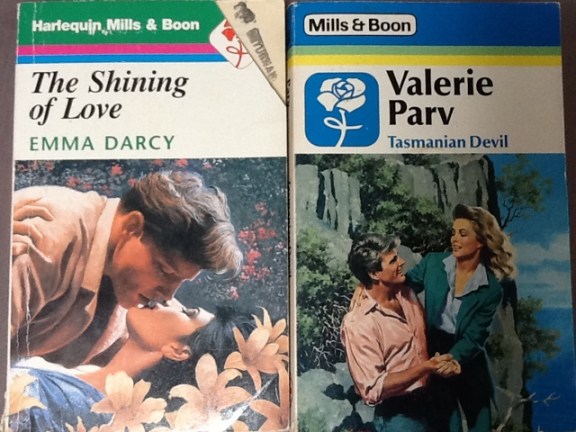
My other 3 choices I found in a second-hand bookshop. 2 titles were by Emma Darcy and one by Valerie Parv.

A Very Stylish Affair by Emma Darcy was perhaps my least favourite of the 4 books though readable enough that I finished it in a day. The out of the bottle red headed feisty heroine grated on my nerves as did the less than professional alpha lawyer hero. Of course, there was the stunning other woman also on the scene with the obligatory lack of communication and misunderstandings between the leading protagonists. I am still not sure why I read this book to completion…perhaps because I really liked the Lindfield/Sydney setting.

20120208-140022.jpg

On a completely different note, Emma Darcy’s The Shining of Love was compelling. Part of a series of books around a family of fostered siblings, this Mills and Boon has the out of the ordinary set up of the female protagonist being married (to a man she loved and respected) and turning down the male protagonist who fell in love with her at first sight and begs her to leave her husband (which she doesn’t). The book spans 18 months, there are parallel missing child storylines, the obligatory “other woman” and a series of coincidences that could have been trite but were handled very well by the author. Though I didn’t feel convinced by the protagonists as a couple, I did however, love the rest of the story.

Last of the pick was Valerie Parv’s Tasmanian Devil. Here is another book that I really enjoyed. A twist on the “alone on a desert island heiress learning to fend for herself” storyline, this is a classic Mills and Boon in that there was an alpha man saving his womAn, jealousies, misunderstandings and many other over the top, melodramatic scenes which make for a thoroughly enjoyable story. I particularly loved the sex scenes which were not at all graphic but filled with swoony allusions. My favourite line was:

Having read these four titles, I will continue on my journey for more Mills and Boon Australian publications throughout this year.

Book 1: It’s Always Been You by Victoria Dahl

This book took me 6 weeks to finish. This is not indicative of a sluggish read but more a sign of my exhaustion working on my house renovation that I could barely manage a chapter a day. Though half way through the book I found myself sneaking off to the hardware shop to “buy a screw/doorhandle/paint/thingmejob” when in actual fact I was driving around the corner, reading a chapter and then returning (remarkably early) shaking my head and claiming that the shop had run out of screw/doorhandle/paint/thingmejob.

20120104-000816.jpg

A lovely read! I liked it muchly. I enjoy Victoria Dahls writing and It’s Always Been You uses the teen romance separated by meddling parents meet up years later trope that I love. Great characters, hot sex scenes, English countryside, and a beautiful blue dress. Go forth and read it too!

Darling Be Home Soon

I love The Lovin’ Spoonful/John Sebastian’s Darling Be Home Soon. It has been covered by many artists from Bobby Darin, Allison Crowe, Joe Cocker and Slade. The simple lyrics to this song still bring tears to my eyes. They speak of needing those moments where you talk and talk and talk with the person you adore. A hand holding song.

Darling Be Home Soon

Lyrics by John Sebastian

Come
And talk of all the things we did today
Here
And laugh about our funny little ways
While we have a few minutes to breathe
Then I know that it’s time you must leave

But darling be home soon
I couldn’t bear to wait an extra minute if you dawdled
My darling be home soon
It’s not just these few hours but I’ve been waiting since I toddled
For the great relief of having you to talk to

And now
A quarter of my life is almost past
I think I’ve come to see myself at last
And I see that the time spent confused
Was the time that I spent without you
And I feel myself in bloom

So darling be home soon
I couldn’t bear to wait an extra minute if you dawdled
My darling be home soon
It’s not just these few hours but I’ve been waiting since I toddled
For the great relief of having you to talk to

Darling be home soon
I couldn’t bear to wait an extra minute if you dawdled
My darling be home soon
It’s not just these few hours but I’ve been waiting since I toddled
For the great relief of having you to talk to

Go
And beat your crazy head against the sky
Try
And see beyond the houses and your eyes
It’s ok to shoot the moon

So darling
My darling be home soon
I couldn’t bear to wait an extra minute if you dawdled
My darling be home soon
It’s not just these few hours but I’ve been waiting since I toddled
For the great relief of having you to talk to

Australian Romance Readers Convention 2011 – Part 2

In my day to day life, I have a few acquaintances who read and enjoy romance novels but it is a rare occasion to be surrounded by romance novel enthusiasts and authors and attending the Australian Romance Readers Convention gives you a chance to talk talk talk about romance novels without the fear that you are getting tiresome.

Here is the second part of my twitter influenced take (that is: 140 words or less per session)

Dinner – Bling and the 2010 Australian Romance Readers Awards – Winners

The ARRC2011 dinner was a dressed up, blinged up affair. An unofficial bling off had been issued and everyone came dressed to the nines. I felt that my tiara might give me the edge on others but unfortunately, Christine Darcas out-blinged everyone in her ballroom dancing, white sequin dress. It was bright & beautiful and her win was well deserved. For more pics there’s Bookthingo and ObsidianTears13 Flickr sets.

As for the favourite authors – there really was a strong Australian/New Zealand bias. Congratulations to Anna Campbell, Nalini Singh, Paula Roe, Jess Dee, Kandy Shepherd and Helene Young. For more details on the winners go to ARRA or Bookthingo.

The food was lovely and the company was splendid. There was much talking and cheer amongst all that attended.

DAY 2

Keynote: Cindy Gerard

Coming from Iowa, corn-fed Cindy Gerard had no idea that romance was the ugly step-sister of the publishing world. She (naively) sent her manuscript to LaVryle Spencer to critique who suggested CG send it to RWA .

Cindy addressed that she knew that she was talking to readers not writers so her talk was not going to be on her craft. She spoke about how, regardless of what you undertake in your life, it is the ability “to confine, control and dominate self-doubt” that will help you succeed. “Self doubt is a sneaky bitch” and can derail any career.

Cindy Gerard was funny, friendly and a lovely person throughout the convention. Stupidly, on each day I kept forgetting to bring my Marriage, Outlaw Style fave Cindy Gerard Silhouette for her to autograph but we did talk cowboy heroes!

Contemporary – The Resurrection of Contemporary Romances

Cathleen Ross, Amy Andrews, Lisa Heidke, Christine Darcas, Ros Baxter

Moderator: Kandy Shepherd

I was excited about this session as it’s my fave sub-genre. Unfortunately, the title was a misnomer as only 2 of the authors wrote contemporary romance. The rest were chick lit authors writing in the first person not the third. This difference was evident when asked for their fave authors. The contemporary authors listed SEP, Rachel Gibson, Crusie, Roberts whereas the chicklit authors listed Marion Keyes & Maggie Alderson.

That said, discussion was fun and lively. Authors articulated their craft, drawing on life experiences. Lisa Hiedke openly admitted to stealing from her own life, Amy Andrews & Ros Baxter on collaborative writing, the use/non-use of children, how much sexual description is enough (at which point Denise Rosetti’s books were described as 3 knicker reads) and the use/non-use of condoms in romance (do they get in the way or is it necessary).

Overall, a great session which would have set different expectations if it had been named Contemporary Romance vs Chicklit.

Category Series – 100 years and still going strong

Kelly Hunter, Melanie Milburne, Michelle Douglas, Paula Roe, Haylee Kerans (Harlequin staff)

Moderator: Annie West

I adore this sub-genres’s short, intense, contemporary stories so attending an intimate talk with these authors was a bonus. Annie West opened questions not only to the panel but to the audience too. Everyone discussed their first ever category read and why they chose to write in the genre.

The authors discussed how satisfying it is to read about alpha males who are at the mercy of the heroine. Kelly Hunter finds the power balance in relationships is important. Paula Roe is still mourning the cancellation of Harlequin Temptations.

Other topics were male virgins, the economy of words and tightly delivered emotions in the short story, tackling issues and the 40 year shift from low sensuality yet broader moral views to high sensuality with more conservative views.

The love promise has stayed core to the category series. The authors said criticism is fine – the reader always owns their response to the story.

By invitation – delegates panel

Cindy Gerard, Helene Young, Anna Campbell, Nalini Singh, Lexxie Couper, Keri Arthur

Moderator: Pamela Diaz (Convention Co-ordinator)

I chose to not take notes at this session. I enjoyed listening to the authors banter with each other about their writing experiences, their favoured genres, what they imagine they would be doi

ng if they weren’t authors. Bookthingo asked them whether they read the last page of a book (I won’t steal BookThingo’s thunder here but I will say that it was a fifty/fifty response). For more details please go to her website!

The convention was wrapped up at this point. It was another fantastic, intense weekend full of romance reading suggestions. My highlight of the convention has to be meeting all the wonderful Twitter folk I have been tweeting with over the last two years. Authors, bloggers, booksellers and readers….oh – and meeting Cindy Gerard, author of one of my favourite ever category romance rereads.

Australian Romance Readers Convention 2011 – Part 1

In my day to day life, I have a few acquaintances who read and enjoy romance novels but it is a rare occasion to be surrounded by romance novel enthusiasts and authors and attending the Australian Romance Readers Convention gives you a chance to talk talk talk about romance novels without the fear that you are getting tiresome.

Here is my twitter influenced take (that is: 140 words or less per session)

Friday Night Cocktails

Ditto!

The cocktail party was an intimate affair overlooking Bondi Beach with readers, bloggers, tweeps and authors mingling and schmoozing. The funny thing is that I didn’t look out at the view even once. The company was so engaging and enjoyable.

It was very exciting to meet up with friends from 2009 and even more so to meet friends whom I have met through Twitter and with whom I have shared many a twitversation. Some were instantly recognisable due to their twitter pictures and names but others who use a pseudonym or pseudophoto would sometimes be talking to you for a while before you realised who they were.

After the cocktails there was an impromptu meet-up in BookThingo’s room where we continued to talk books, romance fiction and bling.

Saturday

Keynote: Anna Campbell

Anna Campbell loves reading about intense relationships. Her first romance was by Joyce Dingwell, a Mills & Boon which she read at 8. Anna gave us a who’s who of Australian. Helen Bianchin, Margaret Way, Lindsay Armstrong, Valerie Parv, Emma Darcy. Up until this point, authors were published out of London by Mills & Boon. Then Harlequin published Bronwyn Jameson along with Annie West, Rachel Bailey, Amy Andrews, Michelle Douglas, Paula Roe, Sarah Mayberry and Melanie Milburne.

Australian single title authors are Stephanie Laurens, Anne Gracie, Mel Scott, Keri Arthur, Erica Hayes, Denise Rosetti, Helene Young, Bronwyn Parry, Anna Campbell and many more.

Anna ended her talk saying that Australia is a good place to be as a romance author because it is culturally aligned between the US & England therefore appealing to a very broad audience.

Book Launch – Helene Young’s Shattered Sky

Helene Young launched her new romantic suspense book Shattered Sky set in North Queensland.

This One Time – Panel discussion

Jess Dee (erotic), Anna Campbell (Historical), Shannon Curtis (Category), Helene Young (Romantic Suspense)

Moderator: Erica Hayes (Urban Fiction)

This one Time:

Discussion ranged from where authors get ideas. Both from their life experiences and their reading influences.

All the writers seemed to draw from their own experiences. Helene Young had the tragic misfortune of finding a dead body on the beach which years later acted as the foundation for her latest book Shattered Sky. Anna Campbell though has never met a Spanish duke in the 19th century and finds that she pulls a lot more out of her captive years at a Dickensian boarding school. For Shannon Curtis trying to get published was turned on its head when she took her blind father’s advice to sex up her writing though she w=ould prefer that he didn’t listen to audiobooks of her writing. Australian’s take blaspheming lightly but the American’s don’t. She gets a lot of complaints about the JC’s but not the fucks. This is a stand out in cultural differences.

This was a funny session with some lovely anecdotes from all the authors.

Romantic Suspense – panel discussion

Cindy Gerard, Helene young, Karlene Blakemore-Mowle, Shannon Curtis

Moderator: Bronwyn Parry

The authors talked about character development and the research they did so they can ensure their story was an entertaining escape and researched with sensitivity and authenticity. Keeping the romance story present in the romantic suspense can be difficult. There is an intensity that lends itself to adrenaline when lots of characters are dying that warrants hot sex quickly for others.

Cindy Gerard has a lot of military fans and her characters tend to be ex-soldiers. She’s vulnerable to her readers that have become friends and feels a responsibility in writing for them.

Research for all the authors plays a large role. Helene Young, also a pilot, needs to keep the flight information realistic without boring the layman yet not dumbing it down either. Cindy uses travel guidebooks and Bronwyn loves Google Earth to work out just how isolated can she make her settings.

Another interesting session.

Auction Booty

I bid on several items at the auction. I missed out on the retro Mills and Boon notebooks and Kathleen O’Reilly books. However I won the following

Kandy Shepherd:

Yay, for Kandy! Despite being an Australian author (and Sydney based) Kandy had been published in the US but not in Australia. I fell in lover with her book covers and she is a funny, scream of an author who was just as excited as I was when I got the winning bid *cheering*

Eloisa James’s Desperate Duchesses and An Affair Before Christmas because she’s one of the author’s I suggest for romance novel sceptics.

Sarah Mayberry’s Her Best Friend, Home for the Holidays and A Natural Father because I wanted to trial an author I hadn’t yet discovered.


Mea Culpa Mea Culpa Mea Bloody Culpa (but then again maybe the bookstores will have to shoulder this one)

Last week, RedGroup went into administration and along with it a number of Australian and New Zealand book chains – Borders, Angus and Robertson and Whitcoulls. Of course, the media have gone crazy blaming the darn internet again (my god – prior to 1994 you could only blame society). With the gradual decline of the print newspaper (hell, they’re giving them away at 8am these days) the media are bitter, enraged and ready to snarl at any hint of online business having healthier sales than a bricks and mortar company.

Now I am being implored by the media to “put my money where my heart is” and support my bricks and mortar independent bookseller and stop buying from those horrid online bookshops.

Well, let me say this to the book chains and indies.  You lost me, and a large chunk of the book buying market (romance readers), by being disdainful of our reading choices. I have spent decades struggling to source romance titles and finally have found places that will not only stock them but will sell them to me at a lower price than venerated bookstores can supply them. Why should I change my buying habits. As it stands, I would still have to source my titles through the online bookstore to give to my indie who has actively chosen not to supply them.

Yes, I do love my indie. Their loyalty program is splendid, their staff are friendly and knowledgeable (and all greet me by name) and for years they would order in books for me (back when I really didn’t feel comfortable with online purchasing). These books were, inevitably, romances.  But did this impact at all upon their book stocks? Well – they always stock Jennifer Crusie. But that is it. Despite the fact that they had staff that enjoyed the genre and and that they had customers that enjoyed the genre and that they had genre sections throughout the shop (Sci-fi, Fantasy, Graphic Novels, Crime) my “beloved” indie chooses to not sell Romance. Somehow, I suspect that independent bookshops would prefer to declare bankruptcy than to dedicate any space to the romance genre.

When you have a mortgage or family  or other responsibilities to look after, your book buying priorities change. Thankfully, I work in a public library so access to millions of books is at my fingertips. These same millions of books are accessible to any Australians who visit their public library. To find these books Trove is the best source for titles held throughout the country. That said, I love my keepers and I am all for the adage of “Buy the best, borrow the rest”. So when I find that I have borrowed and renewed a book multiple times and I am deeply in love with it I will go out and purchase a copy for my home.

I find that I buy approximately 20 books a year for my whole family and I buy these books from various sources. Now, the difference between paying $20 per item by going through my indie/chain or paying $8 for the same book through Book Depository/Amazon – it’s a no brainer. And it is insulting to my intelligence to beseech me to stop buying online. Franky, that “leftover” $12 supplies my home with 10 litres of milk (which lasts 3 days) or 1.5 other book titles. A win/win situation for my family.

And if the issue is “Buy Australian” there are a number of generalist Australian online bookstores who do supply romance titles and promote them, discuss them and enjoy them too. They provide a wonderful service and operate in a similar way to indies (except they know what their customers want to read). And their prices are reasonable, too. A shout out to Booktopia and The Nile.

The question is: do I still buy from my indie? That would be a resounding yes though not as much as I used to. I buy all my Australian and New Zealand authors and publications from them. It is the same price (and in many instances, cheaper) than buying those titles online. Will this save the store? I don’t know. Would I return to my local indie if it set up a romance section? Perhaps. I love reading the last pages of a book before I buy it and I also love skimming through a book to get a sense of the language that is being used. Once again, I can’t do that online. So it would really depend on the price and the quality of the titles being sold.

The important point to observe is that readers who choose to buy their books online do so for a number of reasons, be they cost driven, being too busy to be bothered going into a bookstore or quite importantly, inaccessibility of titles readers want to read.

I am putting my money where my heart is – and my heart is with the suppliers of books that I like to read. So if this means that bricks and mortar bookstores will close down I will be amongst the many who will be saying “Mea Culpa”.

On why more fairies will die

It is a well known fact that every time someone reads the ending of a book before they start – a fairy dies.  I am not making this up. It is true. If you want to know more about the origins of fairies dying you must read BookThingo’s Spoiling a Happy Ending where the whole idea is explained, in depth.

Readers, in general, fall into two categories – those that can’t bear to know the ending of a book, who enjoy a story unravelling around them and read in anticipation of the final moments, and then there are readere who like knowing how a book ends so that they can enjoy the journey without the page turning anxiety of needing to know if the hero and heroine will make it in the end. I am of the latter proclivity. I will read the ending, assure myself that ends in a way that satisfies me and then I will start the journey. It is particularly good for me to read reviews with *spoilers* so I don’t have to read the endings.

In the case of spoilers, a fairy is only maimed. Perhaps a missing limb.

But let me tell you why I am this way:

I started reading the end of books at about 12 years of age. Up until then, for the most part, I had grown up reading children’s fiction which was funny, positively conclusive, life affirming and, in general, a happy read. Then I started entering the world of tear jerkers. Books where you are torn apart with grief.

I remember sitting in Marrickville Children’s Library reading Lois Lowry’s A Summer To Die horrified that Meg’s sister Molly dies. Horrified! Firstly, I was reading and sobbing in a public space that I was not comfortable in. (That may sound odd but, in actual fact, my local library branch The Warren Library in South Marrickville had been closed down a year earlier. I no longer visited the library daily but could go only once a fortnight)…..so anyway….I’m sitting in the corner sobbing with red blotchy eyes but yet unable to stop reading a compelling, touching story.

I learnt my lesson that day. I never again read a book in the library. All books were to be consumed at home. Reading was no longer public.

By the time I read Katherine Paterson’s Jacob Have I Loved I became used to the idea that crying was just part of the story, as were dying people, manipulative relationships and finding your own way in life. To counter-balance these sadness filled novels I discovered the wonderful world of romance novels. And in particular, Mills and Boon.

Short and contemporary, they were easy to hide in your foolscap folder so that your father couldn’t see them when he was checking that you were doing your homework. And best of all they ended happily.

That is, until Anne Weale’s A Portrait for Bethany. In A Portrait for Bethany, Bethany ends up with the WRONG man. WRONG MAN! YES I AM SHOUTING! IT’S IS NEARLY 25 YEARS LATER AND I STILL HAVEN’T RECOVERED. After traumatic Bethany, I never trusted a book again.

So it would have been about…ummm…let say…..25 years ago that I started reading the back page of every novel I read. I read about 100 books a year so that comes to approximately 2500 dead fairies. Now, I did slip into complacency at one stage and stopped reading the last pages of any Harlequin Mills and Boon that I purchased. They were a given Happily Ever After. Guaranteed. The “formula” said so. I was safe! (let’s quickly re-calculate that number. Perhaps drop it to 1800 dead fairies).

Then disaster struck. Late last year, I purchased an auto-buy Harlequin Mills and Boon author, Lynne Graham. Now I adore Lynne Graham’s books. They have incredulous plots with engaging, emotional narratives leading the reader to be enthralled at how she manages to pull it all together. I was on the edge with The Pregnancy Shock but when it ended without closure I was horrified. I would have loved to have thrown the book at my wall but my wall has some lovely prints hanging off it so the floor had to do.

How could the author, editor, publisher, marketing group, janitor and building supervisor do this to Harlequin Mills and Boon readers. How could they do this to fairies? How could they misunderstand the reasons that any woman will tolerate those awful titles and mostly stupid covers is because the HEA is king. Forget Content is King. HEA is the absolute rule here. As romance readers, we will tolerate awful plots, shocking phrases (I’m looking at you Miss Paullina “she looked up at his face but it was as closed as a bank on a public holiday” Simons), ludicrous premises and sometimes Alpha-Brutes that you wouldn’t let approach you with a ten-foot barge pole. We readers will put up with all that for an HEA.

(Please Note: most romances are beautiful, brilliant, well constructed , wonderfully researched, emotionally charged and full of snappy dialogue that would make Al Jaffee proud).

The thing is that since The Pregnancy Shock I now distrust Harlequin Mills and Boon again. I now read their back pages just as I read the back pages of all novels. And sadly, I have come across several that end in an “…there’s more to come” way. And even more sadly, more fairies are dying than needs to be the case.

PS. Should you be a fairy killer and use twitter, remember to use #afairydies.

If clothes maketh the man then the character should be well shod too

Practice Makes Perfect

by Julie James

a shallow reader review

Always assume there are *spoilers*

Now here is an author who consistently delivers well written, contemporary romance novels which are full of scrummy narkiness, scrummy characters and the obligatory HEA. To add to the well written stories Julie James also delivers in the well dressed, well heeled character stakes. And in Practice Makes Perfect the clothing is described is an important part of the image that the protagonists choose to show to others.

Julie James’s Practice Makes Perfect is about two law associates in the last months before they find out if they make partner at one of Chicago’s top law firms. Both Payton (tha chick) and J.D. (da man) partake in snarky one-upmanship and all-round competition against each other.  Their constant bantering makes for fun reading though at times both overstep their boundaries which is where their vulnerability towards each other starts to emerge. Throughout the book they wear corporate clothing that is hand tailored, professional and conforming to the expectations of legal counsel. I felt that their clothes are part of what sets the scene as to the style and tension that is over-riding in this book. The alphamale is capitalised to ALPHA with his Zegna suits, or when going a little casual

“… he wore an open-necked black pin-striped shirt and perfectly tailored charcoal gray pants”.

Yep, I’m one of those women that can sit in the corporate end of town feasting her eyes on those immaculately cut suits. J.D. is hot hot hot.

Julie James slowly builds the tension between the main protagonists until you are on the edge of your seat two-thirds of the way into the book wanting to scream “Will you just get it on!”. I enjoyed the slow weaving of why each protagonist chose their career path and I liked that the majority of the action in the book was in the corporate office setting.

The book did have a few unresolved storylines at the end. But they did not particularly worry me. The unresolved tension between J.D. and his domineering judge father – did not worry me. That Payton never explores J.D’s work motivations – did not worry me. And the sabotaged shoe scene – did not worry me. What did worry me was that throughout the book Payton’s complete outfit is described. Her dresses, shirts, skirts, suits all the way down to the heels of her Jimmy Choos and other stiletto numbers that she wears at work (this goes totally against the grain for me as a librarian who happily dons her flat, stylish yet sensible, Camper shoes). Yet, when J.D. is described, he has hotness trousers, great shirts, growl man ties and suits to die for but his shoes are not mentioned. I reread the book a second time in search for a reference to his shoes and I could not find one. Does he not wear any? Is he shoeless? Where are his Oxfords, Legates, monkstraps or wingtip Bluchers? Where are his John Lobb or Berluti shoes? This omission seems incongruous in light of the meticulously attired J.D.

So please, when you read this fab romance, please, if you catch a mention J.D’s shoes – drop me a line.


Love and the Dead Scientist

“Do you know why you’re afraid when you’re alone? I do. I do.” Vincent Gray

I have recently read 2 novels, both of which had romantic elements and both of which had the female protagonist conducting an imaginary relationship with a dead scientist.

Both books had a great plot, were well written and were engaging but I had trouble dealing with the dead scientist conversation. It was odd. It didn’t sit right with me. I phoned my scientist sister and asked her if she knew any of her male/female scientist counterparts who talk to their imaginary hero/mentor/role model. She told me she was busy and not to bother her with ridiculous concepts. I took this to mean “No”.

The language in Addition by Toni Jordan captured me. The heroine has OCD and is constantly counting. This agitated me but rightfully so as it was able to make me, the reader, understand how the protagonist feels. The protagonist also spends a lot of her time relating her actions back to Nikola Tesla. The dead scientist dialogue is as odd as the rest of the book but it all makes sense as you near the end. The romantic lead totally enamoured me. I liked that he is fashion-challenged, seriously – he wears boaters, and I liked his patience and steadfastness!

In Loving Richard Feynman by Penny Tangey the letter writing to a dead scientist seemed out of place for me. The various storylines worked well and I would recommend this book but I struggled with the concept of a teen finding solace in an imaginary relationship with Richard Feynman. This would ring alarm bells as to my child’s sanity. Nonetheless, the relationships in this book are wonderful and I adored the beautiful ending.

Having come across two Australian publications with a similar premise I hope that this is not going to become a favourite storyline. To me, it made no sense and it detracted from two books that would have otherwise been great. I understand that I am supposed to suspend disbelief and somehow relate to different peoples’ experiences but does anybody know anyone that has enriching and enabling conversations with dead scientists, teachers, Kennedys…..anyone other than the kid from The Sixth Sense?