
Wendy the SuperLibrarian provides a short description for April’s TBR challenge theme of Fool’s Errand. She writes that it is “some sort of harebrained/desperate/Hail Mary kind of motivation for one of the main characters, fake relationship/engagement etc. And I have to say that you can’t get more fake a relationship when you are convinced that your romantic fate is coupling with a plane. You read that correctly.
As always, I remind you that I have spoilers throughout my review. The ending is revealed, the crazy is revealed. Though is it a spoiler if it is mentioned in the blurb? Now hold onto your smelling salts, this review is hell-a sweary!
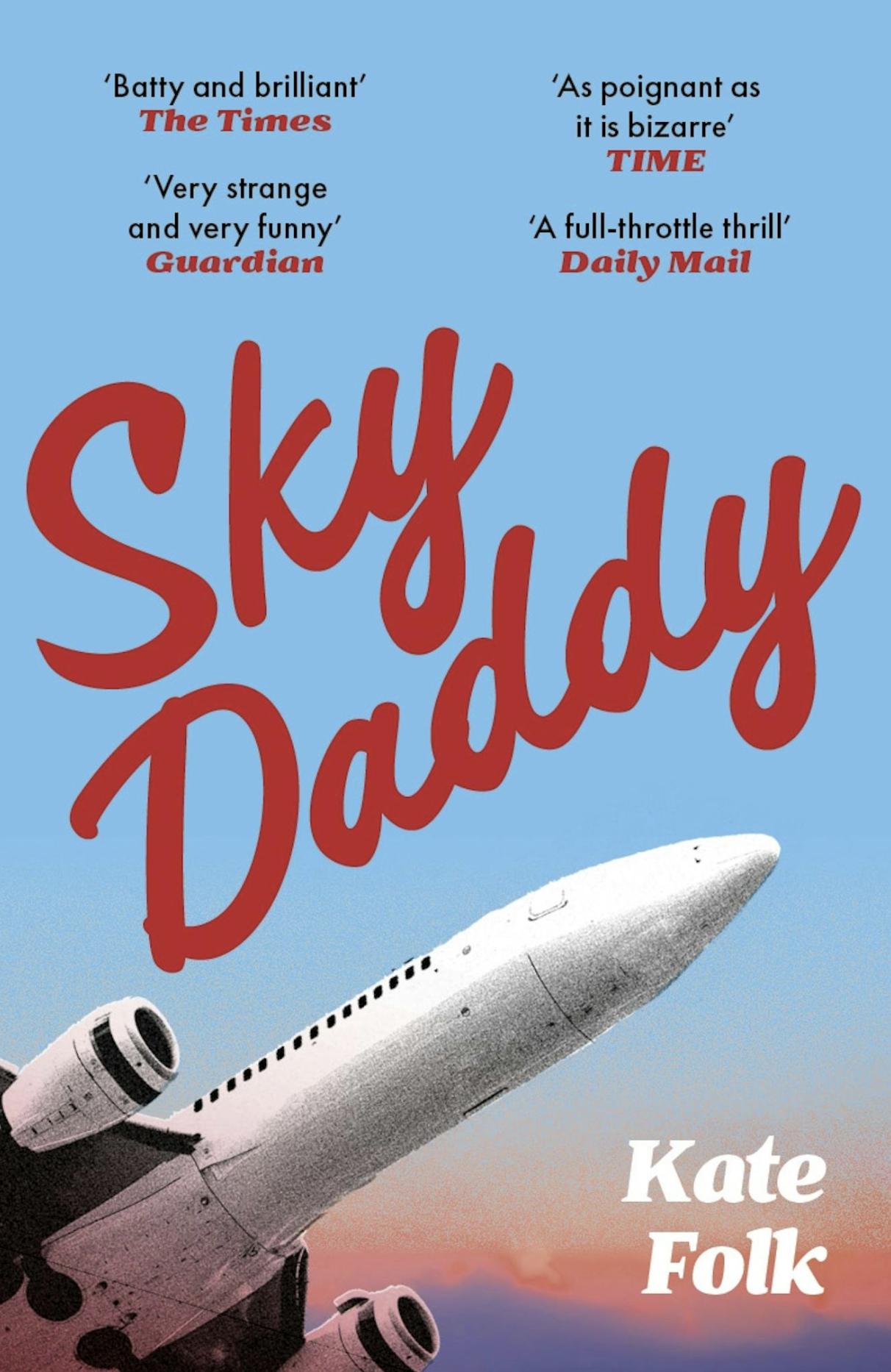
Kate Folk’s Sky Daddy.
The blurb is taken from GoodReads as the publisher blurb was much shorter.
Linda is doing her best to lead a life that would appear normal to the casual observer. Weekdays, she earns $20 an hour moderating comments for a video-sharing platform, then rides the bus home to the windowless garage she rents on the outskirts of San Francisco. But on the last Friday of each month, she indulges in her true passion: taking BART to SFO for a round-trip flight to a regional hub. The destination is irrelevant because each trip means a new date with a handsome stranger—a stranger whose intelligent windscreens, sleek fuselages, and powerful engines make Linda feel a way that no human ever could.
Linda knows that she can’t tell anyone she’s sexually obsessed with planes—nor can she reveal her belief her destiny is to “marry” one of her suitors by dying in a plane crash, thereby uniting her with her soulmate plane for eternity. But when an opportunity arises to hasten her dream of eternal partnership, and the carefully balanced elements of her life begin to spin out of control, she must choose between maintaining the trappings of normalcy and launching herself headlong toward the love she’s always dreamed of.
So there are no surprises when I say that Kate Folk’s Sky Daddy is a fucking wild ride (read?). It is everything that the blurb promised and yet it totally blindsided me. And I am further blindsided by the fact that this book is traditionally published by a Big 5 (Big 4?) company. I am not used to trad pubs going all out with wild stories and I wish there were a lot more easily available.
Our main protagonist Linda works as a comments moderator for a tech company in San Francisco. Linda makes decisions on whether the engagement of audience/users in the comments of an unnamed platform are acceptable behaviour or not:
Next, the queue fed me a string of flagged comments on a video of a teenage girl’s morning routine, calling her such names as slut, bitch, cum dumpster, ugly whore; but thanks to my expertise, I understood these comments were in good fun, playful ribbing among friends. One comment read, OMG I hate your perfect skin you cunt, which the video poster had “liked” and replied to with a kissing-face emoji. I was intimidated by the girl’s popularity. When I was her age, I’d been exempt from such camaraderie, but I couldn’t permit envy to impede my judgement. I applied the green button to the comments, allowing the girls to continue enjoying their youth.
What the fuck is this quote? It signals early in the story how lonely and odd Linda is. But it also makes you question your own judgment. Is there a platform venacular where this is standard “banter” among friends. Am I too old for the youth banter (my sons will shout YES!). The c-word is not a word I use anywhere1. The “cunt” (I am quoting the book) comment which the video poster liked is also not out of the ordinary, using the C-bomb (this is awkward me who doesn’t like using this word) is common-place, often understood as a compliment, at least in Australia. A high-end compliment especially when accompanied with the prefix sick-C*** (once again this is me not the book). But the use of this word leaves the reader askew. Were the rest of the comments acceptable? Is this harassment? Am I misunderstanding her work?
Linda is always the best employee as she just passes every comment as acceptable in her Hate and Harassment stream. She is an “efficient moderator” a glorified human bot who just lets everything pass. But Linda is not a careful or reliable moderator nor is she a reliable narrator. Unlike her work colleague and eventual friend, Karina who is deeply affected by her moderation of the Violence stream. Linda questions why Karina stays there with Karina replying that “it was what she deserved”, a secret that Karina divulges toward the end of the book. A secret that gets carried as a ghost in everyone’s life. The self-flagellation of our personal crimes and misdeeds and feeling that we deserve mistreatment due to our past misdoings.
Early in the book we discover that Linda is in love with, and convinced, that she will one day marry a plane. Linda carries a “chunk of 737” in her purse, which she never leaves home without it. It needs to be close to her. She doesn’t have relationships with men because that would prohibit her from marrying a plane. She things
But no man could do for me what a plane could. What man could propel himself to a speed of 150 knots before lifting us to an altitude of 37,000 feet? What man could carry me across continents and seas, all while keeping me warm and oxygenated inside his aluminium torso? No man I’d ever chanced to meet.
Linda wholeheartedly believes that the only way that she can marry a plane is if it plummets to the ground melding her into its steel in a fiery (little) death. An orgasm from the real to the unreal, transforming her from mere mortal to a plane!plain wife where she finally fulfils her traditional role. Her destiny more than free will. But Linda needs to be on a plane to be able to even have the chance to die on one. And this is where she needs to compromise her ideals and accept the humans, male paramours and female friends, to wheedle herself onto more flights than she can personally afford. And those flights are weird-ass fucked up.
As unreliable that Linda is, she is equal parts messed up and funny until she starts trying to go cold-turkey from flying and pretending that she is not obsessed with having sex with (not on) a plane even though she considers “to be the sole conscious human on board a ghost plane was my ideal scenario” But after a very corporatesque presentation to a group of women, she is told to “Go after your dreams, you crazy bitch”. And she stops trying to be normal, she eschews humanity, and Kate Folk delivers us an ambiguous story has me questioning the dictates of my destiny, my manifestations, my friendships and the objects some people may choose to be in a relationship with. Like a freaky phallic plane. Linda the BAMF!
I have recommended this book to many friends since I read it. It is weird, absurd but oddly plausible. At no point does it tip into speculative fiction. Keep in mind, this is not a romance novel. But yeah, you can certainly squint and pretend it is even though it certainly feels unrequited. Plane doesn’t love Linda back.
This novel has also had an unexpected impact upon my heart-on-my-sleeve oft declared fear of flying evidenced by my crazed scrawls of fear on my travel notepads, writing my fear out when I am on a plane being catapulted upwards to my destination. I traveled to Europe this year after 8 years of not holidaying overseas due to my fear. This time, I found a difference in my demeanor. Though I still had that heart clenching, adrenaline rush which I hate, in my head I kept thinking that at least I am not Linda. Because fear of plummeting to my death feels like such a healthier state of mind than Linda’s experiences trying to manifesting her death. After years of panic, this book gave me a weird sense of calm.
Thank you, Linda, you crazy bitch 2.
Metadata
My metadata: absurd, antropomorphic, bat shit crazy, dads, damaged characters, death, depression, digital, erotic, flight risk, friendship, fucked up, funny, grief, planes, still waters run deep, trauma, trust.
My local library’s metadata: Women — Fiction, Airplanes — Fiction, Infatuation — Fiction, Female friendship — Fiction.
Once again, I think the metadata fails this book but not in the usual sense. I think the descriptors are mostly accurate, but it is not a complete sense of the book’s key themes. The metadata fails to recognise mental health issues, humour, the digital media setting. So much that isn’t captured. I am unsurprised but also recognise that libraries continue to underfund their cataloguing and collections staff.

