
Here is my September TBR challenge review. A few reviews ago, I wrote about Cat Sebastian’s roadtrip romance Peter Cabot Gets Lost, and here is another roadtrip romance by Cat Sebastian this one being her first contemporary novel. As usual, there are lots and lots of spoilers so don’t bother reading if your like surprises.
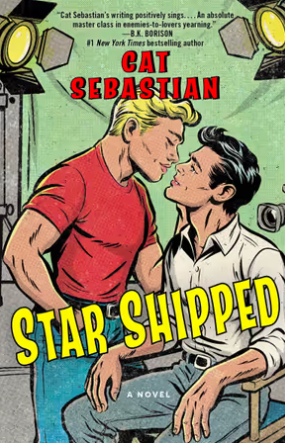
Cat Sebastian’s Star Shipped
The Blurb: Simon and Charlie, actors on a long-running sci-fi show, can’t stand one another. Charlie is impetuous, outgoing, and basically feral, and Simon thinks he should have stayed in reality television where he belongs. They’ve spent the better part of a decade quarreling over the spotlight and pretty much everything else, and everybody in the industry knows it. Now that Simon’s contract is finally done, he can move to New York, start fresh with work he actually likes, and get away from Charlie.
Simon’s only problem is that people might assume he’s been pushed off the show due to being impossible to work with. And he is kind of difficult to work with. He doesn’t get along with people—unlike Charlie, who somehow tricked everyone on the show into adoring him despite some outrageously bad on-set behavior during the show’s first season. Simon would rather never have to see Charlie again, but reluctantly agrees to stage a very public friendship during the short time before he moves. When Charlie has to leave town to deal with a family emergency, this means Simon comes along. Their road trip brings Simon to places he would never have willingly chosen to visit—and he finds he’s actually not having a terrible time.
The more he gets to know Charlie, the more Simon suspects he’s underestimated his former coworker. Simon also realizes that after seven years, Charlie might know him better than anyone ever has. Even stranger, Charlie seems to be starting to actually like him, despite knowing him so well. Still, Simon is about to move three thousand miles away, so whatever’s starting between him and Charlie can’t really amount to anything… right?
In Star Shipped, long-term costars who can barely stand each other, Simon Devereaux and Charlie Blake have been acting together in a Star Trek-y TV series for 7 years. Simon is a complete snob who feels that Charlie lowers the tone of their show as Charlie is a former reality TV star – a bit of shirtless, pretty boy muscles – eye candy for the viewers. Charlie is younger, extroverted, a people pleaser and fun. Charlie is a puppy dog who “accumulates friendships like some kind of snowball of extroversion, always gathering and never letting go”. Meanwhile, Simon is introverted, anxious, suffers from debilitating migraines, has one friend Jaime and his dog, and Simon behaves like a dickhead and isn’t anywhere near as insightful as he thinks he is. Grumpy Simon’s the opposite to Charlie which being co-leading men in the sci-fi series makes life tense for them and their friends even though it makes great TV propelling lots of fandom shippers. Despite his disdain, there are occasional moments with Simon acknowledging that “Charlie learns his lines faster than anyone Simon’s worked with and he’s quick on his feet” and other such asides.
After 7 years on the show, Simon has decided to leave the show to go back to his more serious acting goals. However, he doesn’t want to be labelled as a difficult actor (even though he is) so he agrees to a PR stint with Charlie to show that he can be friendly. This turns into a forced proximity roadtrip (Cat Sebastian does love them!), where Simon starts to realise that Charlie is kinder and much more complex than Simon had thought. Charlie grew up in foster homes whose experiences were far from wholesome, so his smarts are equal parts hyper-vigilance (scared of getting in trouble) and people pleaser.
Though Simon continues to hold Charlie in disdain, there is a penny-drop moment when “a piece of information that doesn’t fit anywhere in Simon’s brain, and so it rattles around’. Simon has a propensity to think the worst of Charlie thinking that he is “tacky” and in “poor taste” rather than recognising a colleague in crisis, and it takes a while into the book for Simon to get a clearer understanding of Charlie. Simon feels he is the worst friend and colleague yet there are so many people who still like him despite his total internalisation and dickyness which we later find out is due to his illness. Perhaps his friends and colleagues suspected this.
There is this moment of introspection (LOL 90% of Simon in this book is introspection) that deeply resonated with my catastrophising tendencies but it also informs you of how messed up Simon is (and maybe I am):
“People always say that there’s no point to worrying, but it isn’t true: one real advantage to comprehensive, thorough worrying is that you rarely get blindsided by a disaster you haven’t already considered. That doesn’t make it easier, but it takes the sharp new edge off and makes the problem into something worn in and familiar”.
The story keeps unfolding through a deep character study of both Simon and Charlie, allowing an unfolding of each man’s crisis response but also how they ultimately find each other attractive but also fall in love through their small (well maybe flying Simon’s dog across the country for him and kissing him as though he is “precious or whatever” is grand) actions for each other. Ultimately, they discover they both have feelings of not belonging. Simon deals with it by internalising his feelings, while Charlie externalises and running around trying to make everyone like him. Eventually even getting Simon to like him, to love him.
Appearances in this book aren’t everything despite what they look like. Especially in the Hollywood celebrity world, as lush as life may look, there are undercurrents and hidden anxieties that individual people experience, especially when they are the stars of their show. Cat Sebastian’s meta-commentary on fandom and fans and their shipping ways adds depth to this already complex story, with its slow-burn, slow unravelling character study. This includes the discussion of how chronic illness feeds into your mental illness and speaking to your needs when you are ill, in some way illness being a character in its own right. The book also examines the depth of friendship, not only the one that emerges between Charlie and Simon but also from the various cast colleagues they share, as well as the need and ability to not always hate on an ex, with Simon’s ex Jaime being a constant support in this story, where their friendship negotiation with Jamie is so delicate and beautifully written.
This book is top stuff really. The love, the emotion, the friendship and understanding. I loved it.
Metadata
My metadata: accidental roommate, angsty, anxiety, bullying, celebrity, childhood crush, chronic, contemporary, damaged characters, date night, depression, enabling, family dynamics, fanfiction, fear, friendship, funny, growing up, indulgent, kindness, kiss, kitchens, knew each other years ago, lgbtq characters, loneliness, m-m, make believe, messed up yet good, misery guts, NYC, opposites, popular culture, queer, regret, road trip, romance, science fiction, secret crush, social media, still waters run deep, vanity.
I realise that even my folksonomic metadata tags are filled with spoilers. Ooops to the Goodreads crowd.
Library Metadata: My local library’s record for this book (left) is pretty shitty; the record to the right is from the neighbouring library service. My library uses Fiction/Romance as a subject heading. That’s it. For a book that does not use the words “gay, LGBTQ” “queer” “male-male” anywhere in its blurb or title. An appalling subject heading belying the depth of this novel. The book from the library on the right hand side has a number of descriptors: Sexual minorities–Fiction, Electronic books, Adaptations (this one confuses me – what is it an adaptation of?), Gay fiction, Humorous fiction, Romance Fiction, Fiction.
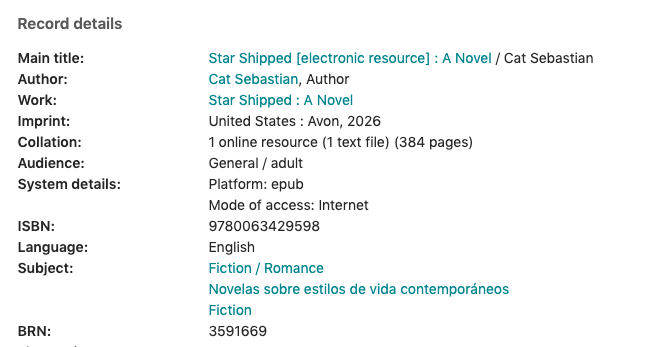
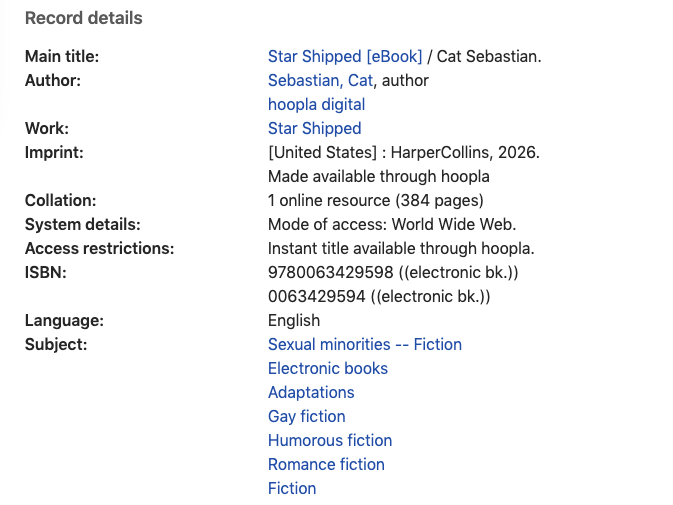
Well, I guess they got the “Fiction” bit right. But “sexual minorities” made me want to vomit. Just a little bit. It is unnecessary. But I would concede this if someone insisted. Overall, the library on the right hand side did make the book searchable for its key topics but I don’t feel it is complete. It does not have a geographic desciptor (let’s hear it in the backrows – USA is not a fiction default), and it doesn’t include “celebrities” or “actors” + Fiction. Occupation of characters is often a key descriptor in records these days.
I am particularly appalled at my local library. I am in one of the highest LGBTQ council areas in all of Australia, and to accept such poor descriptors from their digital library vendors is a reflection of their priorities towards both readers and their queer communities. They really should do better. Especially as it is evident that the records do exist. Oh, and maybe put some money into print copies too. It has not passed me by that the majority of libraries these days are not putting print budgets into their romance collections, leaving these gems only in the digital catalogues.
Ugh!

