
I have been lost to my blogging world since March when I had the good fortune to watch and then read Heated Rivalry. My first post for this topic was a review on Heated Rivalry which then turned into a partial academic paper where I am now sitting on 800 words and a 20 slide presentation with nowhere to present it1. So instead, I am going to write about the road trip romance trope for Wendy SuperLibrarian’s TBR Challenge for March in October. Don’t mind me and my lateness. Also a reminder that I always have spoilers. Look away if you don’t want to know what happens at the end.
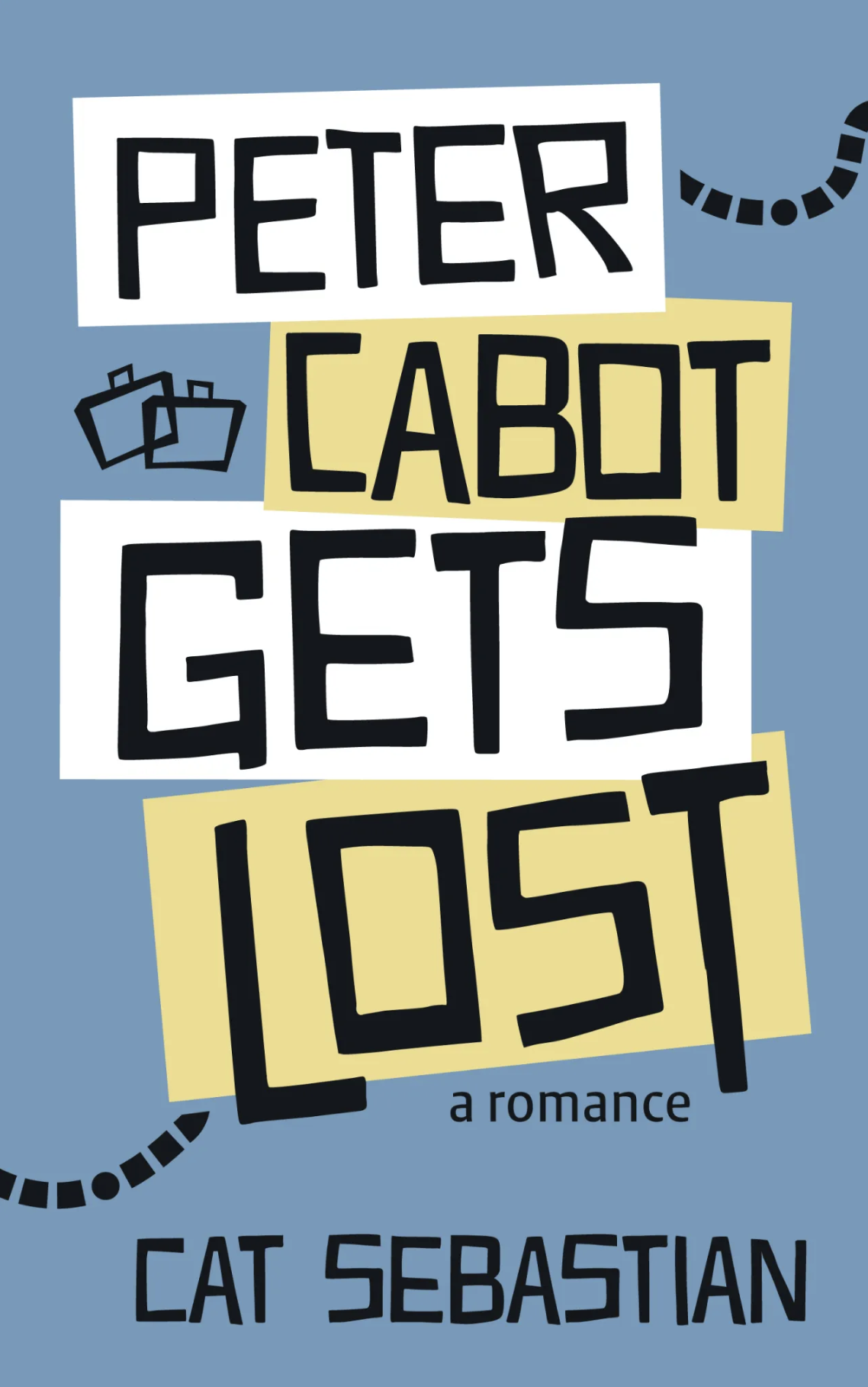
Cat Sebastian’s Peter Cabot Gets Lost.
The Blurb and Content notes taken straight from the author’s website:
Summer 1960:
After years of scraping by, Caleb Murphy has graduated from college and is finally getting to start a new life. Except he suddenly has no way to get from Boston to Los Angeles. Then, to add to his misery, there’s perfect, privileged Peter Cabot offering to drive him. Caleb can’t refuse, even though the idea of spending a week in the car with a man whose luggage probably costs more than everything Caleb owns makes him want to scream.
Peter Cabot would do pretty much anything to skip out on his father’s presidential campaign, including driving across the country with a classmate who can’t stand him. After all, he’s had plenty of practice with people not liking him much—his own family, for example. The farther Peter gets from his family’s expectations, the more he starts to think about what he really wants, and the more certain he becomes that what he wants is more time with prickly, grumpy Caleb Murphy. As they put more miles between themselves and their pasts, they both start to imagine a future where they can have things they never thought possible. Content notes available2.
The road trip is a romance in its own right, with the changeable settings, navigating the landscape. Then add to the road trip love and the coming together of two people who find themselves in forced proximity with all the joys and tensions that come from being in a car. The romance road trip is the modern day Odyssey, a heroes’ journey both to a destination and to finding their sense of self and sense of connection while fighting off the Cyclops and the Laistrygenians. Unlike the wine-dark sea—antiquity’s water superhighway—in the modern day version, the romance is grounded, it is earth based, trees, deserts, lakes, mountains, terra firma, soil beneath their feet, tar for the tyre treads. The modern roadtrip, just like in the Odyssey, culminating with the love proposition, the conviction and reliability of the marriage bed, a journey worthy of courtship3. Cat Sebastian affirms the role of the roadtrip as a narrative choice in this book, writing that “travelling across the country to be with a lover is a venerable tradition”, and for Peter and Caleb, this is story is centred on their own queer journey together.
In Peter Cabot gets lost, Peter starts his journey reluctantly heading to his parents vineyard in Massachusettes to kick off his father’s bid for the USA’s presidency. As he is driving the first few blocks, he happens upon Caleb, a fellow student he doesn’t know all that well, who needs to get to Los Angeles to start a new job. Peter Cabot accidently, and quite deliberately picks Caleb up, takes a wrong turn and he just keeps going. Unlike Jess and Adam in Kate Clayborn’s The Other Side of Disappearing (Reading Note 78) whose roadtrip is spent as a mystery, seeking a family member who doesn’t want to be found, Peter’s road trip is an adult finally finding the courage to run away from family.
For Peter Cabot, driving Caleb Murphy to Los Angeles, is an opportunity to escape his family’s legacy, to take some time to try and get a better sense of who he is. The story does move between both main characters and you get a sturdy sense of each one. Peter is rich and entitled, often not understanding the underlying dangers of easily revealing who he is to others. Caleb though comes from a poorer family and is much more attuned the risk they are taking in this cross-country drive, especially in certain states along Route 66, with both of them making efforts to ensure that people couldn’t recognise them for their queerness. This is the realistic and sad cloud that hovers over this story.
Peter and Caleb don’t only have to navigate these external forces but also their own intimate relationship as it emerges throughout their drive, Peter saying that “his sense of self-preservation was scattered along Highway 66, left in piences at service stations and motels, at restaurants that served pancakes all day long”. Towards the end of the book, when Peter and Caleb arrive in Los Angeles having found their connection, Peter thinks to himself that
maybe eight days with Caleb Murphy had left him thinking the best of himself. Maybe spending time with someone who really liked you, let you see yourself reflected in their eyes, even just a little
This both tore at my heart, as Peter Cabot had obviously never seen himself reflected in anyone’s eyes before in his life. But it also gave me a lot of calm. Finally, he found love. I really liked this story. I love a romance roadtrip, and how the time and spaces travelled reveal people for who they are. But this is also a historical story whose 1960 setting does not pass me by. This story is set in an era when Eisenhower is in power, and he has put in orders against federal employees being “subversive” including having “sexual perversion” with the Wikipedia page (so judge me hard but I very well will cite this crowdsourced anti-AI page). The references state that Eisenhower “explicitly references…homosexuality”. Though Peter and Caleb love each other and there is a sense of their commitment, their happily ever after is one that can only exist in the margins and quiet spaces. As they needed to navigate some difficult regions, ahead of them is a long and difficult navigation into their future together.
Metadata
My Metadata: 1960s, adventure, family dynamics, growing up, historical fiction, hotels, kindness, kiss, lgbtq, love, m-m, queer, road trip, romance, sadness, same-sex, sex, still waters run deep, USA.
I gasped when I realised that this book is considered “historical fiction”. The decade I was born in is “historical” :: weep ::
My local library doesn’t hold this book and, to date, there is only one copy of this book available in an Australian library. This is appalling as Cat Sebastian is a ‘standing orders’ type of author in the queer fiction genre. I borrowed the ebook from a library in the USA where I hold a non-resident e-membership.
The ebook metadata record at this US library does not provide any subject headings. It is empty. A subject void echoing through Libby. The Genre/Form entry lists Electronic books.
The print record include the following metadata:
Subjects – Topical Term: Gay men–United States–Fiction, Automobile travel–United States–Fiction, Nineteen sixties–Fiction
The Genre/Form entry lists Gay fiction, Historical fiction, Romance fiction.
The ebook record is deeply lacking. Electronic Books hardly conveys any sense of the fiction. The metadata record should reflect the print record with the only difference being is the additional form information. The fact that the format of the book changes the level of detail in subject descriptors is infuriating. Ebooks deserve complex descriptors as much as print books. Especially considering the sensitivity some readers may require in communities where queer people may be persecuted, where a print book could cause issues so an ebook is a much more discreet reading choice. I don’t think that this is a spurious and deliberate choice to deliver poor metadata. I truly believe it is sloppy cataloguing choices and libraries need to be precise, accurate and complete in their subject descriptors. And don’t get me started on Automobile travel as the preferred term for a roadtrip. The constraints upon taxonomies are glaring. Who the fuck is going to search for Automobile travel? Let us be honest. This is a term for the record and not for the readers.
1Please don’t suggest all the amazing international conferences – I am not tenured and I cannot afford to spend $4000 to travel overseas for a 15 minute presentation.
2References to period-typical homophobia, fear of being outed, oblique references to past violence, on-page sex.
3I have raging anger4 at Christopher Nolan’s lack of the bedroom scene at the end of his mediocre movie Odyssey
4LOL – the raging Greek response to US-ified, Matt Damon-fied Odyssey is a trope in itself.


::hug:: what a magnificent review!