The Hunt: Reading Note 104

October’s TBR Challenge topic of “The Hunt” was certainly a challenge for me as I have not read any adult fiction or non-fiction that could be described as such. Nor have I watched a movie or TV show with any hunting. I am a wimp and just can’t bear such adrenaline rushes. However, I did read a (long) picture book that connects to the theme.

Sid Sharp’s The Wolf Suit
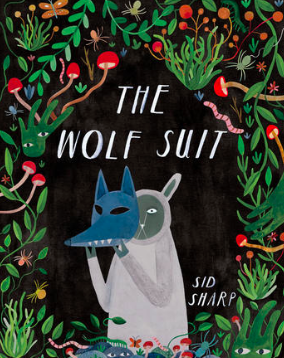
The cover of The Wolf Suit by Sid Sharp.Greenery with red mushrooms border the perimeter, in the middle is a dark house shape with a lamb putting on a wolf mask framed in the middle.

The Blurb: Bellwether Riggwelter is, once again, out of blackberries. This time, rather than tiptoe through a forest full of predators, he comes up with a new plan. He will keep himself safe by blending in—he will sew a Wolf Suit! The disguise works perfectly . . . sort of. Bellwether realizes he can’t enjoy the forest in a bulky suit, and he may not be the only creature in the forest who feels that way. Perhaps not everyone is as wolfish as they appear.

With humor, darkness, and insight reminiscent of Jon Klassen and Edward Gorey, Sharp turns the idiom “wolf in sheep’s clothing” on its head. The perfect contemporary folktale to press into the hands of anyone who has felt they need to pretend to be someone else.

Bellwether Riggwelter is a sheep. He’s a sheep who is rather scared of wolves so he doesn’t venture out of his home much. He has too much fear. Of wolves. However, Bellwether is hungry and needs to find some food (or blackberries). He sews a wolf suit for himself (as sheep are known to have fine motor sewing skills) and ventures out into the woods in pursuit of fruit. He comes across a number of other wolves but is not perturbed as he feels he is acting the part well. Until he sees that his sewing was dodgy and his wolf suit started to fall apart. Decisions had to be made, and in typical happily ever after fairy tale style, no sheep pretending they are wolves died in this picture book.

The picture book was longer than a standard one. It had 4 chapters and seemed to be situated between that picture book and early reader level for kids. Late pre-school or Kindergarten. Though honestly, you can be any age to read this book. It was a lot of fun with great illustrations filled with discoveries embedded throughout for I-Spy inquisitive readers.

Metadata:

My metadata: absurd, anthropomorphic, anxiety, children’s books, environment, fairytale, fear, picture books.

Library metadata: The library closest to my home (where I was once employed) that holds a copy of this book had zero subject descriptors in their metadata. Just the standard Author/Title/Publisher/Year and blurb. Not helpful at all. And annoying.

However, I did find a library in Victoria with a splendid record with the following subject metadata: Genre: Funny animal comics; Subject Term: Self-esteem — Comic books, strips, etc., Self-reliance — Comic books, strips, etc., Wolves — Comic books, strips, etc., Sheep — Comic books, strips, etc., Disguise — Comic books, strips, etc.; Reading Level: Ages 6-11.

I do find it interesting that the book is described as “Comic books, strips, etc.”. It certainly did not have the look and feel of a comic book or a graphic novel. It looked like and read like a picture book. It was just longer. I didn’t think that the expanded length would prohibit a book from being categorised as such.

Go figure! Meanwhile, go read it!

Children’s Reading journal article

I have had a peer-review journal article published. I am honoured to be in the April 2016 edition of TEXT: Journal of Writing and Writing Courses in their issue on Conflicting and Connecting Narratives. My paper is called Marginalising children’s reading experiences: From series books to paratextual reading. The Journal is Open Access so click on the link above for the full article.

Should you have some time to read it, whether you agree or disagree, I welcome your feedback.

Thank you.


The Rule of Five

1. Choose a book based on its author/title/cover design

2. Read the blurb

3. Read the last pages #afairydies (optional)

4. Read the first five pages

5. If you don’t feel compelled to read page six – move on to another book. If you have looked up and it’s page 36 – this one’s a reader!

Everyone has different approaches for how they will read a book.  Some people insist on reading everything they choose from cover to cover regardless of whether they like the book or not. Others will use Nancy Pearl’s Rule of 50 of which I am a major fan – how can I not be a fan. I was fortunate enough to meet Nancy Pearl a few years ago and while we were chatting discovered that we both wanted to be Miranda Melendy in The Saturdays by Elizabeth Enright when we were kids (I digress). But I have lately found that I can’t even apply this rule. I have found that I am now applying my very own Rule of Five in which you judge a book by its cover, get hooked by its blurb, discover the outcome and let those first five pages lead you to a more permanent reading decision.

Of course, there is always an exception to the rule: if you have been told that a particular book is set reading for school/university/work – suck it up and read the bloody thing.

Now for all the bookgroups out there chanting “Exempt me! Exempt me!” – bookgroups are not exceptions to the rule. Life is too short even for bookgroup members. If page six is unbearable download the cribnotes, even if the book had been your choice. If your bookgroup members disparage your choice to not continue reading I would suggest that you find another bookgroup.

So what has led me to this Rule of Five? Late in February, I decided to read Nalini Singh’s Archangel’s Kiss. Many people I know have praised her books to me. They love her and adore her writing but, as I am not a big fan of paranormal romance (I have previously read MaryJanice Davidson, JR Ward and Sherrilyn Kenyon), I have not pursued reading much in this sub-genre. In March, however, I was attending the NSW Readers Advisory Seminar on Fantasy and though I had read several fantasy titles in preparation I thought it would be best that I attempt a title that crossed over with my favourite genre – romance. I was quite enthusiastic in reading this book as I looked forward to discussing it with friends. It starts in a train station, there was some sort of gadget involved in the capture of an errant (was it) angel, there was narrative comparing her capturing tactics with her friend’s tactics etc etc. And then I vagued out and I can’t remember anything beyond that. I was on page five when I gave up and moved on to read a fab kids fantasy book called Urgum the Axeman by Kjartan Poskitt.

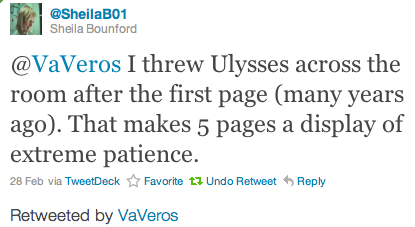
Once I gave up reading this book I tweeted the following:

Only one person objected. The other five who answered all agreed and felt that it was fine to give up and move on…and in one case, seemed to suggest that five pages were admirable.

A week later, I was struck again by the importance of a book engaging the reader in those first pages while I was listening to Brent Weeks at the NSW RA Seminar answering an audience question on how to make books appealing to reluctant readers. He spoke about how he consciously has action in the very first page of his books as he knows that this is a hook for many readers, himself included.

This led me to think of my favourite books and there isn’t a single one that I would say I struggled past the first pages. I remember reading Melina Marchetta’s Looking For Alibrandi in a single inhalation and I did the same with Jennifer Crusie’s Charlie All Night, Audrey Niffenegger’s The Time Traveller’s Wife, Matthew Rubinstein’s Solstice, Rachel Gibson’s See Jane Score, and the list goes on and on. I was not distracted after opening these books. I did not feel the need to put my book down and call a friend just to have a break and, in some reading cases, I wholly forgot to feed my children.

Another point I’d like to make is the attention given by the literary world to the first line of highly regarded books. There are books published on first lines, there are websites dedicated to them and there are infinite trivia quizzes on that all important first line. That first line is the hook and those first five pages are the bait that should draw you into the rest of the book.

I then think about the books that I have picked up, I have liked their covers, I have liked their premise based on a good blurb yet for some elusive reason, be it the writing style, unlikeable characters, too much violence or some vague intangible element, I have decided to move on to a greener reading pasture.

Giving up on a book in its opening pages does not mean that the book is not good. It may have some wonderful qualities and you may decide to revisit the book, or some other book by that author, at some later stage, as I plan to do eventually with Nalini Singh’s books. It just wasn’t the right book for you at this point of your life.

So I beseech you all to not slog through a whole book; don’t labour the first 50 pages. Let your senses take over and make a snap judgement on whether to read on in those introductory five pages.